
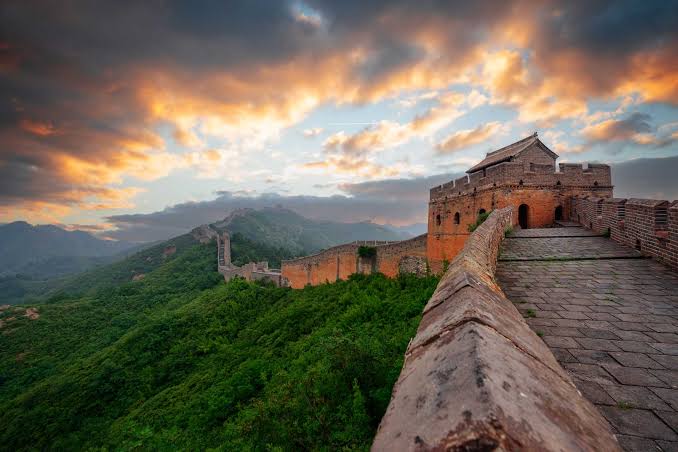
The Great Wall of China is more than the world’s longest man-made structure, it is a remarkable symbol of human determination, military strategy, and engineering brilliance.
Stretching across mountains, deserts, grasslands, and valleys, the wall has protected China for centuries while becoming one of the world’s most celebrated landmarks.
Recognized as a UNESCO World Heritage Site and one of the New Seven Wonders of the World, the Great Wall continues to attract millions of visitors every year. Its towering watchtowers, winding pathways, and breathtaking scenery tell the story of an empire determined to defend its people and preserve its civilization.
A Wall Built Over Two Millennia
The history of the Great Wall began more than 2,000 years ago. During the Spring and Autumn and Warring States periods, several Chinese kingdoms built defensive walls to protect their territories from rival states and nomadic tribes.
In 221 BC, Emperor Qin Shi Huang unified China and ordered workers to connect many of these existing walls. His goal was to strengthen the empire’s northern frontier against attacks from the Xiongnu people.
Successive dynasties expanded, repaired, and reinforced the wall over the centuries. However, the most famous sections that visitors see today were built during the Ming Dynasty between 1368 and 1644. Builders used bricks and cut stone to create stronger fortifications that could better withstand invasions.
More Than Just a Wall
Despite its name, the Great Wall is not a single continuous wall. Instead, it is a vast defensive network that includes watchtowers, fortresses, barracks, beacon towers, garrison stations, and strategic mountain passes.
Soldiers used the watchtowers to monitor enemy movements across the northern frontier. They also sent smoke signals during the day and fire signals at night to warn nearby garrisons and request reinforcements.
The wall also served as an important transportation route for troops and supplies. Officials used it to regulate trade, collect taxes on goods moving along the Silk Road, and strengthen border security.
An Engineering Marvel
The Great Wall stretches approximately 21,196 kilometres, making it the largest man-made project ever completed. It begins near the Bohai Sea in eastern China and extends westward to the edge of the Gobi Desert, crossing rugged mountains, rolling hills, and vast plains.
Builders relied on locally available materials during construction. They used rammed earth in the plains, stone in mountainous regions, and bricks where resources allowed. During the Ming Dynasty, workers strengthened many sections with bricks, stone blocks, lime mortar, and an innovative sticky rice mortar that improved durability.
Thousands of skilled craftsmen, soldiers, labourers, and local workers contributed to the project over many generations. Their efforts created one of history’s greatest engineering achievements.
The Famous Passes
The Great Wall features 15 strategically important passes that controlled movement along China’s northern frontier.
Among the best known is Shanhai Pass, often called the “First Pass Under Heaven.” Located near the Bohai Sea, it marks the eastern entrance to the Great Wall.
At the opposite end stands Jiayu Pass, a magnificent fortress on the edge of the Gobi Desert. As the western gateway of the Ming Great Wall, it protected China’s frontier and welcomed traders travelling along the ancient Silk Road.
Legends Along the Wall
The Great Wall is not only an architectural masterpiece but also a source of Chinese folklore.
One of the best-known legends tells the story of Lady Meng Jiang. According to tradition, her husband died while helping to build the wall. When she learned of his death, she wept with such grief that a section of the wall collapsed, revealing his remains. The story has become one of China’s most enduring legends about love, sacrifice, and loss.
Separating Myth from Reality
For many years, people believed astronauts could see the Great Wall from the Moon with the naked eye. Scientists have repeatedly disproved this claim.
Although the wall stretches for thousands of kilometres, it remains too narrow to see from the Moon without magnification. The myth continues to circulate, but modern space observations have confirmed that it is not visible to the unaided human eye from that distance.
A Lasting Symbol of China
Today, the Great Wall stands as China’s greatest cultural icon. It represents resilience, innovation, and the determination of generations who worked tirelessly to protect their homeland.
Millions of tourists walk its ancient pathways each year, admiring the sweeping landscapes and impressive architecture. Every stone, watchtower, and fortress tells a story of ambition, sacrifice, and survival.
More than two thousand years after construction began, the Great Wall of China remains one of humanity’s most extraordinary achievements. It is not simply a monument of bricks and stone but a living reminder of China’s rich history and the enduring spirit of its people.