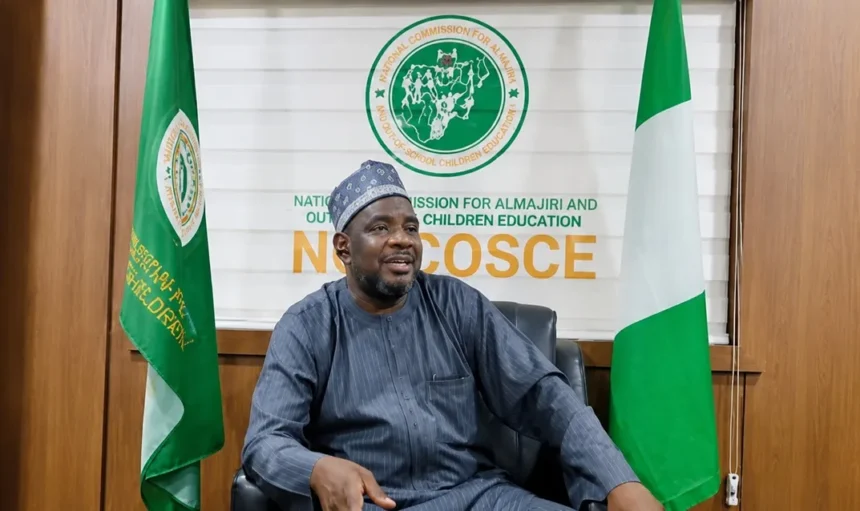
The National Commission for Almajiri and Out-of-School Children’s Education (NCAOOSCE) has clarified that the road construction and other infrastructure projects contained in its 2026 budget were inserted by the National Assembly as constituency projects and do not form part of its statutory responsibilities.
The commission made the clarification on Tuesday through a statement issued in Abuja by its Special Adviser on Media and Communications, Nura Muhammad.
The response followed public scrutiny over the commission’s 2026 Appropriation Act, which earmarked about ₦8.4 billion for road construction despite its core mandate of addressing the challenge of Almajiri and out-of-school children through education, skills acquisition and literacy programmes.
According to details of the 2026 Appropriation Act, the commission received a total allocation of ₦22.82 billion, made up of ₦21.68 billion for capital expenditure and ₦1.14 billion for recurrent expenditure.
Apart from road construction, the budget also contains provisions for projects such as the procurement of ambulances, medical equipment and the installation of solar power facilities, all of which generated questions over whether they align with the commission’s legal mandate.
However, the commission insisted that the projects were assigned to it by the National Assembly under the long-standing practice of implementing constituency projects through Ministries, Departments and Agencies (MDAs).
“The Commission wishes to clarify that these projects are National Assembly constituency projects incorporated into the 2026 Appropriation Act for implementation through the Commission. This is in line with the long-standing budgetary practice under which constituency projects are assigned to Ministries, Departments and Agencies for execution through the Appropriation Act,” the statement said.
The commission explained that because the projects were included in the duly enacted federal budget, it is legally responsible for implementing them in accordance with existing financial regulations, procurement laws and other government procedures.
It stressed that the inclusion of such projects does not alter its statutory mandate, which remains focused on reforming the Almajiri education system and reducing the number of out-of-school children across Nigeria.
According to the commission, it remains committed to expanding access to quality education, strengthening Almajiri education, supporting state governments and collaborating with relevant stakeholders to improve learning opportunities for vulnerable children.
Providing an update on its activities, the commission disclosed that it has identified and profiled more than 700,000 out-of-school children nationwide. It also revealed that it has established 119 learning centres across the country as part of efforts to improve access to education.
The agency further stated that it has continued ward-to-ward advocacy and community mobilisation campaigns while implementing the National Policy on Almajiri Education aimed at reforming the traditional system and addressing the social challenges associated with it.
Reaffirming its commitment, the commission said tackling the plight of Almajiri and out-of-school children remains its highest priority despite the additional constituency projects assigned to it.
It also appreciated the support of the Minister of Education, Tunji Alausa, the Minister of State for Education, Suwaiba Ahmad, and other stakeholders for their continued efforts toward improving access to education in Nigeria.
The clarification comes amid growing public interest in the implementation of constituency projects and renewed calls for greater transparency in the allocation of projects to government agencies, particularly where such projects appear to fall outside their primary statutory mandates.