
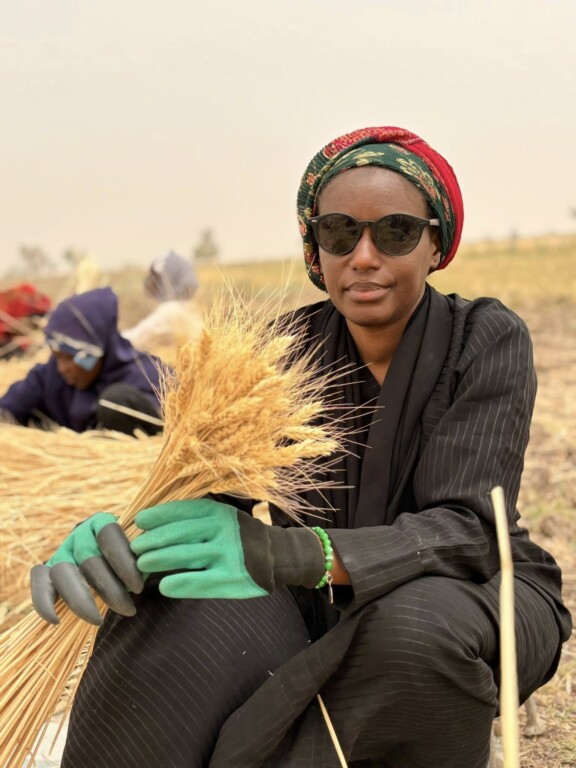
Agricultural advocate Fatimah Yusuf is demonstrating how climate resilience can begin with empowering women farmers in Jigawa State, Northwest Nigeria, through practical and community-driven agricultural initiatives.
As global experts continue to call for urgent action against climate change, communities across Nigeria are increasingly developing local solutions to address environmental challenges. Among those leading such efforts is Fatimah Yusuf, whose work focuses on equipping rural women with the skills needed to improve food production while promoting sustainable farming practices.
Through training programmes under Kaigama Green Agriculture Services, Fatimah has been helping women acquire knowledge in vegetable farming, enabling them to increase household food security, generate income, and adopt environmentally friendly agricultural methods.
For many rural women, access to agricultural training remains limited despite their critical role in food production. Climate change has further worsened farming conditions through irregular rainfall, rising temperatures, and declining soil fertility, making it increasingly difficult for small-scale farmers to sustain their livelihoods.
Recognising these challenges, Fatimah has focused on building local capacity rather than relying solely on external interventions. Her approach centres on training women to grow vegetables using climate-smart farming techniques, improving access to agricultural knowledge, and encouraging sustainable production methods that can withstand changing environmental conditions.
The initiative highlights how agriculture can serve as both an adaptation and mitigation strategy in addressing the climate crisis. Vegetable farming contributes to food security, reduces dependence on distant food supplies, creates economic opportunities for women, and promotes more efficient use of land and water resources.
By providing women with practical agricultural skills, the programme is helping communities become more resilient to climate-related shocks while strengthening local food systems.
Fatimah’s work also reflects the vision championed by economist and Nobel Peace Prize laureate , who advocates transforming environmental challenges into opportunities through community-led solutions and green jobs.
In many ways, her efforts embody this principle. Rather than viewing climate change solely as a threat, she is helping women see agriculture as a pathway to economic empowerment, environmental stewardship, and long-term community development.
The impact extends beyond individual beneficiaries. Every woman trained has the potential to transfer knowledge to her family, neighbours, and wider community, creating a ripple effect that strengthens resilience and promotes sustainable agricultural practices.
Her story underscores an important lesson in climate action: meaningful change does not always begin in international conferences or policy discussions. Sometimes it starts in a nursery bed, a village farm, or a training session where women learn how to cultivate crops that nourish both people and the environment.
As communities across Africa continue searching for practical climate solutions, the experience of Fatimah Yusuf offers a compelling example of what local action can achieve—empowering women, strengthening food systems, and building resilience one farm at a time.