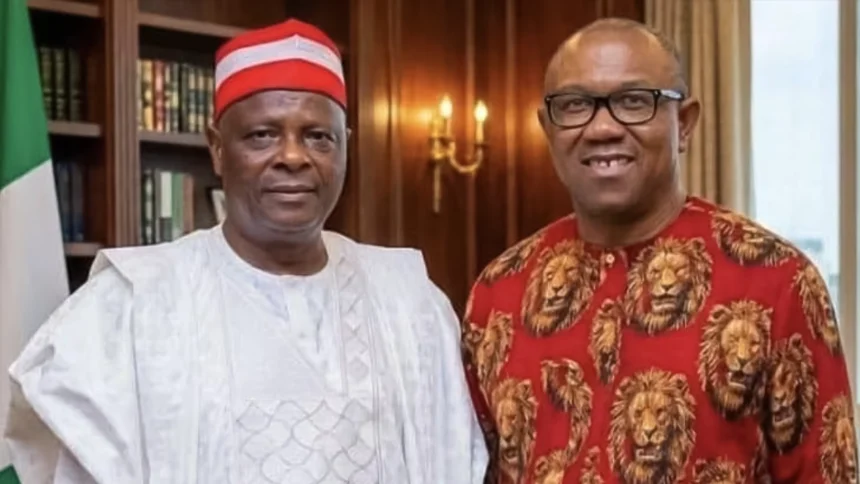
Nigeria’s opposition politics is once again entering a period of uncertainty as key figures reposition themselves across emerging platforms ahead of the 2027 elections. Recent movements involving Peter Obi and Rabiu Kwankwaso have revived long-standing questions about party cohesion, leadership ambition, and the strength of internal democracy within opposition formations.
The discussion has been further sharpened by remarks from the All Progressives Congress, which accused Obi of avoiding party primaries out of fear of competition, an allegation that has fueled wider debate about whether Nigeria’s opposition parties are built for genuine contest or structured around negotiated political arrangements. Against this backdrop, attention is also shifting toward emerging platforms such as the African Democratic Congress and other coalition efforts seeking to position themselves as alternatives ahead of the next electoral cycle.
The concerns are often anchored in the experience of the 2023 presidential election. Bola Ahmed Tinubu of the APC won with 8,794,726 votes, while the opposition vote was divided among Atiku Abubakar (6,984,520), Peter Obi (6,101,533), and Rabiu Kwankwaso (1,496,687). Collectively, the opposition outperformed the winning candidate in raw numbers, but the absence of a unified platform meant those votes were spread across competing tickets, effectively shaping the final outcome.
That electoral reality continues to influence how current realignments are interpreted. As new coalitions are discussed and old alliances are reconsidered, analysts point to a familiar dilemma: whether opposition politics is evolving toward coordination or simply cycling through familiar patterns of fragmentation under new labels. The central concern is no longer just about personalities, but about whether any structure is capable of managing credible internal contests while still maintaining unity at the national level.
Ultimately, the stakes extend beyond party politics. If opposition actors continue to struggle with cohesion and consensus-building, the challenge is not only electoral competitiveness but the quality of democratic choice itself. The question heading into 2027 is therefore not just who emerges, but whether Nigeria’s opposition can finally convert numbers into unity or risk repeating the divisions that defined 2023.