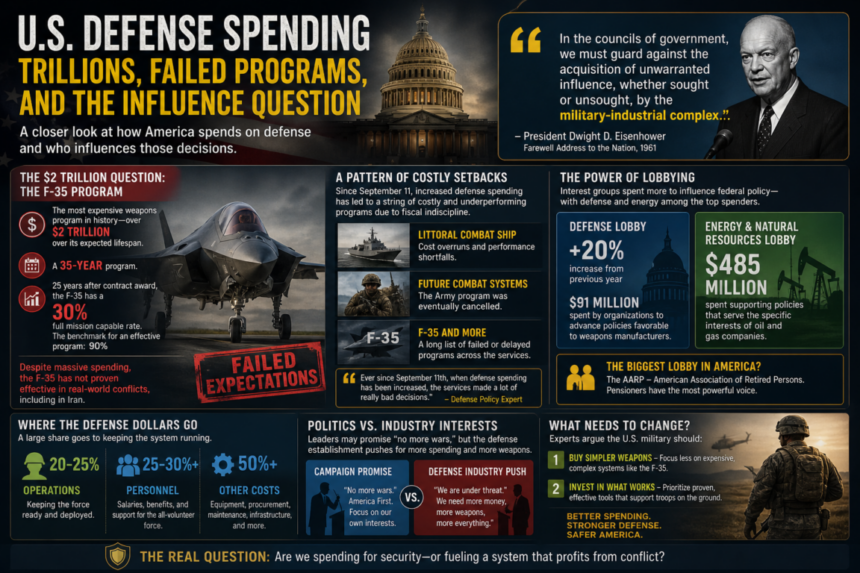
The debate over United States defense spending is once again in focus, raising critical questions about efficiency, accountability, and the growing influence of powerful industries on national security decisions.
At the center of the conversation is not just how much is spent, but how effectively those funds are used.
A System Built on Scale and Strain
The United States allocates hundreds of billions of dollars annually to defense. A large share of that goes into operations and personnel—maintaining an all-volunteer force with competitive salaries.
But beyond salaries and logistics lies a vast defense industry ecosystem—one that continues to attract scrutiny over its influence on policy.
This concern dates back decades. In 1961, former U.S. President Dwight D. Eisenhower warned of the growing power of what he termed the military-industrial complex, a network of relationships between government and defense contractors that could shape national decisions.
The $2 Trillion Question: The F-35 Program
One of the most cited examples in today’s debate is the F-35 Lightning II Program.
Projected to cost over $2 trillion across its lifespan, it is the most expensive weapons program in history. Yet critics argue its performance has fallen short of expectations.
Reports suggest the aircraft has struggled with a full mission capable rate of around 30 percent, far below the 90 percent benchmark typically expected for operational effectiveness.
Despite decades of investment, analysts say the returns remain questionable, fueling concerns about procurement decisions and fiscal discipline.
Beyond One Program: A Pattern of Costly Setbacks
The F-35 is not alone.
Other programs, including the Littoral Combat Ship and the Future Combat Systems, have also faced criticism over cost overruns and limited effectiveness.
Experts argue that increased defense budgets since the September 11 attacks have sometimes led to spending without sufficient oversight, resulting in what some describe as “fiscal indiscipline.”
Lobbying Power and Policy Influence
Beyond procurement, lobbying remains a major factor shaping defense and energy policy.
Recent figures show defense-related lobbying spending reached nearly $100 million in a single year, marking a significant increase. Meanwhile, the energy sector, particularly oil and gas spent nearly $485 million lobbying for favorable policies.
While lobbying is a standard part of democratic systems, critics argue that such large financial influence raises concerns about priorities, especially when tied to sectors that may benefit from geopolitical tensions.
Still, analysts caution that lobbying is not limited to defense or energy. Organizations like the AARP also wield significant influence, highlighting the competitive nature of policy advocacy in Washington.
Security vs. Profit: The Ongoing Debate
At the heart of the issue is a fundamental question:
Does defense spending primarily serve national security or are economic incentives shaping decisions in ways that could encourage prolonged conflict?
Some argue that the system creates a “conflict of interest,” where companies benefit from increased military activity. Others counter that national security decisions are driven by strategic necessity, not corporate pressure.
The political landscape further complicates the picture. Leaders have campaigned on reducing foreign conflicts, even as defense spending remains high, revealing a disconnect between policy rhetoric and institutional momentum.
Rethinking the Future of Warfare
Experts say one possible solution lies in changing how defense dollars are spent.
Rather than investing heavily in complex, high-cost systems like advanced fighter jets, some analysts advocate for simpler, more practical technologies that perform effectively in real-world conditions.
Conflicts such as the war in Ukraine have already demonstrated a shift toward more adaptable, lower-cost tools, reshaping conversations about future military strategy.
The Bottom Line
The debate over U.S. defense spending is no longer just about numbers.
It is about priorities, accountability, and influence.
Because in the end, the real question is not just how much is spent, but whether that spending delivers security, efficiency, and value in an increasingly complex global landscape.