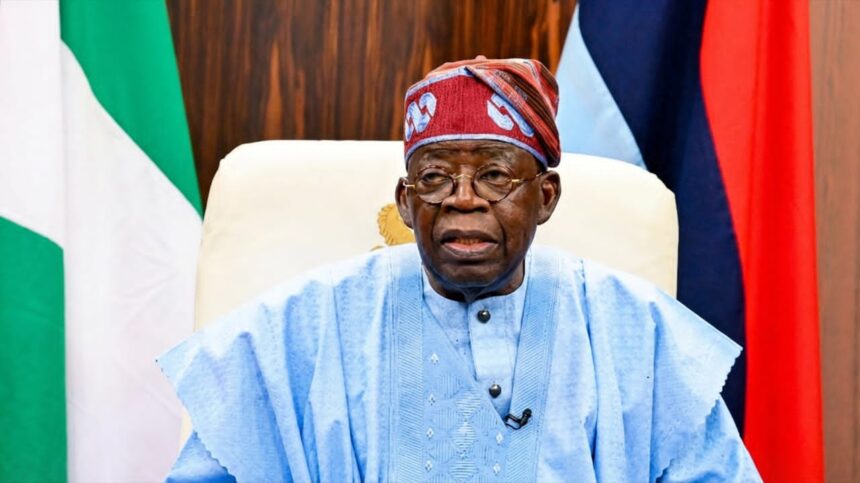
President Bola Ahmed Tinubu’s prolonged stay outside Nigeria has renewed debate over presidential absence, constitutional requirements and the continuity of executive authority.
Tinubu left Nigeria on August 30 for what the Presidency described as a three-week working vacation in London and France. After spending about a week in London, he travelled to Paris, where he held meetings with French President Emmanuel Macron and businessman Vincent Bolloré. (State House)
The Presidency announced on September 21 that Tinubu had extended his stay abroad by a few days and was expected to return to Nigeria over the weekend. However, his return was subsequently delayed, with reports indicating that he was then expected to return on Tuesday following a change in travel plans. (TheCable)
The prolonged absence has attracted questions from opposition figures and civil society actors, particularly concerning the constitutional arrangements governing the country when a president remains outside Nigeria for an extended period.
Section 145(1) of the 1999 Constitution provides that when the President proceeds on vacation or is otherwise unable to discharge the functions of his office, he is to transmit a written declaration to the President of the Senate and Speaker of the House of Representatives. Until a contrary declaration is transmitted, the Vice-President performs the functions of the President as Acting President. (Trust Radio)
The Constitution further provides that where the President fails to transmit such a declaration within 21 days, the National Assembly may, by a simple-majority resolution of both chambers, mandate the Vice-President to perform the functions of the President as Acting President until the President communicates his availability to resume office. (Trust Radio)
The issue has generated differing interpretations.
The Centre for Democracy and Development (CDD) has called for judicial interpretation of the constitutional provisions surrounding the President’s prolonged absence. CDD-West Africa Director, Dr Dauda Garuba, said that although the President has the right to travel and extend his stay, constitutional provisions should be taken into consideration when determining the duration of his absence. (Trust Radio)
The African Democratic Congress Presidential Campaign Council has also demanded greater clarity from the Presidency, arguing that Nigerians deserve information about the President’s whereabouts, the reason for the extension and the constitutional arrangements governing executive authority during his absence. (Punch Newspapers)
However, the Presidency has maintained that Tinubu remains fully engaged with the affairs of government despite being abroad.
Special Adviser to the President on Information and Strategy, Bayo Onanuga, said Tinubu was “hale and hearty” and argued that modern technology allows the President to direct government business without being physically present in Abuja. The Presidency also pointed to Tinubu’s meetings in France and his continued engagement with officials in Nigeria. (Trust Radio)
The President was also reported to have continued issuing directives while abroad, including ordering an independent investigation into the deaths of 37 illegal miners in Minna. (State House)
Meanwhile, Vice-President Kashim Shettima has represented the President at several official engagements. He also led Nigeria’s delegation to the 81st United Nations General Assembly in New York and delivered Nigeria’s national statement on behalf of the President. (State House)
Senate President Godswill Akpabio has dismissed concerns that Tinubu’s absence created a leadership vacuum. Speaking during an event in Akwa Ibom State, he said there was “no vacancy in Aso Rock” and maintained that the President remained in charge of the country. (Trust Radio)
An academic, Associate Professor Lanre Sikiru Nurudeen of Al-Hikmah University, similarly argued that a working leave does not necessarily mean the President has stopped performing his official responsibilities. He said Tinubu could continue to give approvals and communicate with government officials while abroad. (Trust Radio)
The controversy has also coincided with Tinubu’s decision not to personally attend the 81st United Nations General Assembly, marking his third consecutive absence from the gathering. Shettima represented him at the 79th and 80th sessions in 2024 and 2025 as well. (Modern Ghana)
The debate therefore centres on two separate but connected questions: whether a president can effectively conduct government business from outside the country, and whether the constitutional procedure for prolonged presidential absence has been properly followed.
For now, the Presidency maintains that Tinubu has remained engaged in governance and is expected to return to Nigeria following the adjustment to his travel plans. The constitutional questions surrounding the duration of his absence, however, remain a subject of public and political debate. (Trust Radio)