
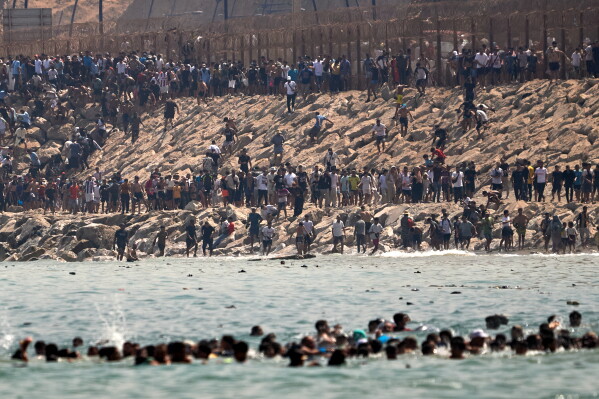
Thousands of migrants attempted to enter Spain’s North African enclave of Ceuta after unrest erupted near the Morocco border, prompting a swift security response from Spanish and Moroccan authorities as both countries worked to prevent a large-scale border breach.
The incident left burnt debris scattered around the crossing and once again highlighted the growing pressure on one of Europe’s busiest migration routes. Security personnel from both countries quickly moved in to restore order, disperse crowds and reinforce the border.
Witnesses reported that many migrants rushed towards the border fence in the hope of entering Ceuta, which is one of Spain’s two autonomous territories on the African continent.
Smoke billowed into the air as burnt objects littered parts of the crossing following the unrest, while security officers acted swiftly to stop the crowd from breaching the border.
Authorities later secured the area as emergency workers cleared debris and assessed any damage caused during the disturbance.
Following the attempted crossing, Spanish and Moroccan authorities deployed additional security personnel to strategic locations around the border.
Officers blocked major access routes leading to the crossing and dispersed groups of migrants before they could reach the fence.
Security patrols continued throughout the day as officials remained on high alert against further attempts to enter the enclave.
Why Ceuta Remains a Major Migration Route
Ceuta, together with the nearby Spanish enclave of Melilla, represents one of the few land borders between Africa and the European Union.
Every year, thousands of migrants travel across North Africa hoping to reach these territories, which they see as gateways to Europe and the opportunity for a better life.
Many migrants undertake the journey after fleeing armed conflict, political instability, economic hardship or limited employment opportunities in their home countries.
Despite tighter border controls and increased cooperation between Spain and Morocco, migration pressure has remained consistently high.
Officials have not confirmed how many migrants, if any, successfully entered Ceuta during the latest incident.
However, security agencies continue to monitor the border and surrounding roads to prevent additional crossing attempts.
Authorities are also expected to review existing security measures as they respond to the latest developments.
While Spain and Morocco continue to strengthen border security, humanitarian organisations have renewed calls for the protection of vulnerable migrants.
Rights groups argue that efforts to manage migration should be balanced with respect for human rights, particularly for women, children and people fleeing violence or persecution.
The latest events at the Ceuta border underline the complex challenge facing European and North African authorities as they seek to balance border security with humanitarian responsibilities.