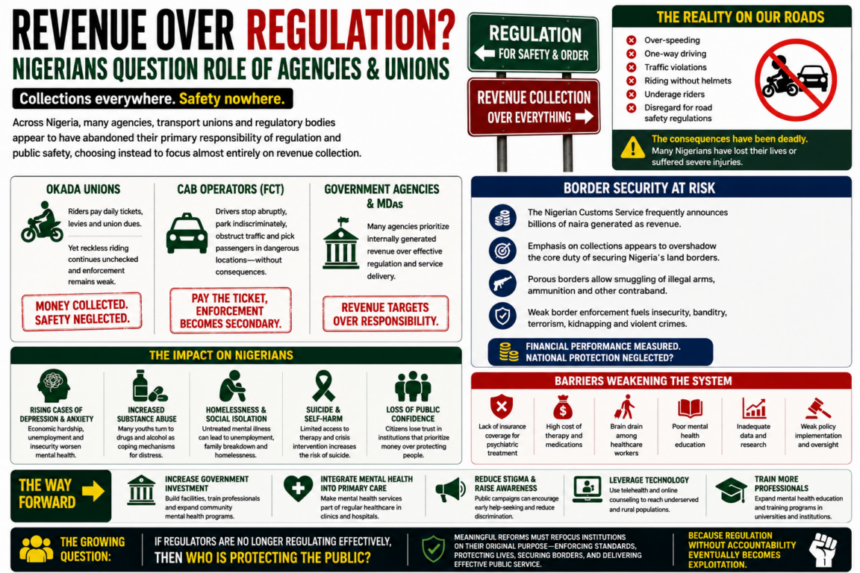
Across Nigeria today, many citizens believe that several agencies, transport unions, and regulatory bodies have shifted away from their core responsibilities.
Instead of prioritising regulation, safety, and accountability, critics argue that many institutions now focus mainly on revenue generation.
From transport operators to government agencies and border authorities, concerns continue to grow that collections and levies now receive more attention than public protection and effective oversight.
Transport Unions Under Scrutiny
In principle, transport unions exist to maintain order, enforce discipline, and improve public safety within the transportation sector.
They are expected to enforce operational guidelines, discipline reckless operators, improve commuter safety, and promote compliance with traffic regulations.
However, many Nigerians argue that some unions now operate largely as revenue collection systems.
Commercial motorcyclists, popularly known as Okada riders, often pay daily levies, union dues, and operational tickets. Yet reckless riding remains widespread across many cities.
Common violations still include one-way driving, over-speeding, riding without helmets, underage riders, ignoring traffic laws, and dangerous passenger loading.
As a result, road accidents involving commercial motorcycles continue to claim lives and cause serious injuries across the country.
Critics say enforcement from unions themselves often appears weak despite the continuous collection of fees from riders.
Abuja Commercial Drivers Also Face Criticism
Similar concerns exist within the commercial transport system in the Federal Capital Territory.
Across several roads and busy junctions in Abuja, commercial drivers frequently stop abruptly on highways, park indiscriminately, obstruct traffic flow, and pick passengers in unsafe areas.
Many residents complain that authorities often focus more on ticket payments and operational charges than on enforcing discipline and road safety standards.
According to critics, once daily payments are made, regulatory enforcement becomes inconsistent.
Revenue Targets Increasingly Define Many Agencies
The concerns extend beyond transport unions.
Many Ministries, Departments, and Agencies have also faced criticism for allegedly prioritising internally generated revenue over service delivery and regulation.
Businesses and citizens frequently deal with multiple permits, repeated levies, enforcement charges, and various taxation demands.
Yet many complain that the same agencies often fail to improve systems, enforce standards, or provide efficient public services.
Analysts warn that when institutions begin measuring success mainly through revenue targets, public accountability can weaken significantly.
Border Security Concerns Raise More Questions
The debate also affects national security institutions, especially border enforcement agencies.
The Nigerian Customs Service regularly announces record-breaking revenue collections and financial targets achieved through customs operations.
While revenue generation remains part of the agency’s responsibilities, security experts argue that border protection should remain the primary focus.
Over the years, Nigeria’s borders have repeatedly faced criticism for being porous.
Authorities and security analysts have linked weak border control to illegal arms smuggling, ammunition trafficking, contraband movement, banditry, terrorism, kidnapping, and organised crime.
Critics argue that excessive focus on financial collections may distract from the broader responsibility of national security and border enforcement.
Regulation Without Accountability
Experts say the larger concern goes beyond money collection itself.
Revenue generation is necessary for government operations. However, analysts warn that problems emerge when institutions prioritise income collection while neglecting oversight responsibilities.
According to governance experts, weak regulation can lead to declining public safety, poor service delivery, increased disorder, loss of public trust, and institutional inefficiency.
Citizens increasingly question whether some regulatory bodies still perform their original mandates effectively.
Calls For Institutional Reforms
Stakeholders say meaningful reform requires institutions to return to their core responsibilities.
They argue that agencies should focus more on public safety, accountability, effective enforcement, border security, professional standards, and transparent service delivery.
Analysts also stress the need for stronger monitoring systems, institutional reforms, and improved public accountability mechanisms.
Many believe that regulation should primarily protect citizens rather than function mainly as a collection system.
The Bigger National Question
The growing debate reflects wider frustrations about governance and institutional performance in Nigeria.
For many citizens, the issue is no longer simply about taxes or levies. Instead, it concerns whether institutions still serve the public interest effectively.
As insecurity, transport challenges, and economic pressures continue across the country, many Nigerians now ask a critical question:
If regulators are no longer regulating properly, then who is protecting the public?