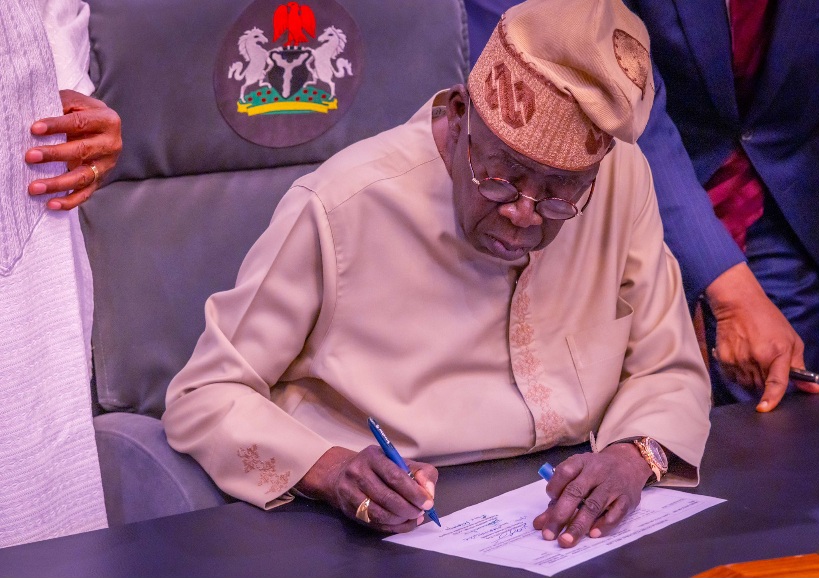
President Bola Ahmed Tinubu has declared that Nigeria is entering a new phase of economic growth and prosperity after three years of difficult reforms aimed at stabilising the country’s economy.
In his Independence Day address to Nigerians on October 1, 2026, Tinubu defended his administration’s economic policies, saying the reforms were necessary to address long-standing structural problems rather than the cause of the country’s economic difficulties.
Using a medical analogy, the President described Nigeria as a sick patient whose economic problems had been allowed to worsen over the years. He compared previous policies to morphine that reduced the pain without treating the underlying disease.
Tinubu said his administration instead chose to confront the structural problems through reforms, despite the immediate hardship they created for households and businesses.
The President pointed to stronger economic growth, falling inflation, rising foreign reserves and increased non-oil exports as evidence that the reforms are producing results.
Nigeria’s economy grew by about four per cent in 2026, according to current estimates from the World Bank and International Monetary Fund. The World Bank reported that real GDP grew by 4.2 per cent in the first half of 2026, supported mainly by services and agriculture.
The President also highlighted the improvement in Nigeria’s external position. The World Bank reported that the country’s foreign reserves had risen to about $51.9 billion by the end of July 2026.
However, analysts continue to distinguish between macroeconomic stability and household welfare. Despite stronger growth and lower inflation, poverty remains widespread and household incomes have not fully recovered.
Tinubu also cited Nigeria’s non-oil export performance as evidence of progress towards economic diversification.
The Nigeria Export Promotion Council reported that non-oil exports reached about $6.1 billion in 2025, the highest formally documented level in the country’s history.
Nigeria exported hundreds of non-oil products to international markets during the year, highlighting the potential for agriculture, manufacturing and other productive sectors to contribute more to foreign-exchange earnings.
The development is significant for an economy that has historically depended heavily on crude oil exports for foreign exchange and government revenue.
The President also pointed to improvements in the oil sector, particularly the reduction in crude oil theft.
Data from the Nigerian Upstream Petroleum Regulatory Commission show that oil theft has fallen significantly from the levels recorded earlier in the decade.
Higher crude production could provide additional revenue for the government and strengthen foreign-exchange earnings, although the sector continues to face challenges involving security, investment and infrastructure.
Tinubu’s speech marked a shift in emphasis from economic stabilisation to broader prosperity.
He said the next phase would focus on reducing the cost of living by lowering the cost of producing and transporting goods.
The President identified agriculture, infrastructure, energy and industrial production as key areas for achieving that goal.
His administration plans to expand mechanised irrigation and dry-season farming, improve access to seeds and fertiliser, strengthen agricultural mechanisation and invest in storage and transportation.
Tinubu also highlighted ongoing investments in roads, railways and ports, arguing that better infrastructure would reduce the cost of moving agricultural and industrial products to consumers.
The President said Nigeria’s large youth population must become an economic advantage rather than a source of unemployment and frustration.
He promised greater emphasis on jobs, enterprise and industrial development.
The government plans to use Nigeria’s gas resources to support industrial growth, expand digital connectivity, develop workforce skills and provide businesses with infrastructure and financing.
Tinubu said he wants to see more Nigerian businesses producing goods for domestic consumption and international markets.
The challenge, however, remains the scale of job creation required to absorb millions of Nigerians entering the labour market each year.
The President acknowledged that many Nigerians continue to struggle with food costs, school fees, medical expenses and transportation.
He said the government’s response includes strengthening the National Social Register and expanding support for vulnerable households.
He also highlighted the Nigerian Education Loan Fund, which provides financial support for students, and the Nigerian Consumer Credit Corporation, which aims to expand access to consumer credit for working Nigerians.
Tinubu described these programmes as a bridge towards prosperity rather than a substitute for productive economic activity.
Despite the economic improvements highlighted by the President, Nigeria continues to face major challenges.
The World Bank says macroeconomic stabilisation has progressed, but poverty remains high and household incomes have not fully recovered.
This creates an important test for the next phase of the government’s economic programme.
Higher GDP growth and stronger foreign reserves are important economic indicators, but Nigerians will also measure progress through food prices, wages, electricity costs, transport fares, employment and access to essential services.
The central question is therefore whether macroeconomic stability can translate into higher household incomes and improved living standards.
Tinubu concluded his Independence Day address by declaring that Nigeria had passed through the difficult period of reform and was now entering what he described as an “age of prosperity.”
He urged Nigerians not to look back, saying the country had corrected its economic direction and laid the foundations for a more prosperous future.
The President’s message is therefore built around a simple economic proposition: the reforms were intended to stabilise Nigeria’s economy, while the next phase must ensure that the benefits of that stability reach ordinary Nigerians.
For the government, the success of the next phase will depend not only on maintaining economic growth but also on creating productive jobs, reducing production costs, improving infrastructure, expanding industrial output and reducing poverty.
Nigeria’s economic story, as presented by the President, is moving from reform and stabilisation to production, jobs and shared prosperity.