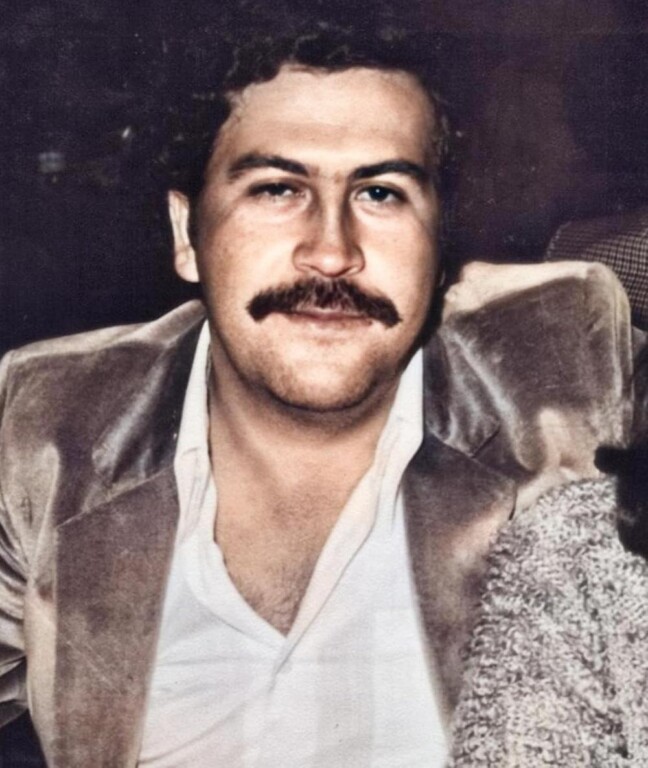
Pablo Escobar did not become one of the world’s most powerful criminals through cocaine alone.,he built an empire through money, fear, political influence, violence and public loyalty.
At the height of his power, the Colombian drug lord controlled a vast cocaine trafficking network and accumulated enormous wealth.
But Escobar’s story goes beyond his fortune. His rise reveals how a criminal organisation can exploit poverty, corruption, weak institutions and public desperation to build power.
Born in 1949 in Rionegro, Colombia, Pablo Escobar grew up in a modest family near Medellín. His father worked as a farmer, while his mother taught school.
Escobar entered crime at a young age. He reportedly started with relatively small-scale illegal activities before moving into smuggling and eventually cocaine trafficking.
The cocaine trade offered something different.
Demand for cocaine was exploding in the United States, while Colombia’s location made it an ideal base for trafficking. Escobar recognised the enormous opportunity and began building relationships with other traffickers.
By the mid-1970s, he had helped establish what became the Medellín Cartel.
How Escobar Built the Medellín Cartel
Escobar understood that controlling the entire business could produce enormous profits.
The Medellín Cartel developed a network that connected cocaine producers, traffickers, pilots, distributors and corrupt officials. The organisation moved huge quantities of cocaine into international markets, particularly the United States.
At its peak, the cartel reportedly supplied a substantial share of the cocaine entering America.
The money became almost impossible to comprehend.
Escobar accumulated so much cash that his organisation struggled to store it. Reports have claimed that the cartel lost millions of dollars each year because rats destroyed banknotes stored in warehouses and moisture damaged other cash.
However, wealth alone did not explain Escobar’s power.
He combined money with intimidation.
“Silver or Lead”
Escobar became associated with the phrase “plata o plomo”, meaning “silver or lead.”
The message was simple: accept the money or face violence.
Escobar used bribery to influence officials, while his organisation used assassinations and bombings against people who resisted him.
Judges, police officers, journalists, politicians and government officials became targets.
This strategy created a climate of fear.
People did not need to support Escobar to obey him. Many simply feared the consequences of opposing him.
That distinction helped his organisation survive.
The Robin Hood Image
Yet Escobar understood another side of power: public support.
He invested heavily in poor communities around Medellín. He funded housing projects, built football pitches and supported community initiatives.
For some residents, he appeared less like a criminal and more like a benefactor.
That image earned him the nickname “Robin Hood.”
But the generosity came with a political purpose.
Escobar understood that people who depended on his money could become loyal defenders. His philanthropy helped him build influence among communities that often felt abandoned by the government.
He was not simply buying houses or football fields.
He was buying legitimacy.
Escobar Wanted Political Power
Money gave Escobar influence, but he wanted something greater.
He entered Colombian politics and eventually became an alternate member of the Chamber of Representatives.
For a man running a criminal empire, political office offered enormous advantages.
It could give him legitimacy, access to powerful people and greater protection from law enforcement.
However, his political ambitions eventually collided with investigative journalism and government opposition. Authorities exposed his criminal connections, and his political career collapsed.
Escobar responded by retreating further into the world of organised crime.
His strategy changed.
If he could not control the government from inside, he would pressure it from outside.
Terror Against the Colombian State
Escobar’s conflict with the Colombian government became increasingly violent, particularly over extradition to the United States.
His organisation launched a campaign of terror.
Bombings, assassinations and kidnappings shook Colombia.
One of the most devastating attacks came in 1989, when a bomb destroyed Avianca Flight 203, killing more than 100 people. Escobar’s organisation also targeted politicians and public officials.
The violence had one central objective: force the government to negotiate.
And for a period, it worked.
La Catedral: Escobar’s Extraordinary Prison
In 1991, Escobar surrendered to Colombian authorities after negotiating conditions that protected him from immediate extradition to the United States.
But his imprisonment looked nothing like a normal prison sentence.
Escobar stayed at La Catedral, a facility he effectively controlled.
The compound reportedly contained luxury amenities, including a football field, nightclub and other comforts. More importantly, Escobar continued exercising influence over his criminal organisation from inside.
He had turned imprisonment into another form of power.
But the arrangement eventually collapsed.
After authorities discovered that Escobar had ordered the murder of associates inside La Catedral, the government decided to transfer him to a conventional prison.
Escobar refused to accept the move.
In July 1992, he escaped.
The escape triggered one of the biggest manhunts in Colombian history.
The Final Manhunt
After his escape, Escobar became a fugitive.
Colombian security forces, supported by the United States, intensified efforts to locate him.
His empire also began weakening.
Government pressure increased. Rival traffickers turned against him. Former allies disappeared. The organisation that once seemed untouchable began to fracture.
On December 2, 1993, Colombian authorities located Escobar in Medellín.
He attempted to escape across rooftops.
A shootout followed.
Escobar died at the age of 44.
The death ended his reign, but it did not erase the consequences of the empire he built.
The Strange Legacy of Hacienda Nápoles
Escobar’s extravagant lifestyle became legendary.
At his enormous Hacienda Nápoles estate, he built a private zoo and imported exotic animals, including four hippopotamuses.
After his death, the animals escaped and reproduced in Colombia.
Decades later, their descendants became an environmental problem. Colombia now has a large population of wild hippos descended from Escobar’s original animals.
The hippos represent one of the strangest reminders of his legacy.
A criminal empire disappeared.
Its consequences did not.
How Did Pablo Escobar Manage to Do It?
Escobar’s success came from combining several forms of power.
First, he understood demand. Cocaine consumption created an enormous international market, and Escobar positioned himself near its supply chain.
Second, he built networks. He did not operate alone. He depended on traffickers, pilots, producers, distributors, corrupt officials and other criminal partners.
Third, he used money strategically. His wealth allowed him to bribe officials, finance operations and win support in poor communities.
Fourth, he used violence as a weapon of control. People who accepted his demands received money. Those who resisted could face deadly consequences.
Finally, he understood perception. Escobar knew that fear could control institutions, while generosity could win public loyalty.
That combination made him extraordinarily difficult to stop.
The Man Behind the Myth
Pablo Escobar’s story has fascinated the world because it combines unimaginable wealth, political ambition, violence and spectacle.
But the mythology can obscure the human cost.
Behind the billions were murdered officials, journalists, police officers, politicians and civilians. Behind the charitable projects stood a criminal organisation that used terror to protect its business.
Escobar did not simply build a drug empire.
He built a system in which money created influence, influence created protection, and violence protected the money.
That system allowed him to challenge a government, manipulate communities and become one of the world’s most notorious criminals.
Yet his downfall demonstrated the weakness at the heart of his empire.
Power built on fear eventually creates enemies everywhere.
And when the money, protection and loyalty began to disappear, Pablo Escobar’s empire collapsed with him.