
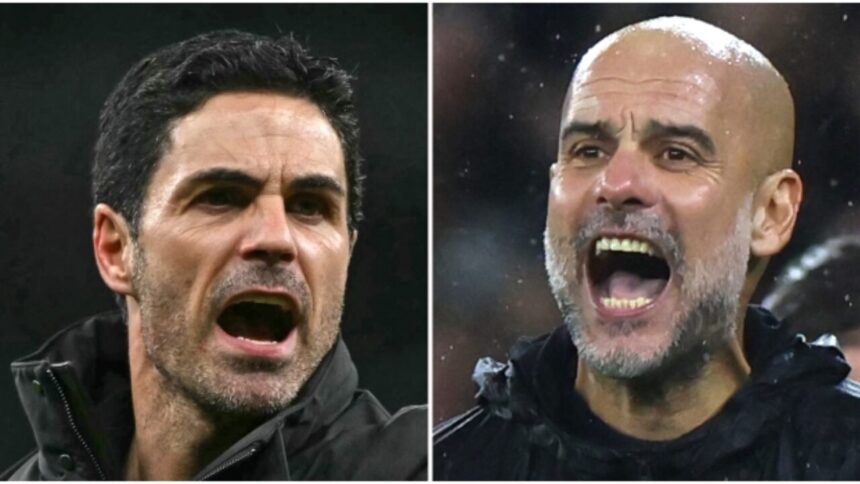
The story of Pep Guardiola and Mikel Arteta isn’t built on conflict or controversy. It’s built on something far more complex trust, influence, and the unavoidable tension that comes when two brilliant football minds chase the same prize. Their relationship began in 2016 at Manchester City.
Guardiola had just arrived in England with a reputation as one of football’s great innovators, and instead of surrounding himself with only experienced assistants, he made a bold call. He brought in Arteta young, recently retired, and unproven in coaching but someone he deeply trusted. That trust quickly proved justified.
Within City’s coaching setup, Arteta became far more than a supporting figure. He was heavily involved in tactical planning, particularly in the attacking phase, working closely with players to refine movement, positioning, and decision-making in tight spaces.
His influence grew quietly but significantly. To Guardiola, Arteta was not just an assistant he was a collaborator, someone who understood his ideas and could challenge them when needed. At the heart of their connection was a shared footballing philosophy shaped by the traditions of FC Barcelona.
Positional play, control of space, and technical precision defined their approach. Arteta absorbed these principles during his time with Guardiola, but more importantly, he learned how to apply them in the high-pressure environment of English football. This period became his true education as a coach.
That is why his departure in 2019 carried emotional weight. When Arteta accepted the managerial role at Arsenal FC, it wasn’t simply a career move, it was the end of a close working relationship. Guardiola made it clear he did not want to lose him. There was a sense that Arteta was part of a long-term project at City, perhaps even a future successor. But ambition doesn’t wait, and Arteta stepped into one of the most demanding jobs in the game.
At Arsenal, he inherited a team lacking structure, confidence, and identity. The early stages were turbulent, but gradually, his ideas began to take shape. The influence of Guardiola was a visible structured build-up play, positional discipline, and an emphasis on controlling matches through possession. Yet over time, Arteta’s Arsenal developed its own personality. There was greater emotional intensity, a stronger defensive edge, and a willingness to adapt tactically depending on the opponent.
As Arsenal improved, the dynamic between the two men inevitably changed. What was once a mentor–student relationship evolved into direct competition. By the 2022–23 and 2023–24 seasons in the Premier League, Arsenal had become Manchester City’s most serious challenger for the title. Their meetings were no longer just tactical battles, they were deeply personal tests of ideas, preparation, and nerve.
Despite the growing rivalry, there has been no dramatic fallout. Both managers continue to speak with respect about each other. Guardiola has praised Arteta’s work repeatedly, acknowledging the transformation at Arsenal. Arteta, in turn, still credits Guardiola as a major influence on his development. But beneath that mutual respect lies an undeniable edge. Elite competition leaves little room for sentiment.
Their encounters on the touchline now reflect that shift. Every decision carry weight. Every tactical adjustment feels like a move in a high-stakes chess match between two people who know each other’s thinking patterns almost instinctively. Familiarity, once an advantage, has become a battleground.
What makes this relationship compelling is not hostility, but evolution. It is the natural progression of mentorship at the highest level of sport. The student learns, adapts, and eventually seeks to surpass the teacher. The teacher, in turn, must evolve to stay ahead.
In many ways, this rivalry is about more than trophies. It is about legacy. About whose ideas will define an era of English football. Guardiola has already built a dynasty. Arteta is trying to prove he can build one of his own, even if it means dethroning the man who helped shape him.
And so, every time Arsenal FC face Manchester City, the narrative deepens. Not because of what is said publicly, but because of what is understood privately.
The mentor and the student are no longer walking the same path.
They are racing toward the same finish line.