Leadership is not always born in the corridors of power. Sometimes, it begins quietly in the community—in the dreams of a young man, in the struggles of ordinary people, in the determination to speak when others remain silent, and in the courage to pursue a vision long before recognition comes.
For Chief Dr. Philip Agbese, the journey from Agila in Ado Local Government Area of Benue State to the Green Chamber of the National Assembly is a story of ambition, advocacy, political evolution and public service.
Popularly known as “Okanga,” Agbese has built a public identity around communication, representation, human rights, legislative engagement and grassroots politics. His journey has taken him from education and professional development into journalism, civil-society advocacy, electoral politics, the House of Representatives and broader African parliamentary engagement.
As an African proverb reminds us, “A tree does not make a forest.” Agbese’s political journey, therefore, cannot be separated from the people, institutions, communities and experiences that have shaped him.
Roots: The Beginning of a Journey
Chief Dr. Philip Agbese was born on 25 February 1987 in Agila, Ado Local Government Area of Benue State, in the heart of the Enone cultural and political constituency.
His roots in Agila and his connection to the wider Ado, Okpokwu and Ogbadibo communities have remained central to his political identity.
The name “Okanga” has also become inseparable from his public persona. In the Idoma cultural context, Okanga refers to a drum, an instrument traditionally associated with communication, gathering people and announcing important messages.
That symbolism has acquired political meaning in Agbese’s career: the drum announces; the representative communicates; and the leader carries the voice of his people.
His story is consequently not merely that of an individual seeking political office, but of a man whose career has increasingly been defined by the desire to create a platform through which the concerns of ordinary people can be heard.
Education and the Making of a Multidisciplinary Mind
Agbese’s educational journey has been broad and diverse.
His early education began at LGEA Primary School, Agila, after which he proceeded to Federal Government College, Ugwolawo, Kogi State.
He later attended the University of Ilorin, where he studied Biochemistry. His professional and intellectual journey subsequently expanded into law, business, human rights and journalism, including studies in the United Kingdom.
This multidisciplinary background has become one of the distinguishing features of his public career.
Science provided him with analytical thinking. Law introduced him to justice, rights and institutions. Business broadened his understanding of enterprise and management, while journalism and public communication equipped him with the tools to engage society.
His educational journey reflects a philosophy that leadership requires continuous learning.
In a rapidly changing world, the leader who stops learning risks becoming disconnected from the people he is expected to serve.
From the Classroom to Human-Rights Advocacy
Before electoral politics became the centre of his public life, Agbese was involved in advocacy, public affairs and human-rights activities.
His professional history includes work with civil-society organisations and the establishment of platforms concerned with human rights, social justice, security and public accountability.
He also became increasingly involved in journalism and public communication, establishing media-related initiatives through which national issues could be examined and discussed.
These experiences were significant because they exposed him to the challenges faced by ordinary citizens beyond the formal structures of government.
It was a period in which advocacy became more than an occupation; it became preparation for public leadership.
The experience of speaking for people who lacked access to power would later become important when he entered the National Assembly.
The Transition Into Politics
The transition from advocacy to politics was a natural progression in Agbese’s public journey.
His growing visibility among young people, professionals, civil-society actors and members of his community eventually translated into an ambition to represent the people of Ado, Okpokwu and Ogbadibo Federal Constituency.
The aspiration was not simply to participate in politics but to enter the legislative space where laws are made, national policies are debated and constituency interests can be presented before the Federal Government.
By 2021, his political ambition had begun receiving public attention, including support from youth organisations and community stakeholders.
The journey from public advocacy to electoral politics had begun.
2023: The Journey to the Green Chamber
The defining electoral moment came in the 2023 general elections, when Philip Agbese contested the Ado/Okpokwu/Ogbadibo Federal Constituency seat in the House of Representatives on the platform of the All Progressives Congress (APC).
He emerged victorious with 19,083 votes, according to contemporary election reports.
The victory brought him into the 10th National Assembly and transformed him from an aspiring political actor into an elected federal legislator.
But victory at the ballot box was only the beginning.
Winning an election gives a politician a mandate; what follows determines the meaning of that mandate.
For Agbese, the task became how to translate electoral confidence into legislative representation, constituency engagement and a stronger voice for Enone.
The Courtroom and the Confirmation of the Mandate
Like many Nigerian elections, the 2023 contest did not end entirely at the polling stations.
His election was challenged before the courts. On 3 November 2023, the Court of Appeal sitting in Abuja affirmed his election and dismissed the appeal against his victory.
The court’s decision provided another important chapter in the establishment of his mandate as the representative of Ado, Okpokwu and Ogbadibo.
From the campaign trail to the courtroom and ultimately to the Green Chamber, the electoral mandate had survived another test.
Entering the 10th National Assembly
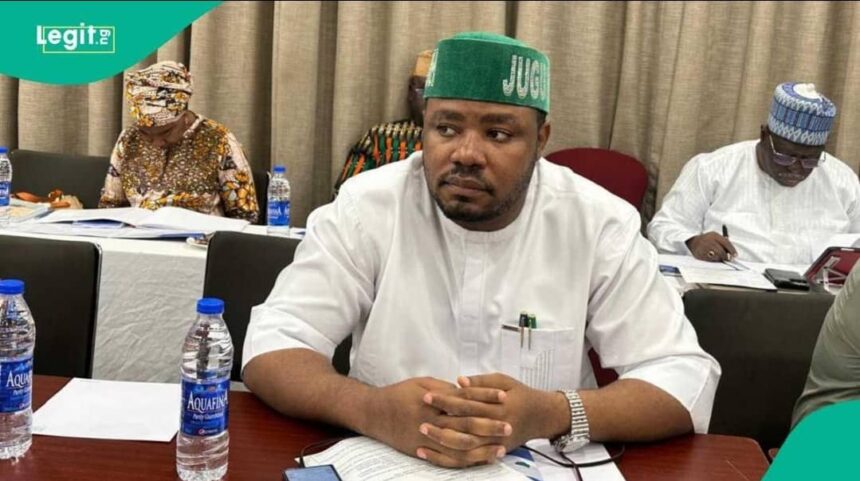
Upon his arrival in the House of Representatives, Agbese became part of the 10th National Assembly, where he began participating in legislative activities and committee assignments.
The National Assembly’s records identify him as a member representing Ado/Okpokwu/Ogbadibo Federal Constituency and record his participation in the House’s legislative structures.
His legislative responsibilities have included participation in committees connected with media and public affairs, among others.
But his most visible responsibility would become communication.
The Voice of the House: Deputy Spokesman
Agbese’s emergence as Deputy Spokesman of the House of Representatives marked one of the most important developments in his legislative career.
The position placed him at the intersection of Parliament, the media and the Nigerian public.
A modern legislature cannot function effectively if citizens do not understand what lawmakers are doing. Bills, motions, resolutions, oversight activities and constitutional questions can easily become complicated to the ordinary citizen.
The responsibility of the parliamentary spokesman is therefore not merely to defend an institution.
It is also to explain Parliament to the people.
In that capacity, Agbese became increasingly visible in national conversations on legislation, governance, security, the economy, constitutional reform, democratic institutions and the activities of the House.
His background in journalism and public affairs became particularly relevant.
The advocate had become a legislator.
The communicator had become part of the institution he once observed from outside.
Representation Beyond Politics
At the heart of Agbese’s political identity remains his constituency.
Ado, Okpokwu and Ogbadibo are not merely geographical names in his political biography. They represent the people whose mandate brought him to Abuja.
His constituency engagement has included raising matters affecting the political and developmental interests of the area within the National Assembly.
One notable example came in 2026 when the House considered a resolution concerning the restoration of suppressed State Constituencies in Ado, Okpokwu and Ogbadibo and urged relevant authorities to address the issue ahead of the 2027 elections.
Such interventions demonstrate an important principle of legislative representation: constituency interests do not cease to exist when an elected representative leaves home for Abuja.
They travel with him to the National Assembly.
Security and Human-Rights Advocacy
Security has remained another major theme in Agbese’s public career.
His earlier experience in human-rights advocacy and security-related public affairs continued to influence his interventions as a legislator.
His public engagements have repeatedly addressed terrorism, kidnapping, banditry, the welfare of security personnel and the need for stronger national security institutions.
His constituency experiences have also brought the realities of insecurity closer to his political work.
In 2024, reports emerged of an alleged assassination attempt involving him during a visit to his constituents in Igumale, Ado Local Government Area. The incident attracted calls for investigation.
For a representative of a constituency in a state that has experienced serious security challenges, the question of security is not theoretical.
It is personal, local and national at the same time.
The Pan-African Dimension
Perhaps one of the most significant developments in Agbese’s legislative career has been his engagement beyond Nigeria.
Through the Pan-African Parliament, he has participated in continental conversations involving governance, human rights, labour, social affairs, African integration and security.
His involvement in Pan-African parliamentary affairs has given his political career an additional dimension.
The representative who began by seeking to speak for Enone increasingly found himself participating in conversations about Africa itself.
That progression—from community to constituency, from constituency to nation and from nation to continent—is one of the defining features of his public journey.
His recent continental engagements have included advocacy against xenophobia and insecurity affecting Africans across national borders.
The message is consistent with his broader philosophy: African integration cannot be meaningful if Africans cannot move, trade, invest and live across the continent with dignity and security.
Author, Communicator and Public Intellectual
Agbese’s engagement with public affairs has also extended into authorship.
He authored Emilokan: The Making of a Man With a Mission – PBAT, a book examining the political journey and emergence of President Bola Ahmed Tinubu.
The publication reflects another dimension of his career—the belief that political history should not only be experienced but documented.
Politics is often remembered through speeches, elections and personalities.
But books preserve political narratives for generations.
Political Realignment: A New Chapter
In March 2026, Philip Agbese entered a new chapter of his political career when he formally defected from the All Progressives Congress to the Labour Party on the floor of the House of Representatives.
Reports at the time stated that he cited political developments and internal party issues as factors behind the decision, while also referring to the wishes and interests of his constituents.
The move attracted considerable attention because Agbese was not simply an ordinary member of the House; he was serving as Deputy Spokesman.
His defection demonstrated another reality of Nigerian politics: political journeys evolve, alliances change and elected representatives sometimes realign themselves in response to changing political circumstances.
His movement to the Labour Party consequently became one of the major chapters in his political evolution after the 2023 election.
Labour Party and the Road to 2027
Following his movement to the Labour Party, Agbese became increasingly involved in the party’s activities.
His political profile within the party expanded, including his involvement in party media and publicity activities.
The focus subsequently shifted toward the 2027 political cycle and the question of whether the people of Enone would renew their confidence in his representation.
For Agbese, the coming election represents more than another political contest.
It is an opportunity for the people to assess the journey so far.
Every elected representative eventually faces the same democratic question:
What did you do with the mandate entrusted to you?
Leadership as a Continuing Journey
The story of Philip Agbese cannot be reduced to titles.
He has been an advocate, journalist, communicator, political organiser, author, legislator and parliamentary spokesman.
Each stage has contributed something to the next.
His human-rights experience shaped his understanding of justice.
His media background strengthened his communication skills.
His political journey brought him into direct contact with grassroots realities.
His legislative career exposed him to the complexities of national policymaking.
His Pan-African engagement broadened his perspective beyond Nigeria.
These experiences have combined to produce a leadership profile that is still evolving.
The Philosophy of Representation
At the centre of Agbese’s public narrative is the idea that political office is a responsibility.
Representation is not simply about occupying a seat in Abuja.
It is about carrying the hopes, frustrations, aspirations and expectations of constituents into the rooms where national decisions are made.
It is about legislation.
It is about oversight.
It is about communication.
It is about constituency engagement.
And ultimately, it is about accountability.
The people may give a politician the mandate, but history determines what that politician does with it.
The Meaning of Okanga
There is a powerful cultural metaphor in the name Okanga.
The drum is not merely an instrument of entertainment.
In traditional African society, the drum can announce the arrival of an important person, summon a community, communicate a message and set the rhythm for collective action.
In that sense, the symbolism surrounding Okanga fits naturally into Agbese’s political journey.
His career has increasingly revolved around communication.
From advocacy to journalism.
From journalism to politics.
From politics to parliamentary communication.
From Enone to Abuja.
From Abuja to the Pan-African Parliament.
The drum has travelled.
And the message has become broader.
A Journey From Agila to Abuja
The distance between a young man growing up in Agila and a legislator standing in the Nigerian Green Chamber is more than geographical.
It is a journey through education, professional development, advocacy, political organisation, elections, legal challenges, legislative responsibility and public scrutiny.
It is also a reminder that political leadership is rarely built overnight.
The foundation is laid long before the public sees the finished structure.
As the African proverb says, “However far a stream flows, it never forgets its source.”
For Agbese, the source remains Enone.
The constituency remains the foundation of the mandate.
And the National Assembly remains the platform through which that mandate is exercised.
The Road Ahead
Chief Dr. Philip Agbese’s story is still being written.
The 2023 election brought him into the National Assembly.
His subsequent role as Deputy Spokesman gave him a national platform.
His Pan-African engagements expanded his horizon.
His 2026 political realignment opened another chapter.
And the 2027 electoral cycle will provide another opportunity for the people of Ado, Okpokwu and Ogbadibo to evaluate his record and decide the direction of their mandate.
Whatever judgment history ultimately records, one fact remains undeniable: Philip Agbese’s political journey has moved through several distinct phases—from advocacy to electoral politics, from constituency representation to national communication, and from national legislative engagement to continental parliamentary affairs.
His story is therefore not simply the story of a politician.
It is the story of a communicator who entered politics, an advocate who became a legislator, and a constituency representative whose political voice has grown beyond the boundaries of his federal constituency.
Conclusion
From Agila to Abuja, from Enone to the Green Chamber, from human-rights advocacy to legislative representation, and from national politics to Pan-African engagement, the life and journey of Chief Dr. Philip Agbese represents a continuing chapter in Nigeria’s evolving democratic story.
His journey demonstrates that leadership is not a destination.
It is a road.
And every road is ultimately judged by where it leads the people who trusted the traveller to guide them.
For the people of Ado, Okpokwu and Ogbadibo, the journey continues.
For Philip Agbese, the responsibility remains.
And for history, the pages are still being written.