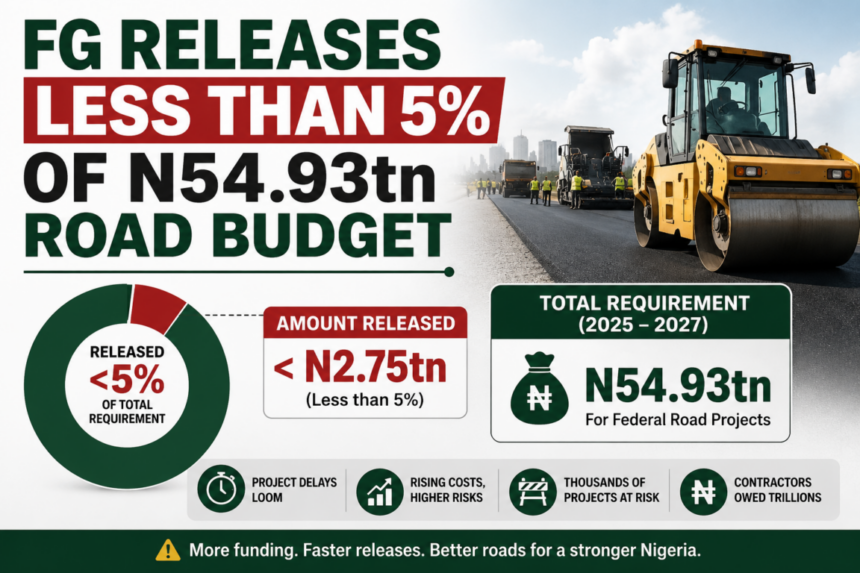
The Federal Government has released less than five per cent of the N54.93 trillion needed to fund federal road projects between 2025 and 2027. The shortfall has raised fresh concerns about the pace of infrastructure development across Nigeria.
Data from the Federal Ministry of Works show that road project commitments continue to grow. However, funding releases remain far below what is required. As a result, hundreds of projects face delays, rising costs, and possible abandonment.
The funding gap highlights a major challenge for the government’s infrastructure programme. Authorities must find enough resources to complete thousands of inherited and newly approved projects amid increasing fiscal pressure.
The Ministry of Works estimates that it will need about N54.93 trillion to complete federal road projects covered under its three-year expenditure plan.
Despite this requirement, government records show that only a small portion of the funds has been released. The amount represents less than five per cent of the total needed.
This situation persists despite repeated assurances that infrastructure remains central to economic growth, trade, and national development.
Industry experts warn that inadequate funding could slow the completion of major transport routes. They also say inflation could push construction costs even higher and deepen Nigeria’s infrastructure deficit.
The funding challenge has created a growing backlog of unpaid obligations to contractors.
Minister of Works, David Umahi, recently disclosed that the government owes contractors about N2.2 trillion for certified work completed between 2024 and 2025.
He also revealed that the ministry had received only N210.3 billion of its expected 2025 capital allocation at the time of his presentation before the National Assembly. That figure represents about 9.7 per cent of the expected releases.
Umahi said the current administration inherited a large number of ongoing projects. According to him, more than 2,000 road projects were already underway nationwide before the transition. Many of them were struggling with funding challenges.
Despite funding constraints, the Federal Government continues to increase budget allocations for road infrastructure.
The Ministry of Works has proposed N3.24 trillion for road construction, rehabilitation, and related projects in the 2026 fiscal year. This ranks among the largest allocations to the sector in recent years.
Budget documents show that the proposed amount is nearly five times higher than what the government allocated two years ago. The increase reflects the administration’s focus on completing key highways and economic corridors.
Major projects include the Lagos-Calabar Coastal Highway, the Sokoto-Badagry Superhighway, and several strategic federal roads that support trade, agriculture, and regional connectivity.
To address the funding gap, the Federal Government has started exploring alternative financing options.
The Ministry of Works has engaged development partners, including the World Bank, to seek support for major road projects.
Government officials argue that better transport infrastructure will improve economic competitiveness and support long-term growth.
The government is also considering tolling selected highways. Officials believe toll revenue could help fund maintenance, support future projects, and reduce financing pressure.
Although infrastructure budgets continue to grow, analysts say implementation remains the biggest challenge.
Nigeria still faces pressure from rising debt-service costs and large budget deficits. Debt repayments consume a significant share of government spending, leaving fewer resources for capital projects.
Many road users are less concerned about budget announcements and more focused on actual project delivery. They want to see funds released on time and projects completed as promised.
Experts warn that strategic road projects may continue to face delays unless funding releases increase significantly. Without adequate financing, businesses, commuters, and communities could wait much longer for critical infrastructure improvements.