
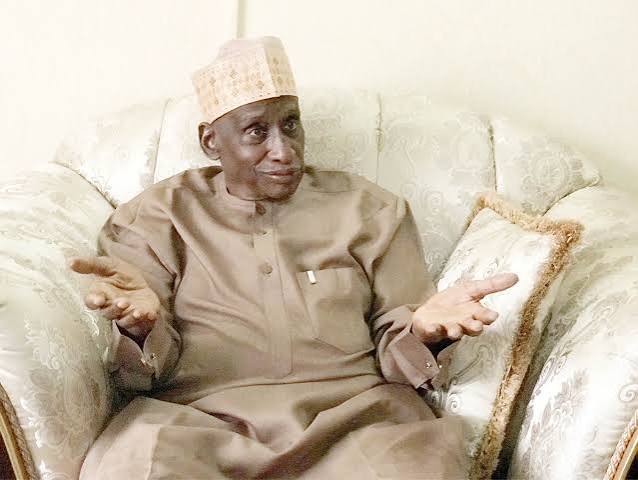
Senator Abu Ibrahim occupies a distinctive place in Nigeria’s Fourth Republic political history, having combined legislative service, opposition politics and participation in the broader struggle against military rule with a long career representing Katsina South Senatorial District.
His political career was not limited to one party or one electoral cycle. He served in the Senate during different phases of Nigeria’s democratic development, including the 2003–2007 and 2011–2019 periods, while also playing a role in the political negotiations that eventually contributed to the formation of the All Progressives Congress (APC).
From Civil Service to Politics
Before entering partisan politics, Abu Ibrahim built a career in public administration. He studied at Government College, Keffi, before graduating from Ahmadu Bello University. He subsequently joined the Kaduna State civil service and worked in the governor’s office.
His early public-service experience also exposed him to economic planning and housing administration. He obtained further qualifications in economic planning and economics and was associated with the development of the state housing corporation. In 1979, he became Director of Administration at the Federal Capital Development Authority after its offices moved from Lagos to Suleja.
That background became an important part of his later political identity: a politician whose career had roots in public administration before moving into electoral politics.
A Voice in the Democratic Struggle
One of the most significant dimensions of Abu Ibrahim’s public career predates his later Senate service.
According to a 2025 tribute by President Bola Ahmed Tinubu, Ibrahim was among politicians who opposed military rule and participated in the resistance following the annulment of the June 12, 1993 presidential election.
Tinubu recalled that Ibrahim was involved when members of the Senate reconvened in Lagos to condemn the annulment and demand an end to military rule. He also recalled that Ibrahim remained in detention rather than leaving while other colleagues remained detained. These recollections form part of the political narrative surrounding Ibrahim’s democratic activism, although they are statements attributed to Tinubu rather than an independent assessment of the historical episode.
This aspect of his career gives his political legacy a dimension beyond electoral contests and legislative office: participation in Nigeria’s prolonged transition from military rule to constitutional democracy.
Representation of Katsina South
Abu Ibrahim first won election to represent Katsina South, also known as the Funtua Senatorial District, in 2003 on the platform of the All Nigeria Peoples Party (ANPP).
He served in the Senate from May 2003 until May 2007. During that period, he became one of the political figures associated with the opposition to the then ruling People’s Democratic Party (PDP).
His first Senate tenure was followed by an unsuccessful bid for the Katsina governorship in 2007. He contested against Ibrahim Shema of the PDP, who won the election. The result recorded Shema with 1,185,489 votes and Abu Ibrahim with 218,302 votes.
Rather than ending his political career, the defeat became another stage in a political journey that eventually returned him to the National Assembly.
Return to the Senate in 2011
In the 2011 election, Abu Ibrahim returned to the Senate on the platform of the Congress for Progressive Change (CPC), the party associated with Muhammadu Buhari at the time.
He defeated PDP candidate Tukur Ahmed Jikamshi in Katsina South. Available election records put Ibrahim’s vote total at 324,652, compared with about 198,000 for Jikamshi.
His return to the Senate was significant because it coincided with a period when opposition parties were increasingly exploring cooperation against the PDP’s dominance at the federal level.
From 2011 to 2015, Ibrahim served as Deputy Minority Chief Whip of the Senate. That position placed him within the leadership structure of the opposition caucus and gave him a role in managing legislative strategy and coordination.
The Citizens’ Rights and Indigeneship Question
One of the legislative initiatives specifically associated with Abu Ibrahim was a citizens’ rights bill dealing with indigeneship.
The proposal sought to address the situation of Nigerians who had lived in a particular community for more than 20 years by providing a pathway for them to be recognised as indigenes of that community.
The issue was significant because the distinction between “indigene” and “settler” has long been a contentious aspect of Nigerian citizenship, political participation and access to opportunities. The proposal therefore connected his legislative work to a broader national question concerning equal citizenship and belonging.
Contemporary reporting cited in accounts of Ibrahim’s career described the indigeneship issue as important to national unity.
Whether viewed primarily as a legislative initiative or as part of the wider debate over citizenship rights, the proposal represents one of the clearer policy themes associated with Ibrahim’s Senate career.
A Role in the Formation of the APC
Another important component of Abu Ibrahim’s political legacy is his involvement in opposition-party negotiations.
Following the 2011 election, the CPC and other opposition forces began exploring ways of overcoming the fragmentation that had weakened opposition politics.
Ibrahim was involved in negotiations between the CPC and the Action Congress, and he served as an intermediary between Muhammadu Buhari and Bola Tinubu. Although the initial negotiations did not immediately produce a merger, similar discussions later contributed to the political realignment that preceded the 2015 elections.
The eventual emergence of the APC represented a major change in Nigeria’s party system. The party brought together political forces from the CPC, Action Congress of Nigeria and elements of the PDP, among others.
Abu Ibrahim subsequently contested the 2015 Senate election under the APC and retained the Katsina South seat.
His role in the opposition negotiations therefore forms part of the political history surrounding the transition from a PDP-dominated federal government to an APC-led federal government in 2015.
Three Electoral Returns and Long Legislative Presence
Abu Ibrahim’s political longevity is another defining feature of his career.
He represented Katsina South in the Senate from 2003 to 2007, returned in 2011 and won again in 2015 under the APC. In the 2019 election, however, he did not return to the Senate. Bello Mandiya won the Katsina South seat for the APC, succeeding him.
This means that his parliamentary career covered multiple political periods and party configurations: ANPP, CPC and eventually APC.
That continuity provides an important lens through which to examine his legacy. Rather than being associated with only one electoral cycle, Ibrahim became part of a generation of politicians whose careers extended from the early years of the Fourth Republic into the consolidation of Nigeria’s contemporary multiparty system.
Beyond Constituency Politics
The record available on Ibrahim’s career suggests that his political significance cannot be measured solely by constituency projects or individual legislative interventions.
His career touched several dimensions of Nigerian politics: public administration, opposition politics, democratic activism, legislative representation, citizenship and indigeneship debates, and opposition-party coalition building.
His participation in opposition politics was particularly important during the period preceding the 2015 political transition. His association with Buhari and involvement in negotiations with other opposition actors placed him within the network of politicians working toward a more coordinated challenge to the PDP.
The Question of Legacy
Assessing Abu Ibrahim’s legacy requires distinguishing between documented actions and political interpretations.
The documented record shows a politician who served multiple terms as senator for Katsina South, occupied a Senate opposition leadership position, introduced a proposal addressing indigeneship and citizenship, participated in opposition-party negotiations and was involved, according to a presidential tribute, in resistance to military rule.
Supporters may therefore point to political consistency, democratic activism and legislative engagement when discussing his contribution to public life. At the same time, a comprehensive assessment of his legacy would also require examining the full record of bills, motions, committee work, constituency interventions, attendance and voting records during each Senate term. The publicly available biographical sources do not provide enough evidence to make a complete quantitative assessment of all those areas.
What is clearer is that Abu Ibrahim’s career represents a political journey across several important chapters of Nigeria’s modern history—from military rule and the June 12 era, through the emergence of the Fourth Republic, opposition politics in the 2000s, the CPC era and ultimately the formation and electoral success of the APC.
A Legacy Beyond One Office
Abu Ibrahim’s legacy, therefore, is not simply that of a former senator from Katsina South.
It is the story of a politician whose career crossed different political eras and whose activities extended beyond electoral representation. His years in the Senate gave him a platform to participate in debates over citizenship and national integration, while his involvement in opposition negotiations placed him among the actors who helped shape the political realignment that produced the APC’s federal victory in 2015.
His political career also illustrates the changing nature of Nigerian opposition politics: from fragmented parties competing individually to negotiations aimed at building a broader political coalition.
For Katsina South, his repeated election to the Senate demonstrated sustained electoral relevance over different political cycles. For Nigeria’s wider political history, his association with democratic activism and opposition-party negotiations provides another chapter in the country’s continuing experiment with constitutional democracy.
Ultimately, a full historical assessment of Senator Abu Ibrahim’s tenure would need to go beyond political affiliation and examine the legislative record, constituency representation and measurable outcomes of his interventions. But the available record establishes him as a long-serving Katsina politician whose career intersected with several major turning points in Nigeria’s democratic development.