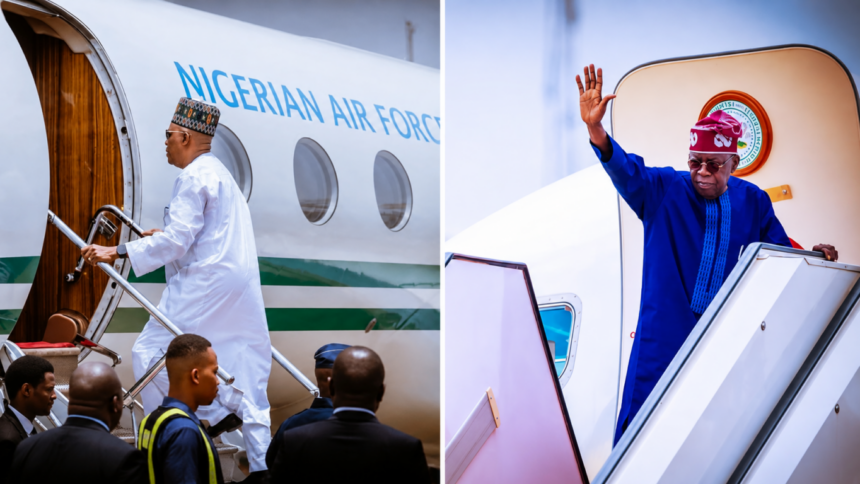
Nigeria’s political leadership has come under public scrutiny following the absence of both President Bola Ahmed Tinubu and Vice President Kashim Shettima from the country.
Vice President Shettima travelled on Saturday to attend an African Union-related engagement, while President Tinubu is also set to leave Abuja for a three-week vacation in Europe, according to a statement by the President’s Special Adviser on Information and Strategy, Bayo Onanuga.
The development has sparked questions among Nigerians about who is constitutionally responsible for the affairs of the country when both the President and Vice President are outside Nigeria.
The question is particularly significant because the Nigerian Constitution establishes the Vice President as the principal constitutional deputy to the President. However, the absence of both office holders does not automatically mean that the country is left without government.
Under Nigeria’s constitutional framework, the President can transmit a written declaration to the National Assembly when he is proceeding on vacation or otherwise unable to discharge his functions. During such a period, the Vice President may perform the functions of the President as Acting President.
However, where both the President and Vice President are simultaneously unavailable, the constitutional position becomes more complicated. The Constitution provides a clear succession arrangement in the event of a vacancy in the offices of President and Vice President, but temporary foreign travel is not necessarily the same as a vacancy.
This is why the circumstances surrounding the President and Vice President’s travel, particularly whether there has been any formal transfer of presidential powers, are important.
For a country of Nigeria’s size and complexity, the absence of the two highest-ranking elected officials also raises broader questions about governance, emergency decision-making and public confidence.
The country continues to face significant economic, security and political challenges. Decisions relating to national security, the economy, diplomatic affairs and urgent emergencies cannot be placed on hold simply because the President and Vice President are travelling.
The situation therefore goes beyond the question of where President Tinubu and Vice President Shettima are. It raises a fundamental governance question: who has the authority to act on behalf of the Nigerian state when both the President and Vice President are outside the country?
For citizens, what matters most is continuity of government.
The National Assembly, the judiciary and the executive institutions remain operational, while ministers, security agencies and other government officials continue to discharge their respective responsibilities. But the constitutional authority to exercise presidential powers is a separate matter that must be clearly established.
The development also highlights the importance of transparency in presidential transitions during temporary absences. Nigerians deserve to know whether presidential powers have formally been transmitted and, if so, to whom.
Ultimately, President Tinubu and Vice President Shettima travelling outside Nigeria does not mean that Nigeria has no government. But it does make constitutional clarity particularly important.
At a time when Nigerians are already concerned about security, the economy and preparations for the 2027 elections, uncertainty over who is exercising presidential authority could further fuel public anxiety.
The central issue, therefore, is not simply “Where are Tinubu and Shettima?”
It is: “Who is constitutionally exercising the powers of the President while they are away?”
That question deserves a clear and official answer from the Presidency and the relevant constitutional authorities.