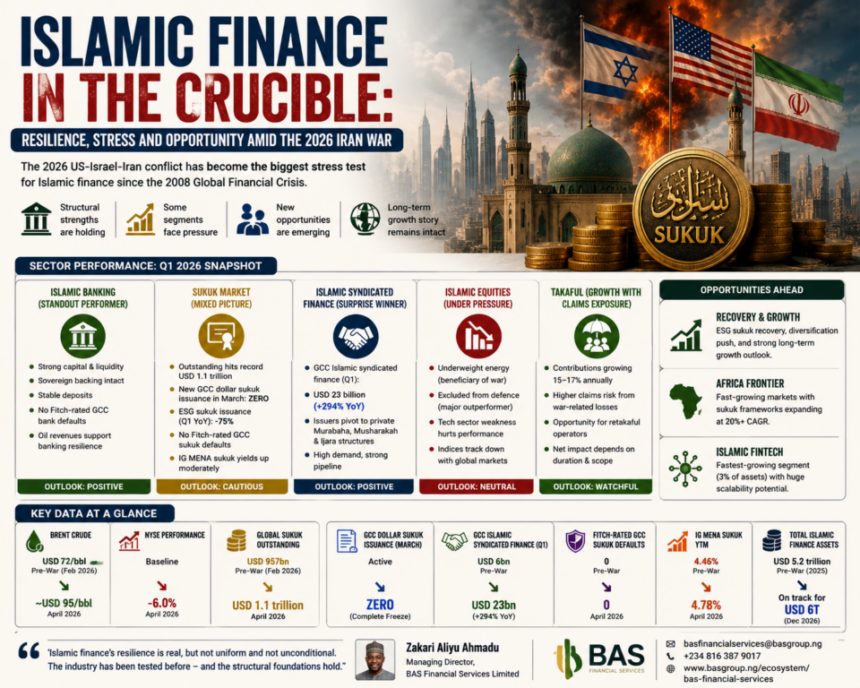
The ongoing conflict involving the United States, Israel, and Iran has created major pressure across global financial markets, forcing the Islamic finance industry into one of its biggest stress tests since the 2008 global financial crisis.
Following the launch of “Operation Epic Fury” on February 28, 2026, oil prices surged sharply, stock markets declined, and several Islamic finance sectors experienced disruption.
However, new market data shows that while some areas of the industry struggled, others demonstrated surprising resilience.
Oil Price Surge Triggers Global Market Shock
Within days of the military strikes, Brent crude oil prices jumped from $72 to nearly $95 per barrel.
At the same time, the New York Stock Exchange lost about six percent of its value, while the market for dollar-denominated Gulf Cooperation Council (GCC) sukuk temporarily froze.
The crisis immediately raised concerns among investors, policymakers, and Islamic finance practitioners over whether Shariah-compliant financial structures could withstand the geopolitical shock.
Islamic Banking Shows Strong Resilience
Despite market turbulence, Islamic banks across the Gulf region remained stable.
Analysts noted that strong capital reserves, government support, and rising oil revenues helped protect Islamic banking institutions from severe financial damage.
According to the report, average Tier 1 capital ratios among GCC Islamic banks remained around 17 percent during the crisis.
Saudi Arabia’s Islamic banking sector also maintained lending activities due to continued economic reforms under Vision 2030.
Experts say the industry’s low exposure to speculative instruments and excessive leverage contributed significantly to its resilience.
Sukuk Market Faces Major Slowdown
Although the overall global sukuk market reached a record value of $1.1 trillion, new sukuk issuance dropped sharply during the conflict.
The report revealed that GCC dollar-denominated sukuk issuance completely froze in March 2026.
Global sukuk issuance across all currencies also declined by more than 35 percent in the first quarter of the year.
Meanwhile, ESG sukuk recorded one of the steepest declines, with issuance falling by 63 percent year-on-year.
Despite the slowdown, investment-grade GCC sukuk maintained stability, with no major defaults recorded.
Islamic Syndicated Finance Emerges as Surprise Winner
One of the biggest developments during the crisis was the rapid growth in Islamic syndicated financing.
According to market data, GCC Islamic syndicated finance reached $23 billion in Q1 2026, representing a 294 percent increase compared to the previous year.
Experts explained that many governments and corporations shifted away from public sukuk markets and turned to private Islamic financing structures instead.
This trend showed that the Islamic finance industry has developed alternative funding mechanisms capable of functioning during periods of market stress.
Islamic Equity Funds Under Pressure
Unlike Islamic banking, Islamic equity markets struggled during the conflict.
Islamic equity indices reportedly underperformed because Shariah screening excludes sectors such as conventional banking and defense industries, which typically benefit during wartime economies.
Technology stocks, which dominate many Islamic equity portfolios, also recorded significant losses during the market downturn.
Analysts say this exposed a structural weakness in Islamic equity investing during geopolitical crises.
Takaful Industry Faces Mixed Outlook
The global takaful sector entered 2026 with strong growth momentum.
However, the conflict created new risks linked to property damage, cargo disruptions, and business interruptions across the Gulf region.
At the same time, geopolitical uncertainty increased demand for insurance coverage, potentially boosting contribution volumes for takaful operators.
Experts believe the sector’s future performance will largely depend on how long the conflict continues.
Industry Still Positioned for Long-Term Growth
Despite short-term disruptions, analysts say the long-term outlook for Islamic finance remains positive.
Global Islamic finance assets currently stand at about $5.2 trillion and are projected to reach $6 trillion before the end of 2026.
Growth drivers include expanding Muslim populations, rising demand for ethical finance, and increasing adoption of Islamic finance across Africa and Asia.
The report also highlighted emerging opportunities in African sukuk markets, Islamic fintech, and ESG-linked Islamic investments.
Experts Highlight Key Lessons
The report concluded that Islamic finance has once again demonstrated resilience during a major global crisis.
However, experts warned that resilience varies across sectors.
While Islamic banking and sovereign sukuk remained relatively stable, equity markets and new sukuk issuance suffered significant pressure.
Still, analysts believe the industry’s core principles, including asset-backed financing, profit-sharing, and restrictions on speculation, continue to provide important protections during periods of uncertainty.