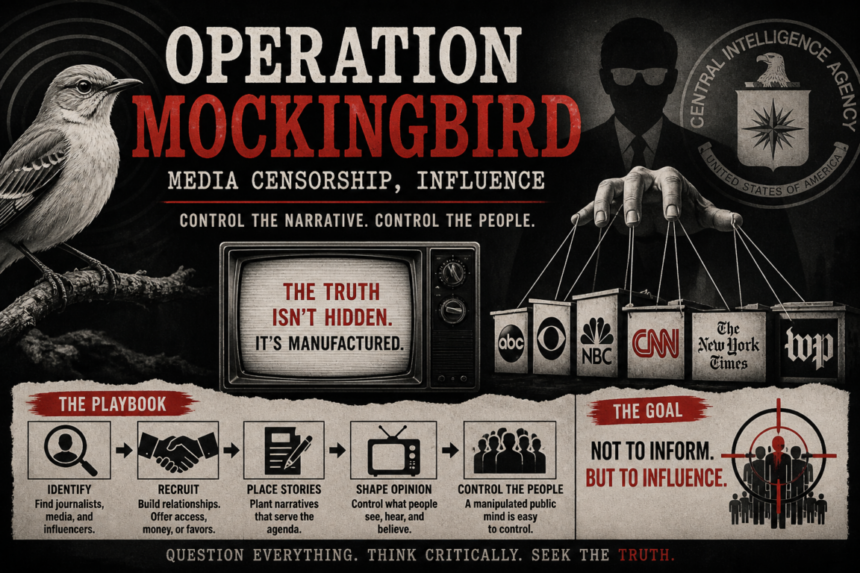
The name “Operation Mockingbird” often comes up in debates about media control, propaganda, and government influence. But what exactly was it and what do we actually know?
Operation Mockingbird is widely described as a Cold War era effort linked to the **Central Intelligence Agency**.
During this period, the United States and the Soviet Union were engaged in an intense battle for global influence—not just through military power, but also through information.
The goal was simple: shape narratives, counter communist propaganda, and influence public opinion at home and abroad.
What Did It Involve?
Declassified reports and congressional investigations in the 1970s confirmed that the CIA had relationships with journalists, editors, and media organizations.
Through these connections, the agency could:
- Share information or talking points
- Influence how certain events were reporte
- Support publications aligned with U.S. foreign policy
This didn’t mean total control of the media—but it did show that intelligence agencies saw journalism as a strategic tool.
The Church Committee Findings
The issue gained public attention during investigations by the Church Committee in 1975.
The committee found that the CIA had worked with dozens of journalists and maintained ties with major media outlets, especially overseas.
However, it did not confirm claims that the CIA controlled all global media or had operatives in every newsroom.
Myths vs Reality
Over time, Operation Mockingbird has become the subject of widespread speculation.
What is supported by evidence:
- The CIA engaged with journalists during the Cold War
- Media was used as part of information warfare
- Influence, not ownership was the primary goal
What is not supported by credible evidence:
- That the CIA controls all media globally
- That every news story is directed by intelligence agencies
- That such a program operates today at the same scale
Why It Still Matters Today
Even though Operation Mockingbird belongs largely to history, the concerns it raised remain relevant.
Questions about media independence, government influence, and misinformation continue to shape public trust, especially in the digital age.
Today, influence is more likely to come through:
- Social media campaigns
- State-backed information operations
- Strategic communication by governments
The Bottom Line
Operation Mockingbird highlights a key reality of modern geopolitics:
Information has always been a tool of power.
But while governments may attempt to influence narratives, the idea of total, centralized control of the media is far more myth than fact.
Understanding that distinction is critical—especially in an era where misinformation spreads faster than ever.