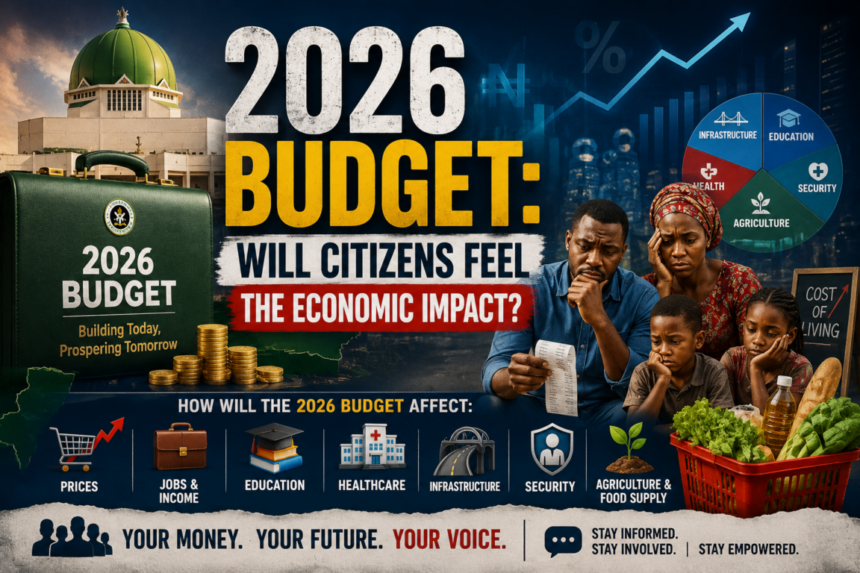
Nigeria’s 2026 budget has officially moved from proposal to implementation after President Bola Tinubu signed the ₦68.32 trillion appropriation bill into law on April 17, 2026.
However, the launch of the new budget has also raised major questions about government spending, debt sustainability, and project execution.
This is because the Federal Government simultaneously extended the capital component of the 2025 budget to June 30, 2026, indicating that several projects under the previous budget remain unfinished.
As a result, many Nigerians are now asking whether the country can effectively deliver a much larger budget while still struggling to complete parts of the old one.
Breakdown Of Nigeria’s 2026 Budget
The 2026 budget is Nigeria’s biggest spending plan ever.
Out of the ₦68.32 trillion total expenditure:
- ₦32.2 trillion is allocated to capital projects
- ₦15.8 trillion is earmarked for debt servicing
- ₦15.4 trillion goes to recurrent expenditure
- ₦4.799 trillion is set aside for statutory transfers
Despite the massive spending plan, projected government revenue stands at only about ₦36.87 trillion.
This leaves a financing gap of more than ₦31 trillion, which the government plans to cover largely through borrowing.
Reports also indicate that Nigeria’s revised borrowing plan is estimated at roughly ₦29.2 trillion.
Rising Concerns Over Debt Burden
The large borrowing requirement has triggered concerns among economists and financial analysts.
Many experts warn that although borrowing can support development, rising debt obligations could place additional pressure on public finances.
In particular, the allocation of ₦15.8 trillion for debt servicing has attracted attention because it is almost equal to the amount budgeted for recurrent spending.
Analysts say this means a significant portion of government revenue may continue going toward settling existing debts instead of funding public services and infrastructure.
Nigerians Want Visible Improvements
For many citizens, the debate is no longer about budget figures alone.
Instead, Nigerians want to know whether the spending plan will improve daily life.
Citizens are asking important questions:
- Will roads become better?
- Will electricity supply improve?
- Will hospitals and schools receive adequate funding?
- Will food prices reduce?
- Will small businesses experience relief?
These concerns remain critical as inflation and rising living costs continue to affect households across the country.
Although government officials insist the budget is designed to stimulate economic growth and improve infrastructure, many Nigerians say the true test will be visible implementation.
Extension Of 2025 Budget Raises Questions
The extension of the 2025 capital budget has also intensified public scrutiny.
Nigeria’s 2025 budget, valued at ₦54.99 trillion, already included major allocations for infrastructure and development projects.
However, the decision to extend part of that budget suggests that several projects were delayed or not completed within the original timeline.
Consequently, many observers are questioning whether the government has the implementation capacity required for an even bigger 2026 budget.
Experts argue that Nigerians are justified in demanding clearer updates on unfinished projects and timelines for completion.
Inflation And Economic Pressure Persist
Economic realities have further shaped public reactions to the budget.
Headline inflation rose to 15.38 percent in March 2026 after months of decline.
At the same time, food prices, transport costs, rent, and energy expenses continue to place pressure on millions of Nigerians.
As a result, citizens increasingly want budget implementation to translate into practical economic relief rather than remaining a policy discussion in Abuja.
Budget Seen As Test Of Credibility
Many analysts now describe the 2026 budget as both a financial and political test.
According to experts, the success of the budget will depend heavily on transparency, accountability, and project execution.
They argue that Nigerians are less interested in large budget figures and more concerned about whether public spending will produce visible development outcomes.
Observers say effective implementation in areas such as infrastructure, healthcare, education, power supply, agriculture, and security could strengthen public confidence in government policies.
Will Nigerians Feel The Difference?
Ultimately, the success of Nigeria’s 2026 budget will not be measured by its size alone.
Instead, it will be judged by whether ordinary citizens experience meaningful improvements in their everyday lives.
If roads improve, businesses grow, electricity becomes more stable, and economic hardship eases, many Nigerians may view the budget as successful.
However, if borrowing increases while living conditions remain difficult and projects remain uncompleted, public skepticism is likely to grow even further.
For now, attention remains focused on implementation and whether the government can transform ambitious spending plans into measurable national progress.