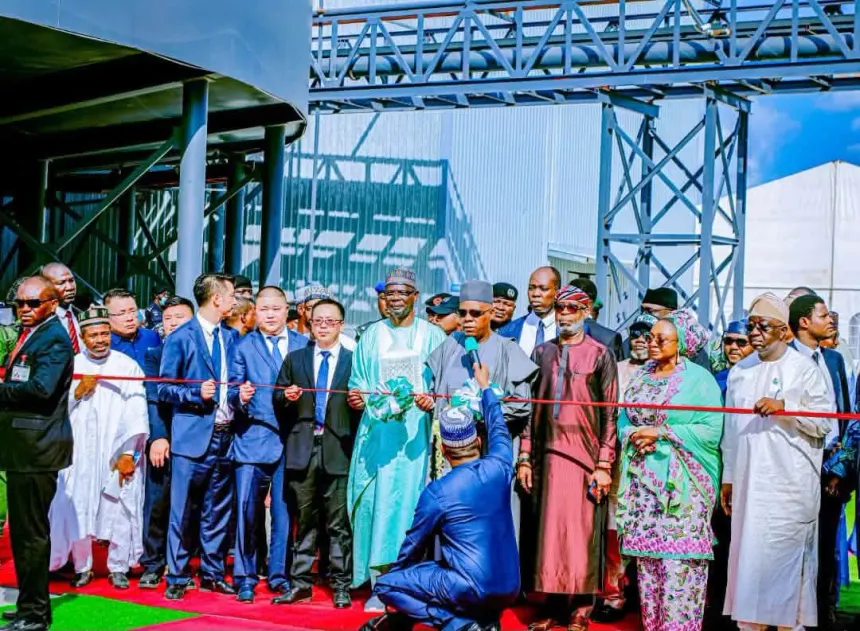
Nigeria has taken a major step toward becoming a leading player in the global critical minerals market after commissioning what the Federal Government describes as West Africa’s largest lithium processing plant in Nasarawa State.
President Bola Ahmed Tinubu, represented by Vice President Kashim Shettima, inaugurated the facility in Endo, Nasarawa Local Government Area, saying the project signals the country’s determination to move beyond exporting raw minerals and embrace local processing, industrialization and value addition.
With a processing capacity of 6,000 metric tonnes of lithium per day, equivalent to three million metric tonnes annually, the facility is expected to play a significant role in Nigeria’s efforts to build a competitive mining industry and strengthen its position in the global battery minerals supply chain.
The plant was developed by Diamond New Energy in collaboration with Chinese partners Jiuling and Canmax, with the project also expected to generate thousands of direct and indirect jobs while attracting additional investment into Nigeria’s solid minerals sector.
Why Lithium Matters
Lithium has become one of the world’s most valuable critical minerals because it is an essential component in rechargeable batteries that power electric vehicles, renewable energy storage systems, smartphones, laptops and other consumer electronics.
As governments and manufacturers accelerate the transition to clean energy, global demand for lithium continues to surge, making countries with processing capacity increasingly important to international supply chains.
Rather than exporting raw lithium ore, Nigeria’s new processing facility enables the country to retain more value domestically by refining the mineral before export. The approach supports industrial growth, creates skilled jobs and encourages technology transfer while reducing dependence on raw commodity exports.
Boosting Nigeria’s Mining Industry
Speaking during the commissioning, Tinubu, represented by the VP said natural resources alone do not guarantee economic prosperity, stressing that sustainable growth comes from transforming mineral wealth into productive industries.
He described the lithium processing plant as more than a mining project, saying it represents confidence in Nigeria’s economy and the Federal Government’s reforms aimed at expanding local manufacturing and increasing value addition across the solid minerals sector.
The administration has consistently maintained that mining should become a key pillar of economic diversification, reducing dependence on oil revenues while creating new opportunities for investment and employment.
Positioning Nigeria as a Critical Minerals Hub
The commissioning strengthens Nigeria’s ambition to become a regional hub for critical minerals at a time when competition for battery materials is intensifying worldwide.
Industry experts believe investments in lithium processing could pave the way for future battery manufacturing, electric vehicle components, renewable energy technologies and other downstream industries that rely on processed lithium.
The project also reinforces investor confidence in Nigeria’s mining reforms and highlights the country’s growing role in supplying minerals needed for the global energy transition.
Part of Africa’s Industrial Shift
Nigeria’s latest investment reflects a wider trend across Africa, where mineral-rich countries are increasingly encouraging local processing instead of exporting unprocessed resources.
By moving further up the manufacturing value chain, African governments hope to capture greater economic value, create more skilled employment and build resilient industrial economies capable of competing in global markets.
With one of the largest lithium processing facilities in the region now operational, Nigeria has positioned itself to play a more prominent role in the future of clean energy manufacturing and the global critical minerals industry.