
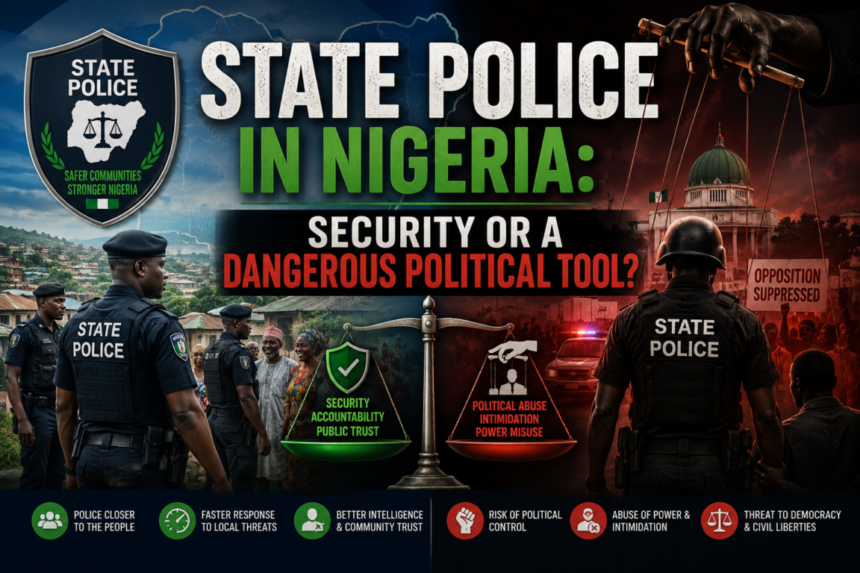
Nigeria’s long-running debate over the creation of state police reached a historic milestone in June 2026 when the National Assembly approved constitutional amendments paving the way for states to establish and operate their own police forces alongside the Nigeria Police Force. The move, widely regarded as one of the most significant security reforms since the return to democracy in 1999, comes amid worsening insecurity across the country, including terrorism, banditry, kidnapping, communal clashes, farmer-herder conflicts, and separatist violence.
For decades, policing in Nigeria has been controlled exclusively by the Federal Government through the Nigeria Police Force. Under Section 214 of the 1999 Constitution, states were prohibited from operating independent police services. However, persistent security challenges and growing criticism of the centralized policing system intensified calls for reform. Governors, traditional rulers, security experts, and civil society groups repeatedly argued that a single police structure could not effectively respond to the country’s diverse and localized security threats.
The push gained momentum under President Bola Tinubu’s administration. In early 2026, the Presidency confirmed that consultations involving the Executive, National Assembly, and security agencies were underway to create a framework for state policing. On June 11, 2026, lawmakers overwhelmingly voted in favour of constitutional amendments establishing state police, marking a major step toward decentralizing Nigeria’s security architecture. The amendment still requires ratification by at least two-thirds of the 36 State Houses of Assembly before it becomes fully operational.
Supporters of state police believe the reform could transform security at the grassroots level. They argue that officers recruited from local communities will possess better knowledge of the terrain, language, culture, and criminal networks operating within their states. Proponents also contend that governors, who are often blamed by citizens whenever insecurity escalates, should have direct control over security personnel in their states rather than relying on directives from Abuja. Faster emergency responses, improved intelligence gathering, and greater accountability are among the expected benefits.
Nigeria Already Has Grassroots Security Networks
One of the strongest arguments in favour of state police is that Nigeria is not starting from scratch. Across the country, various community-based and regional security outfits have emerged over the years to fill the gaps left by the overstretched federal police system.
In the South-West, the Western Nigeria Security Network, popularly known as Amotekun, was established by the six South-West governors in 2020 to tackle kidnapping, armed robbery, and banditry. The outfit has since become one of the most organized regional security networks in the country, working alongside the police and other security agencies.
In the North-East, the Civilian Joint Task Force (CJTF) gained prominence during the Boko Haram insurgency. Made up largely of local volunteers familiar with their communities, the CJTF provided intelligence and operational support to the military in identifying insurgents and securing vulnerable communities.
Northern states also operate various community policing structures, including the Hisbah Corps in Kano and other states operating under Sharia law. Although primarily responsible for moral and social order enforcement, the corps has increasingly become involved in maintaining public peace and assisting security agencies.
The South-East has experimented with Ebube Agu, a regional security outfit established by governors in the zone to combat rising insecurity, armed attacks, and criminal activities. While its operations have attracted both praise and criticism, it represents another example of states seeking localized solutions to security challenges.
Across the North-Central region and many rural communities nationwide, the Vigilante Group of Nigeria (VGN), hunters’ associations, forest guards, and community watch groups continue to play vital roles in intelligence gathering and crime prevention.
The existence of these groups raises an important question: if Nigeria already relies heavily on localized security structures, should these outfits remain loosely regulated vigilante organizations, or should they evolve into constitutionally recognized state police services with professional training, funding, and oversight? For many advocates, state police is simply the formalization of a reality that already exists on the ground.
Yet, despite the optimism, many Nigerians remain deeply concerned about the potential consequences of state police. Critics warn that governors could weaponize state-controlled police forces against political opponents, journalists, activists, and opposition parties. Nigeria’s political history is filled with allegations of abuse of power by state governments, and opponents fear that creating state police could institutionalize political intimidation at the subnational level.
The concern is not entirely unfounded. Some governors already wield significant influence over local vigilante groups, political structures, and security networks operating within their states. Granting them formal control of armed police personnel could create opportunities for abuse, particularly during election periods. Critics fear that state police could become what many Nigerians describe as “political thugs in uniform” a tool used to silence dissent, intimidate opponents, and manipulate electoral processes.
Those concerns have become one of the most discussed aspects of the state police debate. Across social media, radio programmes, and public forums, many Nigerians support the idea of taking security closer to the grassroots but remain wary of the country’s political culture. They argue that without strong safeguards, state police could strengthen the hands of governors at the expense of democracy and civil liberties.
Funding presents another challenge. While economically stronger states such as Lagos, Rivers, Akwa Ibom, and Ogun may be able to finance modern and effective police services, many states currently struggle to pay salaries and pensions. Critics question how such states would recruit, train, equip, and sustain professional police forces without compromising standards.
There are also concerns about recruitment and professionalism. Will state police officers be selected based on merit, competence, and training, or will political loyalty become the primary qualification? Without transparent recruitment systems, there are fears that state police forces could become extensions of state political establishments.
Another unresolved issue is oversight. Who will monitor state police operations? What independent institutions will investigate allegations of misconduct? How will conflicts between federal and state police be resolved? What happens when a governor and the Federal Government disagree on security matters? These questions remain central to discussions surrounding the implementation framework.
For many Nigerians, the state police debate reflects a broader struggle between efficiency and accountability. On one hand, decentralizing security may bring policing closer to the people and improve responses to local threats. On the other hand, without strong constitutional safeguards, independent oversight bodies, and strict operational guidelines, the reform could simply decentralize abuse and political interference.
Ultimately, state police is neither a magic solution to Nigeria’s security crisis nor an automatic threat to democracy. Its success will depend largely on the legal safeguards put in place, the professionalism of officers recruited into the system, the quality of leadership at the state level, and the willingness of institutions to enforce accountability.
As Nigeria moves closer to implementing one of its most ambitious security reforms since 1999, the challenge will be ensuring that state police become instruments of public safety rather than tools of political control. Whether this historic reform strengthens Nigeria’s democracy or creates new avenues for abuse will depend not on the concept itself, but on how it is implemented.