
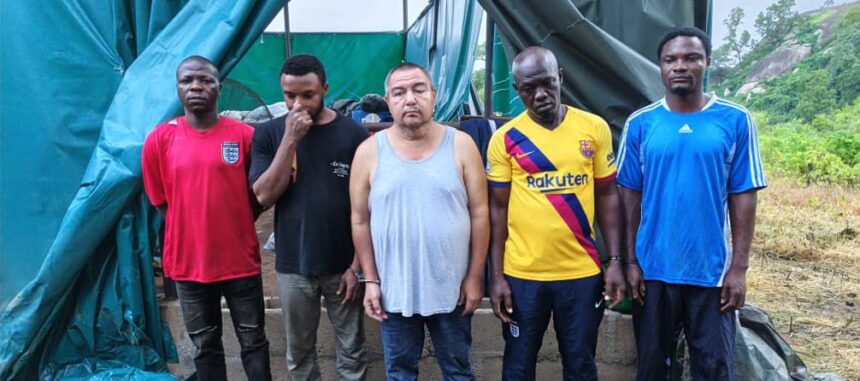
Nigeria’s fight against synthetic drug production entered a critical phase last week after operatives of the National Drug Law Enforcement Agency dismantled a multi-billion-naira methamphetamine laboratory hidden deep inside a forest in Oyo State, exposing what authorities describe as an expanding network of transnational drug syndicates operating within the country.
The operation, carried out on June 17 in Tapa Village, Ibarapa North Local Government Area, led to the arrest of five suspects, including a Mexican national believed to be a specialist in methamphetamine production. Four Nigerian accomplices were also apprehended during the raid.
The latest discovery marks the second industrial-scale methamphetamine laboratory uncovered by the NDLEA within a month, raising fresh concerns that international drug cartels may be attempting to establish Nigeria as a major manufacturing base for synthetic narcotics in West Africa.
Speaking on the development, NDLEA Chairman and Chief Executive Officer, Brig.-Gen. Mohamed Buba Marwa (retd.), described the operation as a significant breakthrough in the agency’s campaign against organized drug trafficking networks.
According to Marwa, intelligence gathered by the agency revealed that the facility was not a conventional drug hideout but a sophisticated production centre equipped with industrial-grade machinery and large quantities of chemical precursors used in the manufacture of methamphetamine.
Among those arrested was 56-year-old Mexican national Jose Villa Ochoa, who investigators believe was brought into Nigeria to provide technical expertise for the operation. The other suspects were identified as Maxwell Nevoh, Olatunji Yusuf, Bankole Owolabi, and Ganiu Monsiu.
NDLEA operatives recovered substantial quantities of chemicals and equipment during the raid, including phenyl-2-propanone (P2P), phenylacetic acid, sulphuric acid, caustic soda, and tartaric acid. Officers also seized industrial mixers, reactor vessels, condensers, distillation units, and drying machines used in the production process.
Forensic examinations later confirmed the presence of methamphetamine at the site.
The discovery has intensified concerns among security experts who warn that Nigeria is gradually shifting from being a transit route for illicit drugs to becoming a production centre for synthetic narcotics destined for regional and international markets.
The involvement of foreign nationals, particularly individuals linked to Mexican drug networks, has further heightened fears about the growing sophistication of criminal organizations operating within the country. Analysts say such syndicates often exploit weak border controls, porous rural communities, and economic vulnerabilities to establish clandestine manufacturing facilities.
The Oyo laboratory was uncovered barely four weeks after NDLEA dismantled what was then described as the country’s largest methamphetamine production facility in Ogun State. That operation resulted in the seizure of more than two tonnes of illicit substances and the arrest of several suspects, including foreign nationals.
Security observers say the back-to-back discoveries suggest a deliberate attempt by organized drug networks to expand synthetic drug production across southwestern Nigeria.
Beyond the criminal implications, experts warn that the proliferation of methamphetamine laboratories poses significant environmental and public health risks. The chemicals used in production can contaminate water sources, damage farmlands, and expose nearby communities to toxic emissions.
For the NDLEA, the latest operation represents both a major success and a warning sign. While authorities have disrupted another sophisticated drug manufacturing network, the emergence of multiple industrial-scale laboratories within a short period underscores the scale of the challenge ahead.
As investigations continue, law enforcement agencies are expected to widen their search for financiers, collaborators, and international connections behind the operation. For many observers, the question is no longer whether international drug syndicates are active in Nigeria, but how deeply they have embedded themselves within the country’s security and economic landscape.