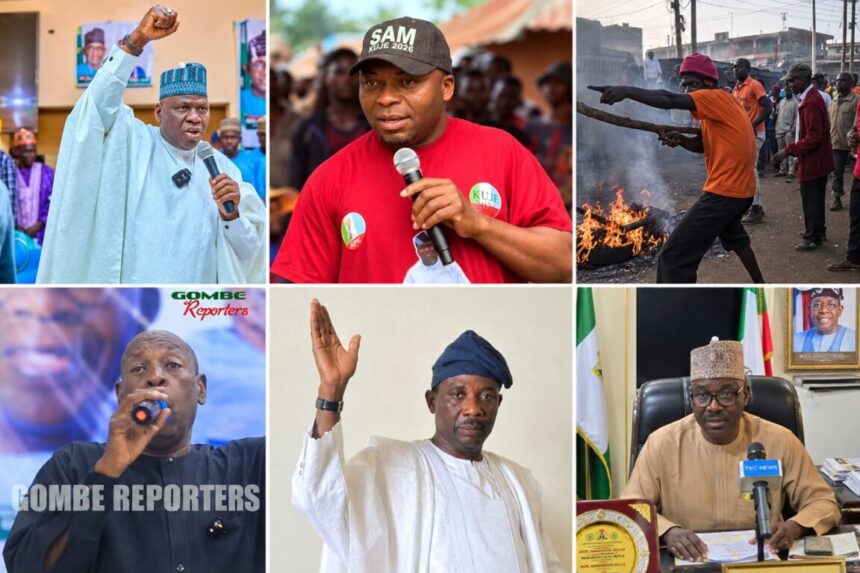
Political tension appears to be rising in different parts of Nigeria as political actors intensify mobilisation ahead of the 2027 general elections, with a series of controversial statements involving threats, intimidation and pressure on voters generating public concern.
The latest incidents involve politicians and political party officials making remarks critics have interpreted as inflammatory, raising questions about the tone of political competition and the protection of citizens’ right to choose their preferred candidates freely.
One of the most controversial episodes involved Senator Francis Fadahunsi, representing Osun East Senatorial District, whose remarks during political activities in Osun were widely circulated on social media.
The senator was accused of calling on supporters to “kill” members of the opposition Accord Party if they encountered them.
The Osun State Police Command subsequently invited Fadahunsi over the alleged remarks, describing the viral video as a matter of concern amid heightened political activity.
However, Fadahunsi later denied intending to encourage physical violence. His media office explained that his reference to “killing” Accord meant defeating the party through votes and described the statement as metaphorical and political.
The controversy nonetheless renewed debate over the language used by political actors during election campaigns, particularly when expressions that could be interpreted as threats are directed at opposition supporters.

Borno Controversy Over Alleged Threat Against Voters
Another allegation circulating in the political space concerns a statement attributed to a commissioner in Borno State, who was reportedly heard warning voters that their fingers could be cut if they failed to vote for the All Progressives Congress.
The alleged remark has been cited in discussions about the increasing use of intimidation in political mobilisation.
Such rhetoric, if accurately reported, raises questions about the extent to which voters are able to exercise their constitutional right to vote freely without fear of retaliation.
Political competition in a democracy is expected to allow citizens to support or reject candidates without being subjected to threats or coercion.
‘Vote APC or Leave Kuje’
The controversy extended to the Federal Capital Territory, where Kuje Area Council Chairman Samuel Danjuma Shekwolo was reported to have warned residents who would not support the APC to leave the council.
The statement generated criticism, particularly because residence and access to public space are not supposed to be determined by political affiliation.
Reports said Shekwolo subsequently sought to clarify or withdraw the position, but the controversy continued to generate debate about the relationship between political officeholders and citizens who support opposing parties. (PM News Nigeria)
The issue also attracted criticism from rights advocates, who argued that linking continued residence in an area to support for a political party could undermine freedom of political association. (Champion News)
The incident has therefore raised a broader question about whether elected officials and political leaders understand that their responsibilities extend to citizens regardless of their political affiliation.

Yobe APC Chairman’s Controversial Remark
In Yobe State, APC Chairman Muhammad Gadaka also generated controversy after reportedly urging married women whose husbands prevented them from voting for the APC to seek divorce.
He was further reported to have offered to pay the dowry of women who left their marriages for that reason and marry them.
The statement triggered reactions across social media and the wider political space. (Punch Newspapers)
Gadaka subsequently withdrew the statement and apologised, saying the remark was intended as a joke and was not meant to encourage married women to divorce their husbands. (Vanguard News)
The episode nevertheless highlighted another dimension of political mobilisation: the extent to which party loyalty can enter private and family relationships.
Political Warnings in Gombe
Gombe State has also witnessed heightened political discussions ahead of 2027, particularly around the future of Governor Muhammadu Inuwa Yahaya and the state’s political leadership.
Political figures and supporters have continued to debate the possible consequences of changes in political leadership as the next election approaches.
Statements attributed to political actors in Gombe warning of possible consequences if the incumbent administration loses power have contributed to an increasingly competitive political atmosphere.
For many observers, the central issue is whether such statements constitute ordinary political persuasion or whether they contribute to a politics based on fear, uncertainty and the perceived consequences of electoral change.
Peter Obi Raises Concern Over 2027
Former Labour Party presidential candidate Peter Obi has also raised concerns about his ability to participate in the 2027 presidential election.
Obi has publicly expressed fears that he may not be alive to contest the election, while alleging that opposition figures and his political activities are being subjected to increasing pressure. (IkengaOnline.com)
His comments have added another layer to the debate over the political environment ahead of 2027.
The former Anambra governor has also been involved in controversy surrounding political movements in Benue, with reports circulating that he faced restrictions or blockades while attempting to enter the state for a political engagement. (Facebook)
Such developments have intensified debate over whether political actors across the country will be able to campaign freely and whether opposition candidates will have equal access to voters as the election approaches.
Growing Concern Over Political Rhetoric
Taken together, the various incidents point to a broader concern about the tone of Nigerian politics ahead of the 2027 elections.
Political disagreements are normal in a democracy. However, when political competition involves language associated with violence, threats against voters, pressure to support a particular party or attempts to restrict political opponents, concerns about electoral freedom naturally arise.
The challenge is particularly significant in a country with a history of election-related violence.
Threatening language can have consequences beyond the individuals who make the statements. It can discourage voters from participating, deepen political divisions and create an atmosphere in which supporters of opposing parties perceive one another as enemies rather than fellow citizens.
It can also place additional pressure on security agencies, electoral authorities, civil society organisations and the media to monitor political activities and prevent rhetoric from escalating into physical violence.
Right to Vote Freely
At the heart of the controversy is the principle that every Nigerian voter should be able to make an electoral choice without intimidation.
A voter may support the APC, PDP, Labour Party, ADC, SDP or any other political organisation—or choose not to support any party at all.
The freedom to make that decision is fundamental to democratic participation.
Political parties therefore face an important responsibility as the 2027 elections approach. Beyond mobilising supporters and winning votes, they must also ensure that their members and candidates understand the consequences of inflammatory statements.
Party leadership, electoral institutions, security agencies and civil society organisations will all have roles to play in discouraging political violence and protecting voters.
The Role of Political Leaders
Political leaders also have an opportunity to change the tone of the 2027 campaign.
Instead of threatening opponents or voters, political parties can compete through policies, programmes, records in office and clear proposals for addressing Nigeria’s economic, security and social challenges.
The electorate should be allowed to judge political parties based on their performance and promises.
The controversies surrounding Fadahunsi, the Kuje council chairman, the Yobe APC chairman and other political actors demonstrate how quickly political statements can become national issues, particularly when they involve violence, coercion or restrictions on political choice.
In Fadahunsi’s case, his subsequent explanation that “kill Accord” meant defeating the party through votes illustrates the importance of precision in political communication. (Punch Newspapers)
Similarly, Gadaka’s subsequent apology demonstrates how controversial political remarks can generate significant public backlash even when their authors later describe them as jokes. (Vanguard News)
2027 and the Politics of Fear
With the 2027 general elections still ahead, political parties have considerable time to shape the character of the campaign.
The question is whether politicians will use that period to build political competition around ideas and accountability or whether increasingly aggressive rhetoric will become a defining feature of the electoral season.
For voters, the expectation remains straightforward: the right to vote should not depend on political affiliation, gender, ethnicity, religion, geography or personal relationships.
The 2027 elections will ultimately test not only the popularity of individual candidates and parties but also the resilience of Nigeria’s democratic institutions.
As political mobilisation intensifies, the ability of politicians to disagree without resorting to intimidation or inflammatory language will remain an important part of the country’s democratic conversation.
The central question is therefore no longer simply who will win in 2027, but what kind of political environment Nigerians will experience before they cast their votes.