
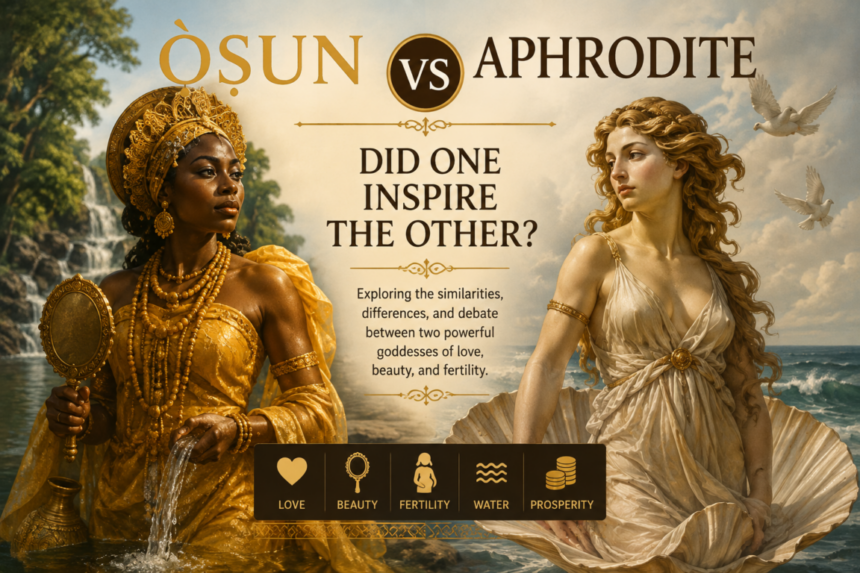
When people think about the world’s most famous goddesses of love and beauty, two names often come to mind: Ọ̀ṣun of the Yoruba tradition and Aphrodite of ancient Greece. Both represent beauty, femininity, fertility, and love. Both have inspired art, literature, festivals, and generations of admirers.
Their similarities raise an intriguing question: Did one inspire the other, or did two distant civilizations create remarkably similar goddesses on their own?
The answer is more complex than many people expect.
The Story of Ọ̀ṣun
Ọ̀ṣun ranks among the most revered Òrìṣà in the Yoruba religious tradition. She rules over rivers, fertility, prosperity, beauty, healing, diplomacy, and love. The Osun River in present day Osun State, Nigeria, serves as her sacred home.
Every year, thousands of worshippers and visitors gather for the Osun-Osogbo Festival to celebrate her through prayers, music, dance, and sacred rituals. For millions of people across Nigeria and the African diaspora, Ọ̀ṣun remains part of a living spiritual tradition rather than a figure from history.
The Story of Aphrodite
Ancient Greek mythology celebrates Aphrodite as the goddess of love, beauty, desire, passion, and pleasure. One tradition says she emerged from sea foam near Cyprus after the birth of the gods. Another tradition describes her as the daughter of Zeus and Dione.
Her stories shaped Greek literature, influenced Roman culture, and introduced the Roman goddess Venus, who shares many of her qualities. Today, people know Aphrodite mainly through mythology, classical art, and ancient writings.
Why Do They Seem So Similar?
At first glance, the similarities stand out. Both goddesses symbolize beauty, romance, fertility, and feminine power. Artists have portrayed both as graceful and elegant figures. Water also connects their stories, although each tradition uses it differently.
Aphrodite’s story begins with the sea, while Ọ̀ṣun draws her identity from fresh rivers that sustain communities and represent life, healing, and abundance.
The Differences Matter
Despite their similarities, the two figures serve different roles.
Ọ̀ṣun influences love, prosperity, motherhood, healing, diplomacy, and the well being of communities. Her followers continue to honor her through worship and annual festivals.
Aphrodite mainly represents romantic love, beauty, attraction, and desire within Greek mythology. Her stories continue to influence literature, art, and popular culture around the world.
Did One Inspire the Other?
This question often appears in online discussions. Some people argue that Aphrodite came from Ọ̀ṣun, while others claim the opposite.
However, historians, archaeologists, and scholars have not found credible evidence to support either claim.
Ancient Greece developed within the Mediterranean world, while the Yoruba civilization flourished in West Africa with its own rich religious traditions. Although trade connected parts of Africa and the Mediterranean over many centuries, no historical record shows that one civilization copied the other’s goddess of love.
Why Do Different Cultures Create Similar Goddesses?
Many scholars offer a different explanation. Human societies often create deities to explain universal experiences such as love, beauty, fertility, motherhood, rivers, and the forces of nature.
People across the world share many of the same hopes, fears, and dreams. As a result, different civilizations can develop remarkably similar beliefs without direct contact.
A Mystery That Still Inspires Debate
The comparison between Ọ̀ṣun and Aphrodite continues to fascinate historians, cultural scholars, and mythology enthusiasts.
Instead of asking which goddess is “real” or who copied whom, a more meaningful question asks why cultures separated by great distances imagined divine figures with such similar qualities.
Whether people approach the topic through history, religion, mythology, or culture, both Ọ̀ṣun and Aphrodite continue to inspire curiosity. Their stories remind us that humanity has always searched for love, beauty, hope, and meaning, even when civilizations developed thousands of miles apart.