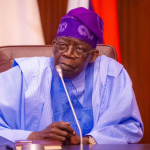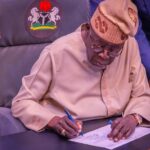

President Bola Ahmed Tinubu has outlined his administration’s economic priorities and described Nigeria as having moved from a period of difficult reforms into what he called an “age of prosperity.”
Tinubu made the remarks on Thursday, October 1, 2026, in his Independence Day address to Nigerians as the country marked its 66th anniversary.
The President acknowledged that millions of Nigerians are still facing economic hardship but maintained that the government’s reforms have placed the country on a new economic path.
Here are seven major takeaways from the President’s address:
1. Nigeria’s Economic Outlook Has Improved
Tinubu said Nigeria’s economy grew by more than four per cent in 2026, with both the oil and non-oil sectors contributing to the growth.
He also said oil theft had declined, inflation had fallen substantially from its peak, foreign reserves had been rebuilt and the foreign exchange market had stabilised.
According to the President, Nigeria also recorded more than $6 billion in non-oil export revenue in 2025, which he described as the highest in the country’s history.
2. Tinubu Defended His Economic Reforms
The President strongly defended the economic reforms introduced by his administration, including the removal of the petrol subsidy and changes to the foreign exchange system.
Using a medical analogy, Tinubu compared Nigeria’s pre-reform economy to a patient suffering from cancer who needed difficult treatment.
He argued that the reforms did not create Nigeria’s economic weaknesses but were introduced to confront them.
He also rejected calls to return to what he described as “addictive subsidies,” saying Nigerians should remember why the reforms were introduced in the first place.
3. Government’s Focus Is Shifting to Prosperity
Tinubu said the government had reached a turning point, with the “emergency treatment” of the economy now over.
According to him, the central economic task has shifted from correcting Nigeria’s economic direction to achieving “shared and widespread prosperity.”
He said prosperity should mean more than economic statistics, stressing that Nigerians should experience better living conditions, affordable food and transportation, productive employment and improved access to education and other services.
4. Lowering the Cost of Living Remains a Priority
The President said his administration would focus on reducing the cost of producing and transporting goods.
He highlighted mechanised farming, irrigation, improved access to seeds and fertiliser, storage facilities and transportation infrastructure as part of the government’s strategy.
Tinubu said improving roads, railways and ports would help connect farms and factories to markets and ultimately reduce costs for consumers.
5. Jobs and Youth Enterprise
Tinubu also placed job creation and youth enterprise at the centre of his administration’s next phase.
He said the government would use Nigeria’s gas resources to support industrialisation, expand digital connectivity, develop relevant skills and provide Nigerian businesses with infrastructure and financing.
The President said Nigeria’s young population should become an engine of production rather than a source of despair.
6. More Support for Vulnerable Nigerians
Acknowledging that many Nigerians continue to struggle with food, school fees, medical bills and transportation costs, Tinubu said the government would strengthen support for vulnerable households.
He mentioned efforts to improve the National Social Register, expand the Nigerian Education Loan Fund and provide access to consumer credit through CREDICORP.
He also said the Federal Government would continue working with state and local governments to strengthen primary healthcare, basic education and other essential public services.
7. Tinubu Says Nigeria Has “Corrected Its Course”
In the closing part of his address, Tinubu expressed optimism about Nigeria’s future.
He said the country had “corrected its course” and described Nigeria as having passed through its own “Red Sea.”
The President urged Nigerians to look forward rather than backward, saying the country’s destination was within sight and that the foundations for future prosperity had been laid.
He described the Nigeria ahead as a country of “abundance and opportunity,” where prosperity would be broadly shared and children would have greater opportunities to build their futures.
As Nigeria marks 66 years of independence, President Tinubu’s speech focused heavily on the economy, defending the difficult reforms of his administration while promising a new phase centred on prosperity, jobs, lower living costs and support for vulnerable citizens.
The speech also acknowledged that significant challenges remain, particularly for Nigerians still struggling with the cost of living and access to basic services.