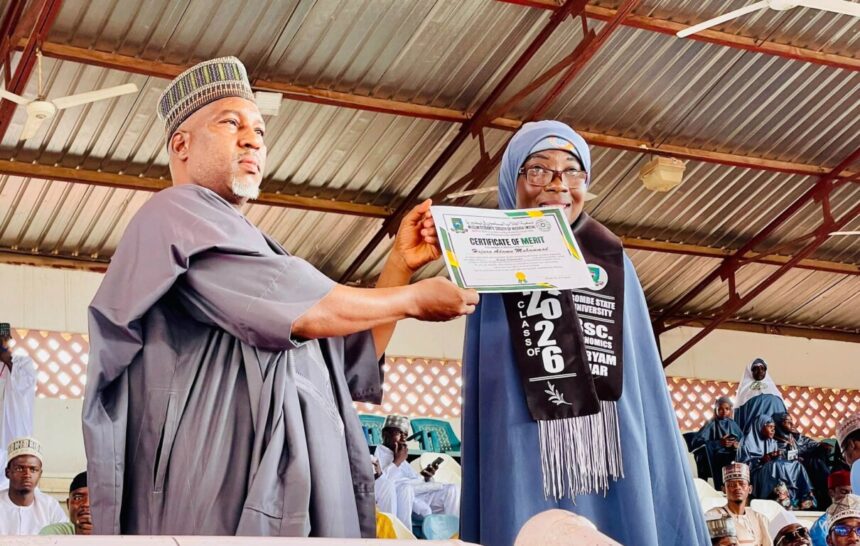
Maryam Ummar’s journey from struggling on the streets to the threshold of becoming a university graduate is emerging as a powerful story of opportunity, inclusion and determination at Gombe State University.
Her story began at a filling station, where she was seen struggling to make ends meet and, at times, asking people for financial assistance.
It was during several conversations that she shared her aspiration of studying Economics at the university.
Despite the difficult circumstances surrounding her life, including living without both hands and having to write with her legs, those who encountered her saw beyond her disability and decided to give her an opportunity to pursue her educational dream.
One of those who became involved in her journey was a staff member of Gombe State University’s International Relations and Development (INTERDEV) Office.
The intervention received support from university authorities, including Professor Aliyu Usman El-Nafaty and Professor Sani Ahmed Yauta, who was then the Deputy Vice-Chancellor and is now the Vice-Chancellor of the university.
According to the account, concerns were initially raised about whether Maryam would be able to cope with university demands, particularly because she wrote with her legs and faced physical challenges that could affect her studies.
However, rather than allowing those challenges to determine her future, members of the university community focused on finding ways to make the environment more accessible to her.
Maryam reportedly became a regular visitor to the INTERDEV Office, where efforts were made to address the barriers she faced and connect her with the support necessary to continue her education.
Several individuals and organisations also played roles in supporting her journey.
The Academic Staff Union of Universities (ASUU) at Gombe State University provided assistance in the form of a scholarship, transportation support and a laptop, helping to ease some of the challenges associated with her education.
The account also acknowledged the contributions of Dr Jauro, former ASUU Chairman, Dr Nigel Y. Bachama, Dr Zainab Tijjani, Adamu Usman Garko, Hassan Bissu Gambo, Adamu Ishaq and staff members of the International Relations and Development Office for their support.
Maryam’s journey was not without difficulties. Her physical condition presented significant challenges, and there were moments when her health and ability to cope with the demands of university life became concerns.
Yet, the support around her demonstrated a broader principle: disability should not automatically become a barrier to education.
Years after she was encountered at a filling station, Maryam is now in her final year and on the verge of graduating from the university.
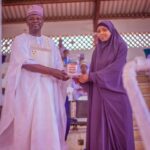
The emotional significance of her journey was captured during an encounter with one of those who had supported her.
According to the account, Maryam simply said:
“Mallam, ina final year. Na gode, Allah ya saka maka.”
Translated from Hausa, she said: “Mallam, I am in my final year. Thank you. May God reward you.”
The simple statement reportedly left the recipient emotional, reflecting the significance of how far she had come.
Maryam’s story is therefore not merely about graduating from university. It is a story about what can happen when institutions and individuals choose to remove barriers rather than define people by their limitations.
From a young woman struggling for survival at a filling station to a university student preparing to graduate, her journey illustrates the transformative power of education, compassion and institutional support.
It also places a spotlight on the importance of creating university environments where students living with disabilities can access education, mobility, technology and other forms of support necessary to compete and succeed.
Gombe State University’s role in Maryam’s journey has equally been presented as an example of how an institution can promote inclusion by providing opportunities to students whose circumstances might otherwise prevent them from accessing higher education.
For those who supported her along the way, Maryam’s success represents more than an academic achievement. It is a reminder that sometimes, providing one person with an opportunity can change the entire direction of a life.
And for Maryam, the journey that began with uncertainty is now approaching a remarkable conclusion: she is about to become a university graduate.
Her supporters have described the moment as one of fulfilment after years of challenges, perseverance and collective effort.
As she prepares to complete her studies, Maryam’s story stands as a message of hope to people living with disabilities and to institutions that have the power to either reinforce barriers or create pathways to opportunity.
Maryam made it.