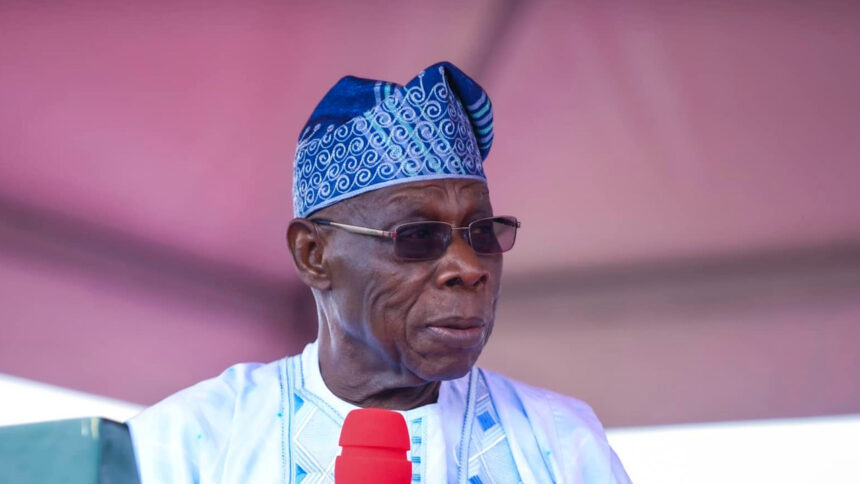
Former President Olusegun Obasanjo has identified corruption and illicit wealth as major obstacles to Nigeria’s development, warning that the poor suffer the most in societies where corruption is allowed to thrive.
Obasanjo spoke on Monday at the public presentation and launch of “Unexplained Wealth: A Trilogy of Nigerian Financial Law,” authored by Senior Advocate of Nigeria, Dr Wahab Shittu, at the Oriental Hotel in Victoria Island, Lagos.
The former President said corruption and development could not coexist, describing corruption as “anti-social,” “anti-development” and “anti-progress.”
According to him, Nigeria cannot achieve meaningful development if corruption is allowed to take the lead in the affairs of the country.
Obasanjo said his involvement in the fight against corruption dates back to his military career, when he served as a prosecutor under military law and participated in a court-martial involving corruption cases.
He also recalled his later involvement with Peter Eigen, a former World Bank official and founder of Transparency International, in efforts to tackle grand corruption globally.
Obasanjo said his experience contributed to efforts that eventually led to the establishment of anti-corruption institutions in Nigeria.
He recalled that the model law provided by Transparency International became the basis for the legislation establishing the Independent Corrupt Practices and Other Related Offences Commission, ICPC.
He added that the Economic and Financial Crimes Commission, EFCC, was later established during his administration to strengthen the fight against financial crimes.
According to him, the fight against corruption requires three critical components: effective laws, prosecution and recovery of illicit assets.
Obasanjo said these mechanisms must be strengthened if Nigeria and other African countries are to effectively tackle unexplained wealth and illicit financial flows.
He stressed that corruption has not been completely eliminated in any country but said governments can prevent it from becoming deeply entrenched.
“There’s nowhere in the world where corruption is totally eliminated. But there are many places in the world where corruption is not allowed to grow,” he said.
The former President also warned that the consequences of corruption disproportionately affect vulnerable citizens.
“Those who suffer most in the corrupt society are the poor. And it makes them poorer,” he said.
He therefore urged Nigeria and other African countries to strengthen their legal and institutional frameworks while sustaining efforts to combat corruption.
Meanwhile, the Emir of Kano, Muhammadu Sanusi II, said legal reforms aimed at addressing unexplained wealth must be accompanied by political and judicial reforms.
Sanusi cautioned that strong laws would have limited impact if investigators, prosecutors and judges did not apply them fairly and transparently.
He called for anti-corruption laws to be applied consistently, irrespective of political affiliation or status.
Representing former Vice President Yemi Osinbajo, his former Chief of Staff, Ade Ipaye, said Nigeria needed a fair and constitutionally sound mechanism for recovering stolen assets without criminalising legitimately acquired wealth.
Book reviewer, Professor Olanrewaju Fagbohun, also cautioned against treating the absence of conventional documentation as automatic evidence of criminality.
He said efforts to recover unexplained wealth must balance asset recovery with the protection of legitimate property rights, particularly for people operating within Nigeria’s informal economy.
The author of the trilogy, Wahab Shittu, said the objective of the publication was to contribute to the development of a system capable of distinguishing legitimate wealth from illicit enrichment.
Shittu stressed that wealth creation itself was not a crime, but acquiring wealth through dubious means was.
The event therefore highlighted the need for stronger institutions, transparent enforcement, effective asset recovery and safeguards for legitimate property ownership in Nigeria’s continuing fight against corruption.
Source: The PUNCH.