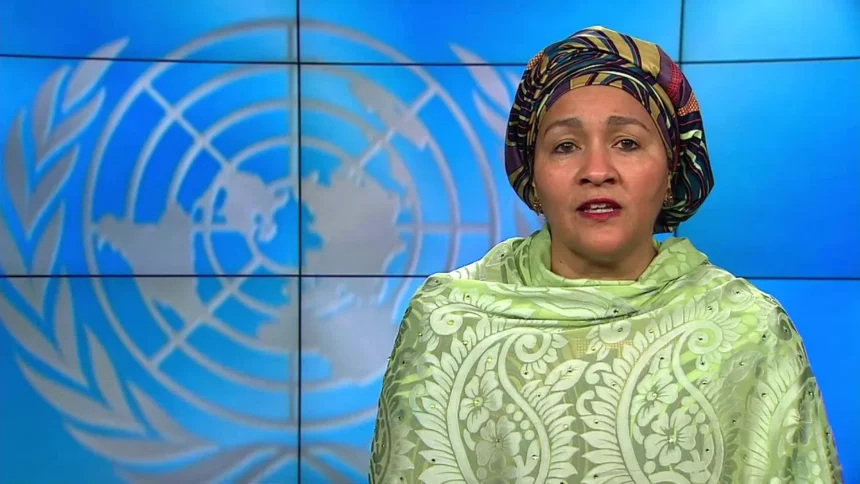
United Nations Deputy Secretary-General Amina J. Mohammed has called on African nations to prioritize homegrown solutions in addressing the continent’s persistent challenges, emphasizing that sustainable progress must come from within.
Speaking on the need for a shift in approach, Mohammed noted that while international partners can provide support, the most effective and lasting solutions will be internally driven by Africans themselves. She stressed that development must begin at the grassroots level, starting from families and communities, and extending to national governance structures.
She acknowledged that many of Africa’s current national boundaries were not organically created but externally imposed. However, she maintained that these borders now define the operational framework for governance and policy implementation across the continent.
Mohammed further highlighted the importance of recognizing Africa’s dual identity as both unified and diverse. According to her, the continent’s diversity—across culture, ethnicity, and political systems—should be viewed as a strength rather than a weakness.
She argued that leveraging this diversity is key to fostering inclusive development and addressing the continent’s complex and layered challenges. By focusing on shared goals while respecting differences, African countries can unlock their full potential and drive meaningful transformation.
The UN official concluded that Africa’s future depends largely on its ability to harness internal capacity, build resilient institutions, and promote unity through diversity.