President Bola Ahmed Tinubu has reaffirmed that Nigeria remains on a path of steady growth and stability as his administration deepens engagement with the international community to sustain economic reforms and combat terrorism.
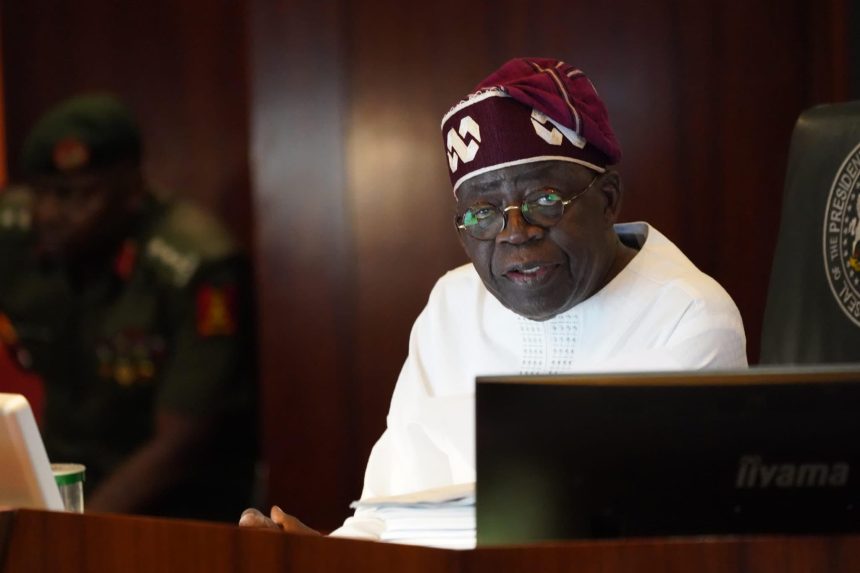
Speaking during Thursday’s Federal Executive Council (FEC) meeting at the State House, following the swearing-in of two new ministers — Dr. Bernard Mohammed Doro (Humanitarian Affairs and Poverty Reduction) and Dr. Kingsley Tochukwu Udeh (SAN) (Innovation, Science and Technology) — the President said Nigeria’s economic outlook continues to improve both locally and internationally.
“The most important thing is that despite the political headwinds and fears of our people, we will continue to engage with our partners,” President Tinubu stated. “The success of the $2.3 billion Eurobond, oversubscribed by 400%, is most assuring. We are engaging the world diplomatically, and we will defeat terrorism in this country.”
Reiterating his commitment to national unity and security, the President assured Nigerians that the government would not relent until all forms of terrorism and criminality are eliminated.
“Do we have problems? Yes. Are we challenged by terrorism? Yes. But we will defeat terrorism. We will overcome the CPC designation. Nigeria is one happy family, and we shall spare no effort until we eliminate all criminals from our society,” he said.
President Tinubu also directed the Minister of Finance and Coordinating Minister of the Economy, Mr. Wale Edun, to brief the Council on the nation’s economic performance, emphasizing the need to consolidate on the current gains and sustain reforms under the Renewed Hope Agenda.
Presenting the report, Edun said Nigeria’s economy is showing its strongest performance in a decade, with the Gross Domestic Product (GDP) growing by 4.23% in Q2 2025, outside the COVID-19 rebound period.
He noted that 13 sectors recorded growth above 7%, up from nine in the previous quarter, while the industrial sector nearly doubled growth from 3.72% to 7.45%.
Read Also: Tinubu Mourns Former Chief of Staff General Abdullahi Mohammed Adangba
He added that inflation eased to 18.02% in September, foreign exchange reserves rose to $43 billion, and the trade surplus reached ₦7.4 trillion — signaling improved macroeconomic stability and investor confidence.
“Clear examples of macroeconomic stability are evident. Citizens now spend about half of their income on basic needs, compared to almost 90% previously. This signals a transition from subsistence to productivity and affluence,” Edun explained.
He emphasized that Nigeria’s removal from the Financial Action Task Force (FATF) Grey List further strengthened its financial integrity and global reputation.
“At the recent World Bank/IMF annual meetings, global leaders commended our reforms and progress, with the IMF revising Nigeria’s growth forecast upward to nearly 4% and improving our credit ratings,” he added.
Edun said the administration’s target of a $1 trillion economy by 2030 remains achievable through sustained reforms, 7% annual growth, and poverty eradication as a moral imperative.
He also urged ministries overseeing infrastructure, education, agriculture, mining, health, and innovation to collaborate with sub-national governments in designing bankable projects that attract investors.
“Every naira must be optimized. The next phase of reforms will remove barriers holding back investment, review tariffs, and stimulate productivity,” Edun concluded.