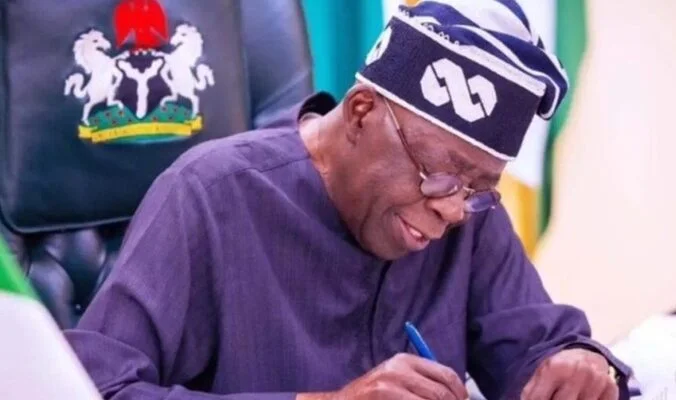
President Bola Tinubu has received the constitutional amendment bill seeking to establish state police in Nigeria.
The President will consult the Attorney-General of the Federation (AGF), Lateef Fagbemi, before signing the bill into law.
His Chief of Staff, Femi Gbajabiamila, disclosed this in a statement on Wednesday, November 18, 2026.
Gbajabiamila said the President received the bill through his Special Advisers on Senate and House of Representatives Matters. They are Senator Basheer Lado and Dr Wasiu Olanrewaju-Smart.
He added that Tinubu would assent to the bill at a formal signing ceremony after reviewing its provisions.
The Chief of Staff confirmed that all 36 State Houses of Assembly had approved the proposed constitutional amendment.
This exceeds the constitutional requirement of 24 states. Section 9(2) of the 1999 Constitution requires approval from at least two-thirds of the 36 state assemblies.
The Senate passed the bill on June 24, 2026. The House of Representatives followed on July 23, 2026.
Both chambers subsequently transmitted the proposed amendment to the state legislatures for consideration and approval.
The unanimous endorsement now clears the constitutional hurdle for the President’s consideration.
Meanwhile, Gbajabiamila disclosed that the Presidential Working Group on State Police had completed nationwide consultations.
The group also engaged stakeholders across the country. It received support from the Policy Advisory Committee.
According to him, the consultations focused on developing a draft National Policing Bill.
The proposed legislation has been submitted to the Federal Ministry of Justice for legislative drafting validation.
The working group will review the validated draft. It will then present the document alongside its report to the President.
The proposed constitutional amendment seeks to establish State Police Services within Nigeria’s national policing structure.
It would introduce a decentralised policing system alongside the existing federal police structure.
Supporters of state police have argued that decentralisation could improve intelligence gathering and local security responses.
They believe state-level policing could help address kidnapping, banditry, communal violence and other security threats.
However, the proposed system will require a clear legal and operational framework.
The National Policing Bill is expected to provide that framework.
Tinubu’s review and eventual assent will therefore mark another major step in Nigeria’s proposed police reform.