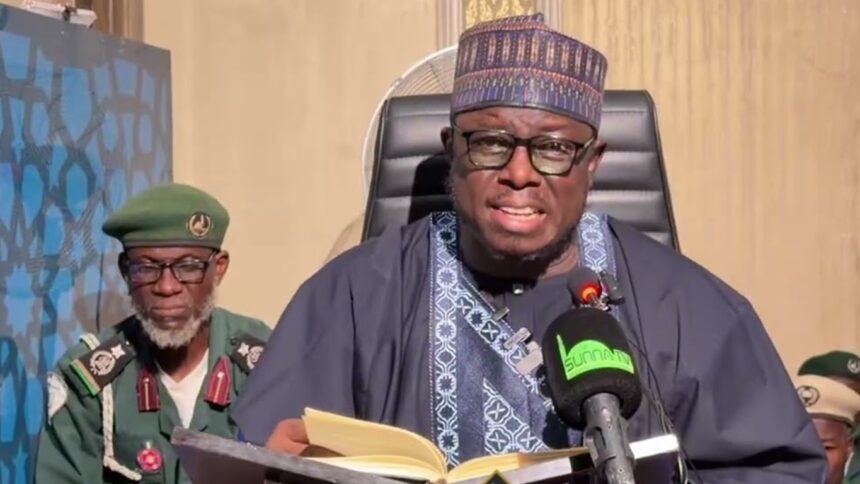
Prominent Kano Islamic scholar and Hisbah Commander, Sheikh Aminu Ibrahim Daurawa, has said Nigeria’s elections are political contests rather than religious obligations, stressing that Muslim-Muslim, Christian-Christian, Muslim-Christian or Christian-Muslim tickets are all subject to the same democratic principles.
Daurawa made the statement in an interview with DW Hausa monitored by Northern Nigeria Hub while responding to the ongoing debate over religious considerations in electoral choices, particularly calls by some clerics for Muslims to vote only for fellow Muslims.
“If a Muslim and a Muslim contest, or a Christian and a Christian contest, or a Muslim and a Christian contest, or a Christian and a Muslim contest, it is all the same thing. It is all politics,” he said.
The scholar argued that Nigeria’s Constitution and democratic system are not structured as a religious system and do not recognise political parties based exclusively on Islam or Christianity.
According to him, if Nigeria were operating under a system of Sharia in accordance with the Qur’an and the teachings of Prophet Muhammad (SAW), only Muslims would contest political offices.
However, he said the reality under Nigeria’s current democratic system is different, making it inappropriate to use religion as the primary consideration when choosing political candidates.
Daurawa urged voters to focus on the competence, character, policies and track record of candidates rather than their religious identities.
He said Nigerians should examine what candidates are doing currently and what they intend to do if elected before deciding who to support.
“If Muslim-Muslim suits them, let them choose it. If Christian-Christian suits them, let them choose it. If Christian-Muslim suits them, let them choose it,” he said.
The cleric added that supporting or opposing any particular religious combination in a political contest does not automatically amount to a religious offence, describing the debate largely as a matter of individual opinion and political perspective.
Daurawa also challenged those who describe political parties as Islamic or Christian organisations to identify any such party officially registered by the Independent National Electoral Commission (INEC).
He argued that there is no political party reserved exclusively for Muslims or Christians, stressing that a Muslim who votes for a party fielding non-Muslim candidates does not, by that action, abandon his faith.
The scholar further cautioned religious leaders who venture into partisan politics to be prepared for the consequences of political alignment.
According to him, clerics who openly identify with political parties risk losing the broad respect they enjoy as religious leaders because partisan politics naturally creates supporters and opponents.
He cited former Vice President Yemi Osinbajo as an example of a cleric who entered partisan politics by contesting for political office.
Daurawa explained that once a religious leader openly flies the flag of one political party among the numerous parties registered in Nigeria, supporters of other parties may begin to view the cleric primarily as a politician rather than as a religious leader.
The Hisbah Commander also outlined four principles he said should guide political campaigns in Nigeria.
He urged politicians and their supporters to avoid distributing drugs to youths, refrain from using weapons, avoid insults and defamatory statements against opponents, and vote sincerely based on merit.
He particularly condemned character assassination involving the families, parents, tribes, religions and personal lives of political opponents.
According to him, political actors should be free to criticise the policies and performance of their opponents, but personal attacks and slander should not be mistaken for legitimate political campaigning.
Daurawa disclosed that the Kano Hisbah authorities plan to organise a workshop for media commentators representing different political parties to promote responsible political communication and discourage inflammatory language during campaigns.
He said sanitising political discourse would help reduce tension and contribute to peaceful elections as Nigeria prepares for the 2027 general elections.