For hours, Osun waited.
Across the state, from Osogbo to Ede, Ilesa, Ile-Ife and Ikire, voters had cast their ballots. Papers had been thumbprinted, sorted and counted. Results were recorded, signed and announced at polling units.
But one question remained unanswered: Who would lead Osun for the next four years?
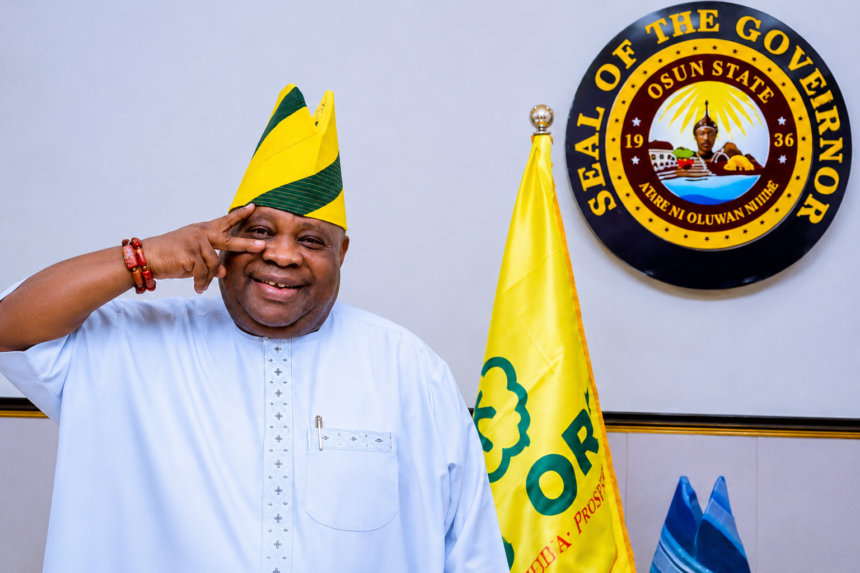
The answer finally came in the early hours of Sunday, August 16, when the Independent National Electoral Commission (INEC) declared the incumbent governor, Ademola Adeleke of the Accord Party, winner of the August 15 governorship election.
Adeleke secured 511,067 votes to defeat his closest challenger, Bola Oyebamiji of the All Progressives Congress (APC), who polled 444,815 votes. African Democratic Congress (ADC) candidate Najeem Salaam came third with 17,180 votes.
The results were announced by the State Returning Officer, Professor Joshua Ogunwole, Vice-Chancellor of the Federal University, Oye-Ekiti, at the state collation centre in Osogbo at about 7:24 a.m.
With the declaration, Adeleke secured another four-year term.
But the story of Osun 2026 goes beyond the final figures.
A State of 2.3 Million Voters
Osun entered the election with 2,339,233 registered voters across 30 Local Government Areas, 332 wards and 3,763 polling units. More than 1.9 million voters had collected their Permanent Voter Cards.
For INEC, organising the election required the deployment of thousands of electoral officials, security personnel and election materials across the state.
The commission also deployed 4,427 BVAS devices to facilitate voter accreditation and strengthen the credibility of the process.
However, technology became part of the election’s challenges.
In some locations, voters complained about slow BVAS accreditation. At a polling unit in Ila-Orangun, more than 1,100 registered voters reportedly had access to only one BVAS machine, resulting in congestion and delays.
For some voters, therefore, democracy meant not only choosing a candidate but also waiting in long queues to complete the accreditation process before accessing the ballot.
Three Major Figures, One Prize
Three major political figures dominated the contest.
There was incumbent Governor Ademola Adeleke, who left the Peoples Democratic Party (PDP) to contest under the Accord Party.
There was Bola Oyebamiji, the APC candidate and former Managing Director of the National Inland Waterways Authority, who campaigned on reforms in education, healthcare, agriculture, power and security.
Then there was Najeem Salaam, former Speaker of the Osun State House of Assembly, who contested under the ADC.
Although 14 political parties participated in the election, the contest increasingly became a two-horse race between Adeleke and Oyebamiji, with Salaam seeking to challenge the dominance of the two major political structures.
For Adeleke, the election was a test of his popularity and the strength of his administration after his first term.
For Oyebamiji and the APC, the objective was to reclaim the Osun Government House.
The Campaign Before the Ballot
Osun had been one of Nigeria’s closely watched political battlegrounds long before election day.
The election carried memories of the dramatic 2022 contest, when Adeleke defeated the then-incumbent governor, Gboyega Oyetola.
Four years later, the political equation had changed.
Adeleke was now the incumbent, while Oyebamiji emerged as the APC’s candidate. Oyetola remained an influential figure in the state’s political landscape but was no longer the party’s standard-bearer.
Adeleke’s decision to contest under Accord also altered the political calculations.
While the governor had the advantage of incumbency, Oyebamiji relied on the APC’s political structure and promised a different direction for the state.
Campaign rallies, endorsements and grassroots mobilisation intensified as election day approached.
By election week, every local government, ward and polling unit had become politically significant.
When the Votes Started Speaking
Then came August 15.
Voters turned out across the state to exercise their franchise.
At Adeleke’s polling unit in Ede North, the governor secured a commanding victory, polling 421 votes against the APC’s 43.
Elsewhere, however, the results produced different outcomes.
Political influence did not always translate into votes. Former Governor Rauf Aregbesola, for instance, lost his polling unit to the APC, which secured 256 votes against Accord’s 43 and ADC’s 13.
The result reflected one of the peculiar features of Nigerian elections: political influence at the national or state level does not necessarily guarantee victory at the polling unit.
There were also isolated incidents of tension.
At the polling unit of ADC candidate Najeem Salaam in Ejigbo, suspected thugs reportedly disrupted voting shortly after he cast his ballot. Voters and officials were temporarily forced to move away until security personnel intervened.
Despite such incidents and complaints about BVAS, the election was generally reported as peaceful across much of the state.
The Other Battle: Money, Technology and Trust
Beyond the contest among candidates was another struggle — the battle for electoral credibility.
Reports and observer accounts raised concerns about vote-buying, slow accreditation and isolated incidents of violence.
The electronic transmission of results also attracted attention.
Following the conclusion of voting, Nigerians monitored INEC’s Result Viewing Portal, IReV, waiting for polling-unit results to be uploaded.
Delays in transmission generated questions among political actors and supporters.
Musician Davido, who openly campaigned for his uncle Adeleke, also questioned the delay and urged voters to ensure that their polling-unit results were uploaded and accurately reflected.
The broader message was clear: voters and political actors wanted to follow the results from the polling unit through the collation process to the final declaration.
That became one of the defining issues of Osun 2026.
The Long Night
As results moved from polling units to wards and then to local government collation centres, political tension increased.
Adeleke’s camp became increasingly confident, while the APC maintained hope of an upset.
Supporters on both sides closely monitored every result.
By the time results from all 30 local government areas were presented, the overall pattern had become clear.
Adeleke won 19 LGAs, while Oyebamiji won 11.
Some contests were extremely close.
In Boluwaduro, Adeleke polled 7,118 votes against Oyebamiji’s 7,050. In Ede North, however, Adeleke recorded a much wider margin, scoring 35,427 votes against the APC’s 10,283.
In Osogbo, Adeleke secured 36,480 votes, while Oyebamiji polled 30,474.
The electoral map was becoming clearer.
Then came the final arithmetic.
The Numbers That Ended the Suspense
The final results were:
Accord — Ademola Adeleke: 511,067 votes
APC — Bola Oyebamiji: 444,815 votes
ADC — Najeem Salaam: 17,180 votes
Total valid votes stood at 985,079, while total votes cast were 1,005,800.
The number of accredited voters was 1,010,684.
Professor Joshua Ogunwole subsequently declared Adeleke the winner and returned him elected after determining that he had satisfied the requirements of the law.
The long wait was over.
What the Victory Means
For Adeleke, the victory represents more than a second term.
It is political validation.
He has demonstrated that his move from the PDP to Accord did not prevent him from retaining the governorship. He has also moved from being the challenger who defeated Oyetola in 2022 to an incumbent who successfully defended his position.
For the APC, the result demonstrates that Osun remains highly competitive.
Although Oyebamiji lost, his 444,815 votes and victories in 11 LGAs show that the party retains a significant electoral base in the state.
For the ADC, the result highlights the difficulty third-party candidates face when two dominant political structures control most of the electoral space.
But perhaps the biggest question will only be answered with time.
Elections are not simply about who occupies the Government House. They are also about what follows the celebration.
After the Confetti
On Sunday morning, Adeleke’s supporters celebrated the victory.
Davido, who had campaigned energetically for his uncle, celebrated online with the words: “We did it Unc.”
But beneath the celebration lies the responsibility that comes with another four-year mandate.
Osun voters have handed Adeleke another opportunity to govern.
That mandate comes with expectations: improved infrastructure, economic opportunities, better public services, stronger institutions and an administration capable of serving beyond political supporters.
For Oyebamiji and the APC, the election also offers lessons.
The party demonstrated that it can still command hundreds of thousands of votes across Osun. How it consolidates that support before the next election will be important.
For INEC, Osun 2026 provides another electoral report card.
The election demonstrated the potential of BVAS and electronic result transmission, while also exposing the frustrations that arise when technology experiences delays or voters question the speed and transparency of the electoral process.
In the end, Osun voted.
It was not a perfect election. There were complaints, technical challenges, political tensions and concerns about vote-buying. But the ballots were counted, results were collated and a winner was declared.
The people of Osun have spoken.
Now the harder part begins.
Governing.