
Fashion has always been about more than clothes. It is about identity, culture, confidence and self-expression.
Today, modest fashion is proving that covering up does not mean fading into the background.
From Hollywood red carpets to international runways and luxury campaigns, modest fashion is commanding attention. More importantly, it is doing so without abandoning the individuality and cultural identity that make it powerful.
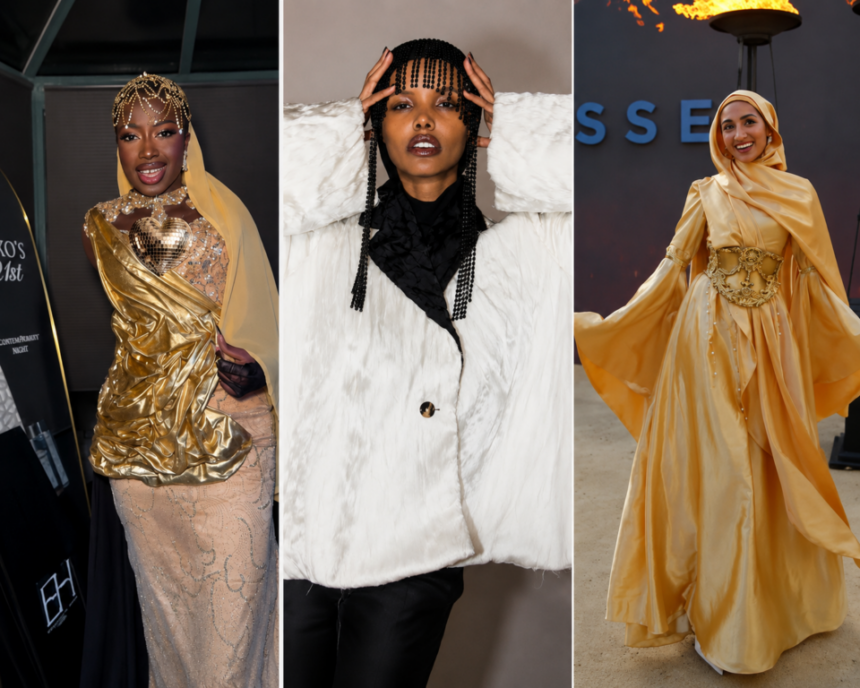
One recent example came from British content creator Zainab Jiwa at the London premiere of The Odyssey.
Jiwa arrived in a dramatic custom gold gown with a hood. The striking look caught the attention of Hollywood star Zendaya, who reportedly stopped to admire it.
Jiwa said the two had a brief stare-off before Zendaya praised the outfit.
The encounter later went viral on TikTok, attracting millions of views.
Yet, while Jiwa’s moment shows the current influence of modest fashion creators, the movement has been building for years.
Few people demonstrate that journey better than Halima Aden.
Halima Aden Changed the Runway
Halima Aden made history by becoming the first hijab-wearing model to compete in the Miss Minnesota USA pageant in 2016.
Her appearance helped introduce modest fashion to audiences far beyond Muslim communities.
Soon after, she moved into high fashion and challenged an industry that had long centred revealing silhouettes and narrow ideas of beauty.
Aden made her New York Fashion Week debut walking in Kanye West’s Yeezy Season 5 show. She appeared in a floor-length fur coat and hijab, creating one of the runway’s most memorable modest looks.
She later walked for major fashion houses, including Max Mara and Alberta Ferretti in Milan.
At Max Mara, her tailored styling showed how traditional runway sophistication could work with hijab-friendly fashion.
Her presence sent a simple but powerful message: modesty does not have to sit outside high fashion.
It can exist at its centre.
Muslim Women Are Making Their Own Fashion Waves
The influence of modest fashion now extends far beyond a few trailblazing models.
Across runways, red carpets, social media and luxury campaigns, Muslim women are creating their own space in the fashion industry. More importantly, they are redefining what fashionable, glamorous and modern can look like while staying connected to their values and culture.
Today, hijab-wearing models, fashion creators, designers and influencers are bringing fresh ideas to mainstream fashion. They mix traditional garments with contemporary tailoring, experiment with colours and textures, and turn modest silhouettes into statement pieces.
Meanwhile, social media has played a major role in this change. Muslim women can showcase their personal styles directly to global audiences. As a result, a creator in London can inspire someone in Lagos, Dubai or Kuala Lumpur with one outfit.
This growing visibility is also challenging old assumptions about modest dressing. Covering the hair, arms or legs does not have to limit creativity. Instead, it can encourage more thoughtful styling through layering, accessories, fabrics and structure.
Furthermore, Muslim women’s growing presence is changing how fashion brands approach their audiences. Designers and retailers increasingly recognise that Muslim women are not one market with one style. They have different tastes, cultures and personalities.
Some prefer minimalist looks, while others embrace colour, couture and dramatic silhouettes. In either case, the freedom to define modesty remains at the heart of the movement.
Rather than waiting for fashion to decide what modesty should look like, Muslim women are helping shape that conversation themselves. Through their choices, they are showing that modest fashion does not need to imitate mainstream trends to remain relevant.
Instead, it can create new trends, challenge old ideas and give women more ways to express who they are.
Modest Does Not Mean Predictable
This is where the modern modest-fashion movement becomes particularly interesting.
There is no single way to dress modestly.
A woman can wear an abaya with sneakers, a tailored suit with a hijab, an oversized blazer over a flowing dress or a dramatic couture gown with full coverage.
The possibilities are endless.
That freedom has allowed modest fashion to develop its own visual language.
Creators are experimenting with layering, oversized silhouettes, bold colours, structured tailoring, dramatic sleeves, statement accessories and elaborate head coverings.
The result is fashion that feels personal rather than restrictive.
For Zainab Jiwa, this creativity extends to the red carpet.
She builds outfits around the films she covers while adapting them to her own style and beliefs. For Spider-Man: Brand New Day, she incorporated spiderweb henna into her look.
For Gladiator II, she embraced gold armour-inspired styling, at another premiere, she wore a red gown created by a student designer.
Her philosophy is simple: if an outfit does not fit her modest style, she finds a way to reinterpret it, She describes the process as “halalifying” the look.
That approach captures the spirit of modern modest fashion.
It is not about rejecting fashion.
It is about making fashion work for you.
Couture Joins the Movement
The rise of modest fashion has also reached luxury couture.
In 2023, designers increasingly embraced high-neck, long-sleeved and full-coverage silhouettes across bridal and evening collections.
Design houses including Maison Sara Chraibi, Zuhair Murad and Valentino showcased designs that demonstrated how glamour can exist without relying on exposed skin.
The trend reflected a broader change in luxury fashion.
Modest silhouettes were no longer being treated simply as niche alternatives. Instead, they were becoming part of the conversation around elegance, sophistication and quiet luxury.
For years, fashion often associated glamour with revealing clothing.
However, the growing popularity of modest couture challenged that assumption.
A floor-length gown can be just as dramatic.
A high neckline can be just as sophisticated.
Long sleeves can create a stronger silhouette.
And a covered look can still turn heads.
Social Media Is Giving Modest Fashion a Bigger Voice
Social media has accelerated this transformation.
Platforms such as TikTok and Instagram have allowed creators to build audiences without waiting for traditional fashion institutions to give them permission.
As a result, women who may once have felt excluded from mainstream fashion can now create their own platforms.
Creators can showcase their styling ideas directly to millions of people.
They can reinterpret runway trends, experiment with layering and demonstrate how modest clothing can work in everyday life.
The audience is also changing.
People are no longer simply consuming fashion from magazines and catwalks. Instead, they are watching creators transform trends in their bedrooms, homes and streets.
That makes fashion more accessible.
It also makes representation more personal.
Culture Is Part of the Style
For many modest-fashion wearers, clothing is closely connected to culture and identity.
The hijab, for example, can become part of an entire outfit rather than an accessory added at the end.
Colours, fabrics, embroidery, jewellery and silhouettes can also reflect cultural heritage.
This is why representation matters.
When women see people who dress like them on runways, magazine covers and red carpets, fashion becomes more inclusive.
Halima Aden’s career helped create that visibility.
Zainab Jiwa is continuing it in a different way.
One works primarily through modelling and fashion campaigns. The other combines entertainment, social media and red-carpet presentation.
Together, they show that modest fashion can have a strong personality.
The Future Is More Individual
The biggest change may be that modest fashion is no longer trying to fit into one definition.
It is becoming increasingly individual.
Some women choose minimalist neutral outfits, while others prefer bright colours and dramatic silhouettes.
Some wear traditional garments. Others mix modest pieces with streetwear.
Some cover their hair, while others focus primarily on longer hemlines, loose clothing or higher necklines.
There is room for all of them.
That variety is helping modest fashion move beyond the idea that modesty equals simplicity.
Instead, modesty can be bold,it can be glamorous, experimental remain cultural and still completely original
From Halima Aden to Zainab Jiwa
Halima Aden’s historic runway appearances helped prove that a hijab could belong on some of the world’s biggest fashion stages.
Years later, Zainab Jiwa’s viral encounter with Zendaya showed how modest fashion can command attention on the modern red carpet.
Between those moments lies a much bigger transformation.
Fashion is becoming less interested in forcing everyone into the same definition of beauty.
Instead, individuality is becoming the statement.
The future of modest fashion may therefore not be about creating a separate category.
It may simply be about creating more space for people to dress exactly as they are.
And when originality becomes the goal, covering up does not make a fashion statement smaller.
Sometimes, it makes it unforgettable.