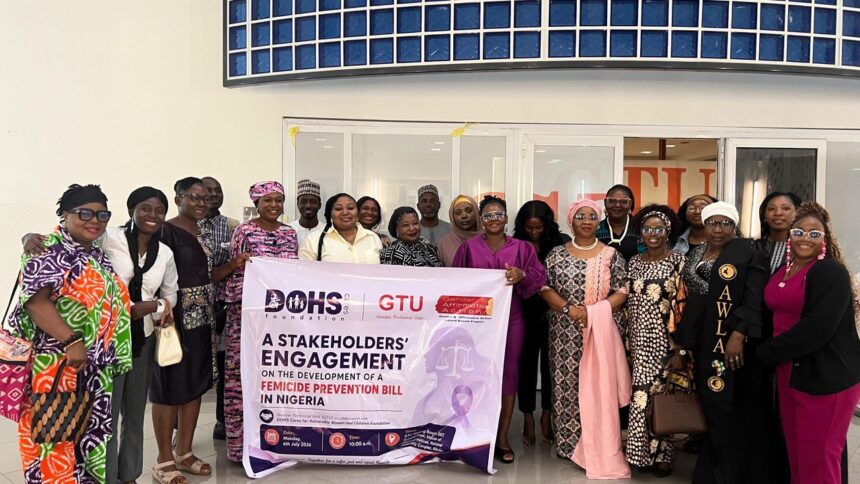
A coalition of women’s rights advocates, civil society organisations and government representatives has called for urgent legislative action to curb the rising cases of femicide in Nigeria, as stakeholders met at the National Assembly to advance the development of a dedicated Femicide Bill.
The stakeholders’ engagement, organised by the DOHS Cares Foundation in collaboration with the Gender Technical Unit (GTU) of the House of Representatives, brought together 26 representatives from government agencies, civil society organisations and women’s rights groups to review findings from the foundation’s 2025 Femicide in Nigeria Report and chart a legislative path toward preventing gender-related killings of women and girls.
Speaking during the meeting held at the GTU office in the National Assembly Complex, Abuja, participants expressed concern over the increasing rate of femicide in the country and stressed the need for stronger legal protections.
Representing the Heinrich Böll Foundation, Dorothy Njemanze urged authorities to address the culture of silence surrounding domestic violence, calling for measures to prevent families from concealing abuse cases and for greater public awareness.
A representative of the Yargote Foundation highlighted the importance of engaging men as allies in the fight against gender-based violence and promoting early interventions to challenge toxic masculinity.
Princess Dr. Jumai Idonije, who represented the Minister of Women Affairs, said the ministry’s Gender-Based Violence dashboard reflected similar trends identified in the DOHS report. She recommended that provisions of the proposed Femicide Bill be incorporated into the ongoing review of the Violence Against Persons Prohibition (VAPP) Act and advised wider consultations with the Federal Ministry of Justice.
Also speaking, Sola Folayan of the Westminster Foundation for Democracy advocated stronger collaboration among stakeholders and called for post-legislative scrutiny to ensure future laws are effectively implemented.
Ajuma Drisu of TechHerNG warned that technology-facilitated gender-based violence is increasingly becoming a precursor to femicide and should be addressed in any proposed legislation.
Betty Abah, Executive Director of CEE-Hope Shelter, stressed the need for better support systems for survivors of gender-based violence, noting that Nigeria currently has only 22 functional shelters compared to more than 300 in Canada despite Nigeria’s larger population.
Founder of DOHS Cares Foundation, Ololade Ajayi, announced plans to establish a safe haven where survivors of gender-based violence and families of femicide victims can receive psychosocial support and begin the healing process.
The engagement also featured an emotional testimony from Monica Agbane, a family member of a femicide victim, who recounted the killing of Deborah Okwori by her former boyfriend, Lintex Ogale. She appealed to lawmakers to enact legislation that would help prevent similar tragedies.
Clerks of the House of Representatives who attended the meeting pledged to brief members of the House on the outcome of the engagement and provide feedback on the proposed legislation.
As part of the agreed next steps, the GTU and DOHS Cares Foundation will circulate a concept note and establish a technical working group involving key stakeholders, including the Federal Ministry of Justice, to push for the integration of femicide-specific provisions into the VAPP Act.
According to data presented by the foundation, a woman is killed through femicide in Nigeria approximately every 49 hours, underscoring the urgency for stronger legal and institutional measures to tackle gender-related killings.