
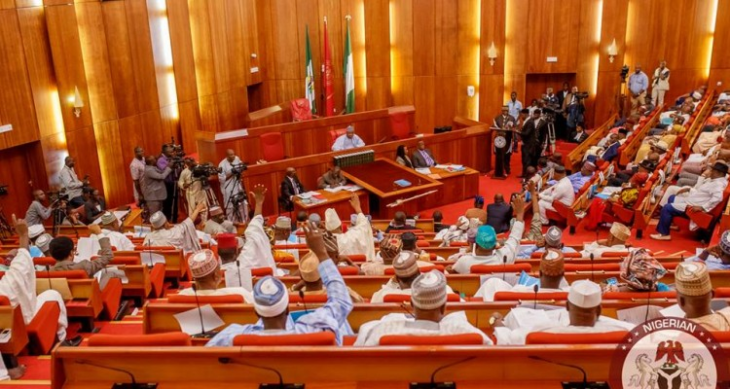
The Nigerian Senate on Wednesday passed the long-awaited Constitution Alteration Bill seeking to establish state police across Nigeria, marking a historic milestone in efforts to decentralise the country’s policing system amid growing security challenges.
The landmark legislation secured the support of more than two-thirds of senators following a clause-by-clause consideration and a manual voting process conducted during plenary.
Senate President, Godswill Akpabio, announced the passage of the bill after lawmakers overwhelmingly voted in favour of the proposal.
The bill was adopted following the presentation of a report by the Senate Committee on the Review of the Constitution, chaired by Deputy Senate President, Barau Jibrin.
Leading debate on the legislation, Senate Leader, Opeyemi Bamidele, described state policing as a critical reform capable of strengthening internal security and improving responses to local threats.
The proposed amendment establishes a state policing framework that will operate alongside the existing federal police structure, effectively ending the Federal Government’s exclusive control over policing.
A major provision of the bill empowers state governors to appoint Commissioners of Police for their respective states, subject to confirmation by their state Houses of Assembly.
Under Clause 17 of the amendment, while the Federal Police Service will remain under the leadership of the Inspector-General of Police, each State Police Service will be headed by a Commissioner of Police appointed by the governor and confirmed by the state legislature.
The bill also grants governors the authority to issue lawful policy directives on public safety and order within their states.
To address concerns over possible political abuse, lawmakers included safeguards aimed at protecting civil liberties and democratic freedoms. The legislation expressly prohibits state police commissioners from arresting, detaining, investigating, or deploying force against individuals, political parties, or groups solely for criticising the government, except as permitted by law.
The Senate adopted a manual voting process after abandoning plans to use an electronic voting system due to technical concerns that could have disenfranchised some lawmakers.
Supporting the switch, Bamidele argued that every senator should have an equal opportunity to participate in what many described as a historic constitutional vote. Akpabio also endorsed the move, saying open voting would guarantee transparency and allow Nigerians to see where their representatives stood on key national issues.
Several high-profile government officials witnessed the proceedings, including Kaduna State Governor, Uba Sani; Ogun State Governor, Dapo Abiodun; Ondo State Governor, Lucky Aiyedatiwa; and Chief of Staff to the President, Femi Gbajabiamila.
The passage of the State Police Bill represents one of the most significant constitutional reforms undertaken by the 10th National Assembly and could fundamentally reshape Nigeria’s security architecture if it secures approval from state Houses of Assembly and completes other constitutional requirements.
Supporters argue that state police will help tackle banditry, terrorism, kidnapping, communal violence, and other security threats by enabling more localised and responsive policing. Critics, however, continue to warn that the system could be exploited by governors to target political opponents and suppress dissent.
With the Senate’s approval, Nigeria has crossed a major legislative hurdle in its decades-long debate over state policing, bringing the country closer than ever to the creation of state-controlled police services operating alongside the federal police system.