Nigeria’s worsening electricity crisis has reached a critical point, with mounting debts, persistent outages, and institutional failures pushing even government agencies off the national grid. As confidence in the system erodes, urgent reforms and coordinated action are now the only path to recovery.
Nigeria’s power crisis has entered a dangerous new phase. For years, citizens and businesses have quietly adapted to unreliable electricity buying generators, installing solar panels, and adjusting their lives around blackouts. But now, something more troubling is happening.
Even government institutions are beginning to abandon the national grid. This is not just a reaction to poor service. It is a vote of no confidence in Nigeria’s electricity system.
And when the very institutions responsible for governance begin to opt out of a national system, the question becomes unavoidable:
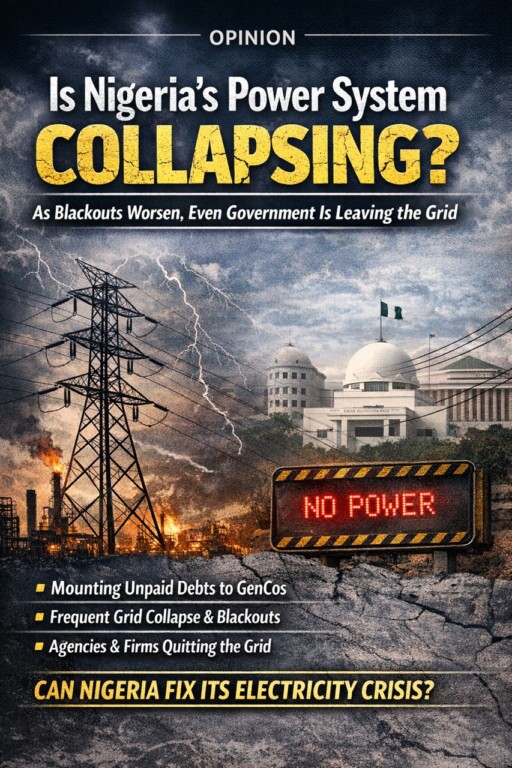
Is Nigeria’s power system collapsing?
At the heart of the crisis lies a broken financial structure.
Power generation companies commonly known as GenCos, continue to produce electricity, but they are not being paid adequately. The Federal Government of Nigeria and distribution companies (DisCos) owe them trillions of naira in accumulated debts.
This has created a chain reaction:
- GenCos reduce output due to liquidity constraints
- Transmission struggles to manage limited capacity
- DisCos ration power supply
- Nigerians experience blackouts
It is not a shortage of electricity alone. It is a failure of the entire system to sustain itself financially. The signing of the Electricity Act 2023 by President Bola Ahmed Tinubu was widely seen as a turning point.
The law aimed to:
- Decentralize electricity generation and distribution
- Empower states to generate their own power
- Encourage private sector investment
- Open the door for renewable energy solutions
On paper, it was transformative. But in practice, progress has been slow. Many states are still navigating regulatory frameworks. Investors remain cautious. And the transmission backbone, still under federal control, continues to limit how much power can actually be delivered.
Reform has begun, but it has not yet reached the people.
When agencies and major organizations begin to generate their own power, they are doing what every rational actor would do: seeking reliability. But collectively, this behavior weakens the national system.
- The grid loses high-value consumers
- Revenue declines further
- Investment becomes less attractive
- The cycle of decay accelerates
Nigeria risks drifting into a fragmented energy landscape where:
- The wealthy and institutions power themselves
- The average citizen remains trapped in darkness
This is not just an infrastructure issue, it is an equity crisis.
For decades, Nigerians have endured:
- Constant blackouts
- High electricity tariffs
- Rising fuel costs for generators
- Noise and environmental pollution
And yet, reliable electricity remains out of reach. At some point, the question is no longer about patience, it is about fairness. Should Nigerians continue to suffer in a system that is not working?
The growing shift toward self-generation suggests that many have already answered: No.
Nigeria stands at a crossroads. One path leads to a functional, decentralized, and modern electricity system. The other leads to a collapsed grid, energy inequality, and institutional withdrawal.
The warning signs are already here. When citizens leave the grid, it is adaptation. When businesses leave, it is survival. When government leaves, it is a crisis.
Nigeria’s electricity system is not beyond repair, but time is running out. The current trajectory is unsustainable. The longer reforms are delayed, the harder recovery becomes.
This moment demands urgency, coordination, and political will. Because if the grid continues to lose its users, including the government itself, then the real question will no longer be whether the system is broken…It will be whether it still exists at all.