
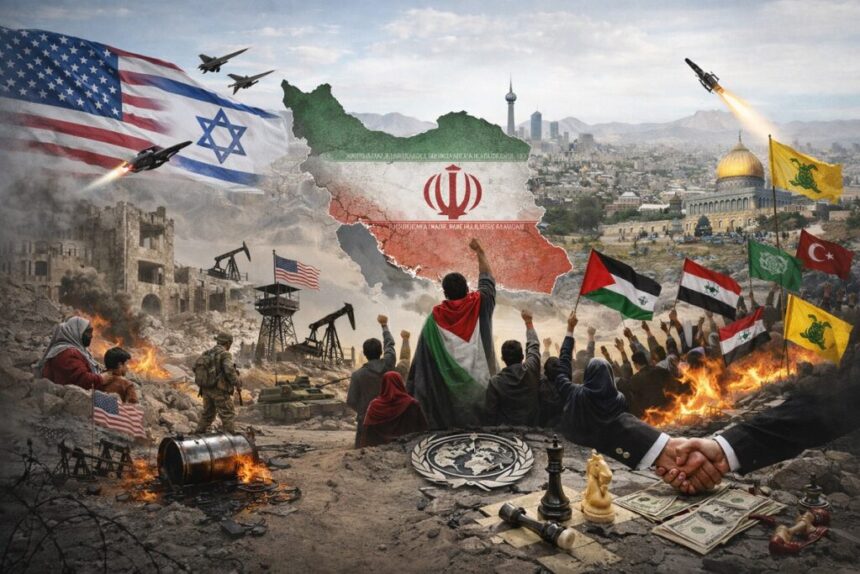
As tensions rise between Iran and the United States, the choices of the Arab Gulf states face intense scrutiny. Although the region shares history, culture, and religion, Gulf nations and Iran are following different paths. Security concerns, foreign alliances, economic needs, and regional rivalries shape their strategies.
Recent Iranian missile and drone attacks targeted U.S. bases and Gulf territory, including Saudi Arabia, Qatar, the UAE, Bahrain, Kuwait, and Oman. These strikes have sharply increased tensions and could trigger a wider regional conflict. Analysts note that these attacks, reportedly in response to U.S. and Israeli military action, have pushed Gulf states closer to Washington’s security agenda.
Historical and Strategic Foundations
The Persian Gulf’s security system evolved over decades of competition between Iran and Gulf Cooperation Council (GCC) states, supported by sustained U.S. involvement. During the 1980s Iran–Iraq War, Gulf states backed Iraq as a shield against Tehran’s revolutionary ambitions. This period made Arab leaders view Iran as a serious regional threat.
Over time, the U.S. became the main security guarantor for Gulf monarchies. It established defense agreements and permanent bases, including the U.S. Fifth Fleet in Bahrain, CENTCOM headquarters in Qatar, and facilities in the UAE and Kuwait. These bases deter Iranian influence and secure global energy routes, particularly the Strait of Hormuz, where a large portion of the world’s oil passes.
Divergent Gulf Approaches to Iran
The Gulf states do not have a single approach to Tehran.
Oman remains neutral and often mediates between Iran and other powers. Its policy reflects its geography, economy, and desire to avoid conflicts.
Qatar maintains complex ties with Iran. It hosts Al Udeid Air Base, a major U.S. installation, while engaging Tehran diplomatically. Qatar emphasizes peaceful regional relations and hopes to maintain constructive ties with Iran, even after attacks on its territory.
Saudi Arabia and the UAE take a tougher line. Both condemned Iranian strikes and signaled readiness to defend their territories. Statements from Riyadh and Abu Dhabi during recent escalations show a firm stance against Tehran.
Gulf states act cautiously due to economic and security pressures. Their economies are tightly linked to Western markets, so stability is critical for investment and growth. Cooperation with the U.S. provides protection against Iranian threats but ties Gulf states to Washington’s strategic priorities, sometimes conflicting with Tehran.
Iran’s warnings add further risk. Tehran has stated that countries hosting foreign military forces involved in attacks may be considered legitimate targets. Gulf governments often call for peace but act carefully to avoid antagonizing Iran while keeping their strategic partnerships with Washington.
Impact of Recent Escalations
Iran’s recent drone and missile attacks mark a turning point. Targeting infrastructure and U.S. assets, they challenged Gulf air defenses and tested states that usually avoid direct conflict. Analysts say Iran’s use of inexpensive drones can strain defense resources and create economic and psychological pressure on Gulf nations.
The attacks have drawn sharper condemnation from Gulf governments than past incidents. This reaction suggests Tehran prioritizes regime survival and regional influence over neighborly relations. As a result, Gulf states are moving closer to collective defense postures aligned with the West.
Regional Fault Lines and Global Dimensions
Gulf states’ balancing act is complicated by global shifts. China and Russia increasingly influence Middle Eastern diplomacy, sometimes offering alternative negotiation channels. These powers can challenge traditional Gulf-U.S. alliances.
Trade disruptions, especially through the Strait of Hormuz, threaten regional and global stability. The stakes are high, increasing the urgency for diplomatic solutions.
The divide between Iran and the Gulf states goes beyond religion or culture. It stems from decades of strategic competition, economic links, security alliances, and global politics. Gulf leaders call for peace but must navigate threats, protect economic stability, and balance relations with major powers.
With U.S. military bases in the region and Tehran’s assertive posture, geopolitical fault lines will continue to define Middle Eastern politics.