
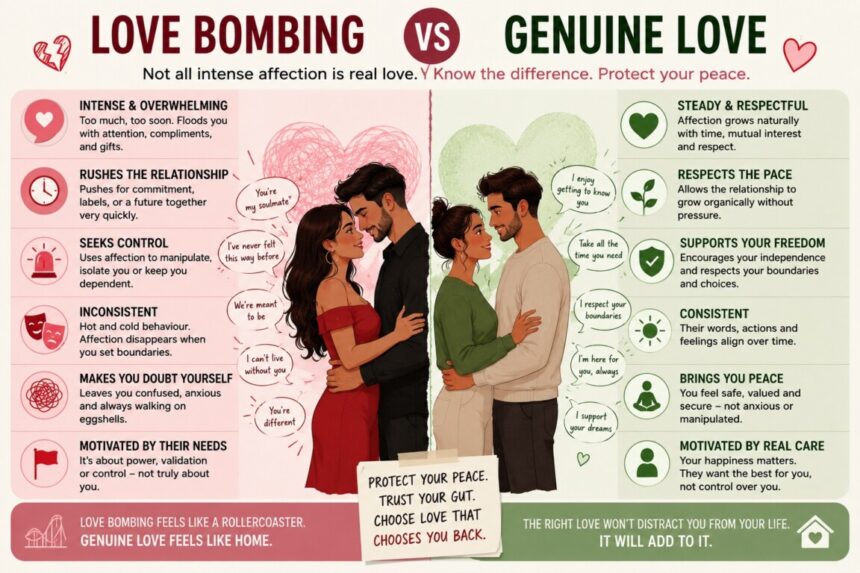
Butterflies are cute. Anxiety disguised as romance? Not so much.
In an era where someone can call you their soulmate on Monday, ask for matching outfits by Wednesday, and start planning your wedding playlist by Friday, it has become harder to tell the difference between genuine affection and emotional speed running.
Spoiler alert: if someone acts like they’ve known you for 30 years after three dates and one FaceTime call, you may not be witnessing destiny. Instead, you could be watching a love bombing masterclass unfold in real time.
Love Bombing: When Affection Comes With Fine Print
Love bombing is the relationship equivalent of a flash sale. Everything feels exciting, intense, and impossible to resist, until you realize there were terms and conditions you never agreed to.
At first, it seems harmless.
You receive good morning texts every day. Random gifts begin to arrive. Compliments flow endlessly, and statements such as “I’ve never felt this way before” begin to sound like background music.
Then the plot thickens.
Suddenly, you’re hearing:
“I’ve never connected with anyone like this.”
“You’re different from everyone I’ve met.”
“I think you’re the one.”
Meanwhile, they’ve known you for nine business days.
Granted, love bombing does not always stem from bad intentions. In some cases, it comes from insecurity, attachment issues, or emotional immaturity. However, it can also become a tool for creating dependency, gaining control, or accelerating intimacy before trust has had time to develop.
After all, when someone skips the getting to know you stage and jumps straight to forever, it’s fair to ask a simple question: are they falling in love with you, or are they simply in love with the feeling of being in love?
Genuine Affection Doesn’t Need a Soundtrack
Healthy love is not boring. It simply does not arrive wearing a cape, demanding immediate exclusivity, and behaving as though it is competing for Best Picture.
Instead, genuine affection understands pacing. It respects boundaries and recognizes that intimacy takes time to build.
More importantly, it does not panic because you took two hours to reply. Likewise, it does not treat your need for personal space as an international betrayal.
Someone who genuinely likes you wants to know your favourite food, your ambitions, your fears, and even why you still haven’t finished that book you started six months ago.
By contrast, love bombing often prioritizes intensity over intimacy. Genuine affection builds connection, while love bombing creates pressure. One encourages patience and trust; the other demands access before emotional closeness has had time to grow.
Healthy affection says, “Let’s see where this goes.”
Love bombing says, “I’ve already picked our honeymoon destination, and we’ve known each other since March.”
Healthy Love Isn’t Boring, We’re Just Addicted to Drama
Social media has convinced many people that romance must be loud to be real.
Apparently, if someone isn’t sending flowers every Tuesday, posting cryptic captions about your eyes, or planning a trip to Santorini after two weeks, they are suddenly “not serious.”
Respectfully, that’s not necessarily true.
In reality, healthy love often looks like consistency. It involves checking in without keeping score. It means remembering the little things because someone genuinely cares, not because they are trying to secure a lifetime subscription to your emotions.
The truth is that stability rarely goes viral. Drama gets the headlines. Mixed signals become conversation starters. Emotional chaos often gets mistaken for chemistry.
Meanwhile, healthy relationships tend to look ordinary from the outside. However, they thrive because they are built on trust, communication, and mutual respect rather than grand gestures and emotional fireworks.
The Real Test? Watch What Happens When You Say No
Nothing reveals intentions faster than boundaries.
Tell someone you need space.
Say you’re not ready.
Decline a grand gesture.
Maintain your friendships.
Keep your hobbies.
Protect your routines.
A person with genuine affection will respect your pace. On the other hand, a love bomber may become distant, frustrated, offended, or suddenly less affectionate.
That reaction matters because, for some people, the goal is not connection, it’s access.
Unfortunately, access without boundaries rarely leads to healthy relationships.
Romance Is Beautiful. Emotional Whiplash Is Not.
There is absolutely nothing wrong with excitement. Likewise, there is nothing wrong with enthusiasm. Some people simply love deeply and express themselves passionately.
Nevertheless, healthy love does not leave you confused, overwhelmed, or guilty for having boundaries. It should not make you feel like you’re auditioning for the role of “perfect partner.”
Nor should it demand exclusivity before you’ve memorized each other’s surnames.
At its core, genuine affection feels safe. Meanwhile, love bombing often feels urgent.
One invites you in.
The other rushes you through the door before you’ve had time to read the signs.
So, the next time someone calls you the love of their life after a handful of conversations, smile politely and remember this:
Real love grows.
Manipulation performs.
And not everyone carrying flowers is bringing peace. Sometimes, they’re simply armed with emotional confetti.
Take your time.
Ask questions.
Keep your standards high.
Above all, remember that healthy love does not need to sprint to prove it is real.