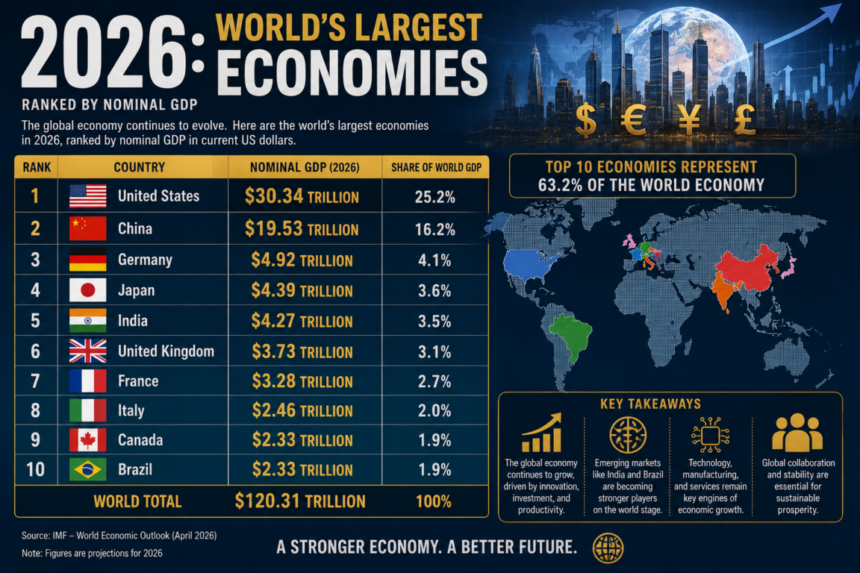
The United States is projected to remain the world’s largest economy in 2026 with an estimated gross domestic product of $32.1 trillion, according to new global economic forecasts released by Focus Economics.
The rankings reflect how technology, industrial capacity, financial markets, demographics, and geopolitical developments continue to shape the global economy.
While the U.S. and China maintain a significant lead over other nations, countries such as India are rapidly expanding their economic influence through services, digital innovation, and domestic consumption.
1. United States – $32.1 Trillion
The United States remains the world’s largest economy, accounting for more than a quarter of global economic output in nominal terms.
Its dominance continues to be driven by technology, finance, healthcare, artificial intelligence, advanced manufacturing, and consumer spending.
Major innovation hubs such as Silicon Valley and financial centers like Wall Street continue to strengthen America’s global economic leadership.
2. China – $20.2 Trillion
China remains the second-largest economy globally, powered by large-scale manufacturing, exports, infrastructure, and industrial production.
The country continues to dominate global electronics, machinery, and textile manufacturing despite facing challenges linked to debt pressures, property market weakness, and demographic decline.
China also remains a major player in electric vehicles, renewable energy, and supply-chain production.
3. Germany – $5.4 Trillion
Germany maintains its position as Europe’s largest economy due to its strong industrial and engineering base.
Its export-driven economy is supported by manufacturing giants in automobiles, machinery, chemicals, and industrial equipment.
Economists also credit Germany’s network of medium-sized businesses, known as the Mittelstand, for sustaining industrial competitiveness.
4. India – $4.5 Trillion
India continues its rapid economic rise and is increasingly viewed as one of the world’s fastest-growing major economies.
The country’s growth is driven by information technology, digital services, infrastructure expansion, and rising domestic demand.
India’s young population and expanding middle class are also expected to support long-term economic growth.
5. Japan – $4.4 Trillion
Japan remains one of the world’s leading industrial economies, particularly in robotics, electronics, and automobile manufacturing.
Despite its technological strength, the country continues to face long-term economic challenges related to an aging population and slower domestic growth.
6. United Kingdom – $4.2 Trillion
The United Kingdom continues to rank among the world’s largest economies, largely due to its powerful services sector.
Finance, insurance, technology, and professional services remain key pillars of the British economy, with London serving as one of the world’s leading financial centers.
7. France – $3.6 Trillion
France maintains a diversified economy supported by luxury goods, aerospace, agriculture, tourism, and manufacturing.
Global companies such as Airbus and LVMH continue to strengthen France’s international economic influence.
8. Italy – $2.7 Trillion
Italy’s economy remains heavily supported by manufacturing, fashion, machinery, automotive production, and tourism.
Its industrial northern region continues to drive exports and economic activity.
9. Russia – $2.5 Trillion
Russia remains heavily dependent on oil and gas exports despite ongoing sanctions and geopolitical tensions.
Energy exports continue to serve as the backbone of the Russian economy, although external pressures have reshaped trade relationships and investment patterns.
10. Canada – $2.4 Trillion
Canada rounds out the global top 10 with an economy driven by natural resources, finance, mining, forestry, and energy production.
The country also benefits from strong trade relations with the United States and expanding technology sectors.
Technology and Geopolitics Reshaping Global Economy
Economists say the global economic landscape is increasingly influenced by artificial intelligence, demographic changes, energy transitions, supply-chain restructuring, and geopolitical tensions.
The rise of emerging markets, especially India, is also expected to reshape future global rankings as countries compete for investment, industrial capacity, and technological leadership.
At the same time, aging populations, debt burdens, and political uncertainty remain major challenges for several advanced economies.