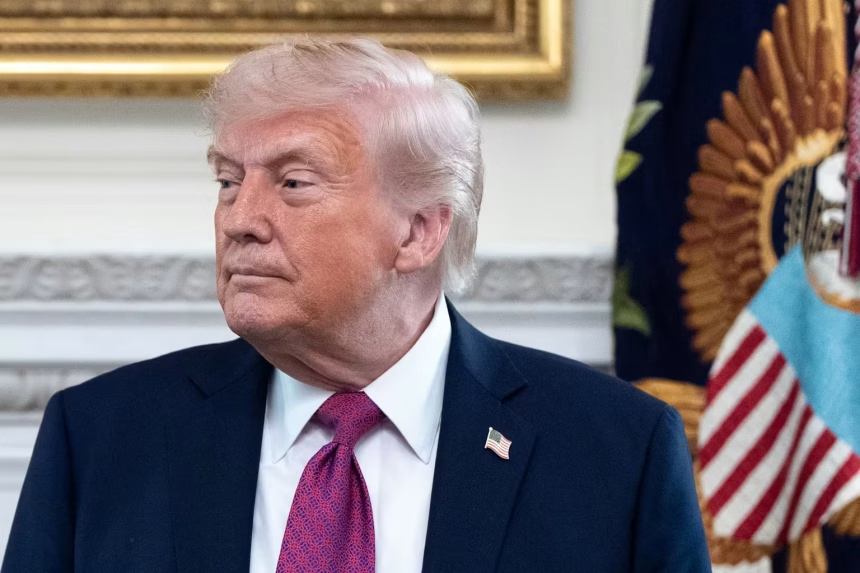
Donald Trump has cancelled a planned trip by US envoys to Pakistan for peace talks with Iran.
He made the announcement on Saturday, saying the decision does not signal an immediate return to war involving the United States, Israel, and Iran.
The move comes at a sensitive time, as diplomatic efforts continue to find a path toward ending the ongoing conflict.
The White House had earlier confirmed that senior envoys Steve Witkoff and Jared Kushner would travel to Islamabad.
They were expected to hold face-to-face talks with Iranian officials in a bid to revive stalled negotiations.
However, Trump said he cancelled the trip, arguing that further long-distance meetings were no longer necessary at this stage.
“We have all the cards. They can call us anytime they want,” he said, suggesting the US prefers direct engagement on its own terms.
His comments signal a more cautious and controlled approach to diplomacy.
Iran Continues Diplomatic Engagement
Iran’s Foreign Minister, Abbas Araghchi, had just concluded a diplomatic visit to Islamabad.
During the trip, he met with Pakistan’s Army Chief, Asim Munir, as well as Prime Minister Shehbaz Sharif and Foreign Minister Ishaq Dar.
The meetings focused on mediation efforts and possible frameworks to end hostilities.
Araghchi described the visit as “very fruitful” and said Iran had presented ideas for a workable peace arrangement.
He, however, questioned whether the United States was fully committed to diplomacy.
Uncertainty Over Peace Efforts
Despite ongoing diplomatic contacts, uncertainty continues to surround the peace process.
Iranian officials have indicated that there are no immediate plans for direct talks with US representatives.
Instead, Pakistan may continue to act as a channel for communication between both sides.
Trump also played down fears of renewed conflict, stating that cancelling the trip does not mean a return to war.
Still, analysts say the lack of direct engagement could slow progress toward a lasting agreement.
Strait of Hormuz Crisis Deepens
The urgency for a deal has increased due to tensions around the Strait of Hormuz.
This narrow waterway is one of the most important routes for global oil and gas shipments.
Iran’s Revolutionary Guards said they would maintain control over the strait as part of their strategic posture.
They described it as a key tool for countering pressure from the United States and its allies.
In response, the United States has imposed its own restrictions on Iranian ports, further escalating tensions.
Global Concerns Over Energy Supply
The standoff has already begun to affect global energy markets.
European Council President Antonio Costa called for the immediate reopening of the strait.
He warned that any prolonged disruption could have serious consequences for the global economy.
Energy analysts say uncertainty in the region could lead to rising oil prices and supply shortages.
Tensions Extend to Lebanon
The conflict has also spilled over into Lebanon.
Trump recently announced a three-week extension of a ceasefire involving Israel.
However, the situation on the ground remains fragile.
Benjamin Netanyahu accused Hezbollah of attempting to undermine peace efforts.
Meanwhile, Hezbollah lawmaker Mohammed Raad warned that any deal may not receive broad support within Lebanon.
Violence Continues Despite Ceasefire
Despite the ceasefire extension, violence has not fully stopped.
Recent airstrikes in southern Lebanon reportedly killed several people.
Residents in affected areas remain uncertain about whether peace will hold.
Some displaced families are beginning to return home, even as fears of renewed fighting persist.
Efforts to end the conflict remain delicate and uncertain.
Both sides continue to hold firm positions on key issues, including military actions and economic restrictions.
Analysts say meaningful progress will depend on sustained dialogue, trust-building, and compromise.
For now, the cancellation of the Pakistan talks highlights the slow and complex nature of the peace process.