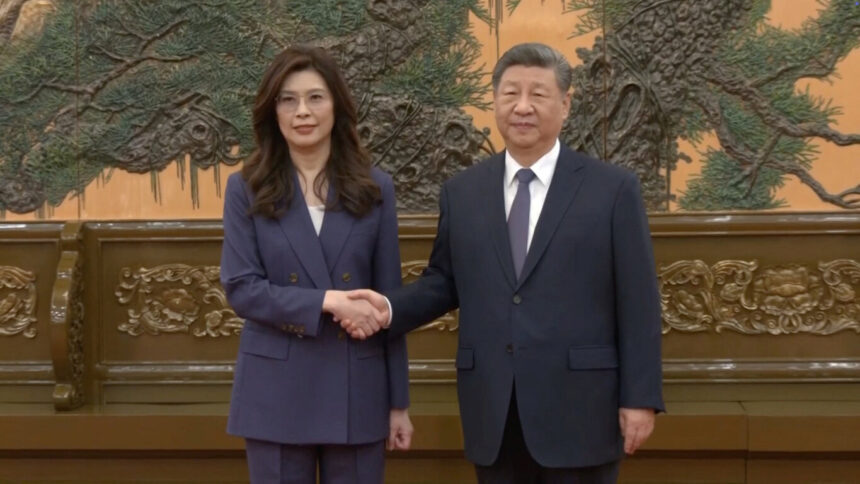
Xi Jinping met with Cheng Li-wun in Beijing on Friday, in a rare high-level meeting focused on cross-strait relations. Both leaders stressed the need to maintain peace and stability between China and Taiwan.
Cheng, who leads the Kuomintang (KMT), became the first sitting party leader from Taiwan’s main opposition to visit China in a decade.
The meeting took place at the Great Hall of the People. It marks a rare moment of direct engagement between Beijing and a major Taiwanese political figure.
During the meeting, Xi said both sides must work together to protect peace and stability. He stressed the importance of dialogue and cooperation.
However, he added that engagement must rest on opposition to Taiwan independence. He also repeated China’s position that people on both sides of the Taiwan Strait share a common identity.
In response, Cheng said both sides should pursue peaceful development. She described cooperation as beneficial for regional stability and global progress.
Cheng also highlighted the importance of the “1992 Consensus,” an understanding that both sides belong to “one China,” though they may interpret it differently.
The KMT has long supported this framework. It believes the approach helps reduce tensions and avoid conflict.
Cheng said maintaining this position could help prevent war and promote cooperation between both sides.
Meanwhile, the ruling Democratic Progressive Party (DPP) criticised the visit.
Party members accused Cheng of aligning too closely with Beijing. They argue that such engagement could weaken Taiwan’s sovereignty.
The DPP has consistently rejected the 1992 Consensus, saying it undermines Taiwan’s independence.
Tensions between China and Taiwan remain high. Beijing considers Taiwan part of its territory and has not ruled out the use of force.
China also refuses to engage formally with Lai Ching-te, whom it labels a separatist.
However, Lai has pledged to maintain the current status quo while protecting Taiwan’s democratic system.
Most people in Taiwan see the island as self-governing. However, many prefer to maintain the status quo.
They neither support formal independence nor unification with China. Instead, they favour stability and peace across the Taiwan Strait.
Overall, the meeting highlights ongoing efforts to manage tensions through dialogue. However, deep political differences remain.
As a result, cross-strait relations are likely to stay complex, with both cooperation and conflict shaping the future.