
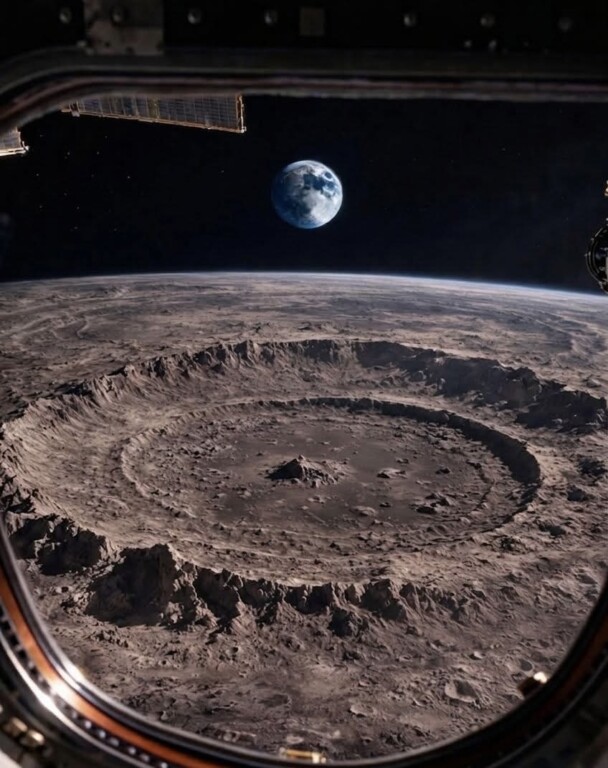
Astronauts aboard the Artemis II have achieved a historic milestone, capturing the first complete human view of the Moon’s Orientale Basin.
The image, taken from the Orion spacecraft, reveals the full scale of one of the Moon’s most striking geological formations, something never before seen directly by human eyes.
The Orientale Basin is a vast, multi-ringed impact crater stretching roughly 600 miles (965 km) wide.
Formed billions of years ago, its structure appears as concentric rings spreading across the lunar surface, resembling ripples from a stone dropped in water.
Read Also: Trump Hails Artemis II Crew as Astronauts Reach Milestone
Because of its location at the edge of the Moon’s near side, the basin has never been fully visible from Earth, appearing only as a partial, distorted feature.
The image was captured at a precise moment as the Orion spacecraft passed directly over the basin.
Through the capsule window, astronauts documented the entire diameter of the formation, with Earth visible in the distance, a rare alignment that adds both scientific and symbolic significance to the moment.
Following the flyover, the crew has begun its transition behind the Moon, entering a phase where communication with Earth is temporarily lost.
This approximately 40-minute blackout, often referred to as the “zone of silence,” occurs because the Moon blocks radio signals between the spacecraft and Earth.
The milestone underscores the growing capabilities of human space exploration under the Artemis programme.
As the mission continues toward the Moon’s far side, it represents not just a technical achievement, but a renewed human presence in deep space, pushing beyond the boundaries last reached during the Apollo program.