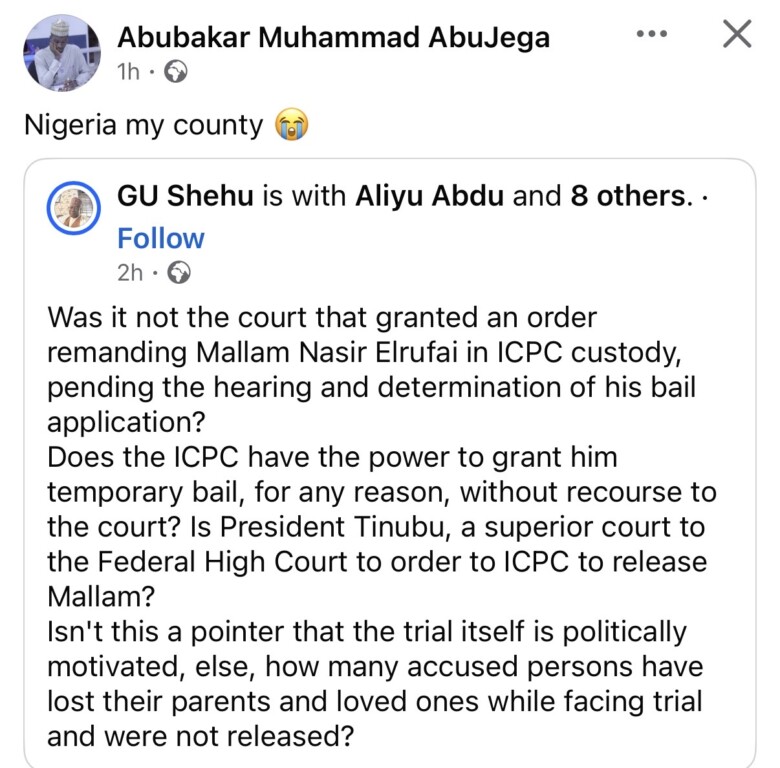
A social media post has sparked debate over the release of former Kaduna State governor, Nasir El-Rufai, from the custody of the Independent Corrupt Practices Commission (ICPC).
The development has raised legal and political questions about due process and the limits of institutional powers in Nigeria’s justice system.
What the Post Is Saying
The post questions whether a court had earlier ordered that El-Rufai be remanded in ICPC custody pending the hearing of his bail application.
It also raises concerns about whether the ICPC can grant temporary bail without returning to court.
In addition, it suggests that any intervention by President Bola Ahmed Tinubu could undermine the authority of the judiciary if it overrides a court decision.
Legal Questions Raised
At the centre of the debate are key legal concerns:
- Can the ICPC release a suspect after a court orders remand?
- Does the executive arm of government have the power to influence such a release?
- What is the proper legal process in this situation?
Under Nigeria’s legal framework, once a court orders remand, any change such as bail or temporary release, typically requires court approval.
Therefore, legal experts argue that due process must be followed strictly to avoid undermining judicial authority.
Claims of Selective Treatment
Meanwhile, the post raises concerns about selective justice.
It argues that many defendants facing trial have not received similar considerations, even in personal or humanitarian situations.
As a result, the debate has expanded into broader concerns about equality before the law and whether high-profile individuals receive preferential treatment.
Wider Implications
Beyond the immediate case, the situation touches on the principle of separation of powers.
This principle ensures a balance between the executive, legislature, and judiciary.
However, if one arm appears to overstep its authority, it can weaken public confidence in the rule of law and judicial independence.
What We Know vs What Is Claimed
It is important to separate facts from claims.
So far, the concerns raised remain public questions and opinions, not confirmed legal conclusions.
Authorities have yet to fully disclose the legal basis for the release. In some cases, however, decisions like this may involve humanitarian considerations within the law.
The Bottom Line
Overall, the controversy highlights ongoing public sensitivity around accountability, fairness, and due process in Nigeria.
It also reinforces the need for transparency in high-profile legal matters, as public trust depends on clear adherence to the rule of law.