Nigeria stands at a defining moment in its national development journey, as Africa’s largest economy and most populous country, Nigeria possesses enormous economic potential, strategic regional influence, and vast human and natural resources.
Yet despite these advantages, the country continues to face mounting pressure from the growing intersection of insecurity, macroeconomic instability, and global geopolitical uncertainty.
What is increasingly clear is that insecurity in Nigeria is no longer only a security issue. It has evolved into a major economic and developmental challenge affecting investment, food production, fiscal stability, inflation, foreign exchange management, and long-term growth prospects.
Research conducted by Suleiman Yusuf Usman and published in Bullion, the policy journal of the Central Bank of Nigeria, highlights how domestic instability and external economic pressures are reshaping Nigeria’s development outlook. The study argues that national security and macroeconomic stability are now deeply interconnected, with each directly influencing the other.
Insecurity Is Affecting Nigeria’s Economy
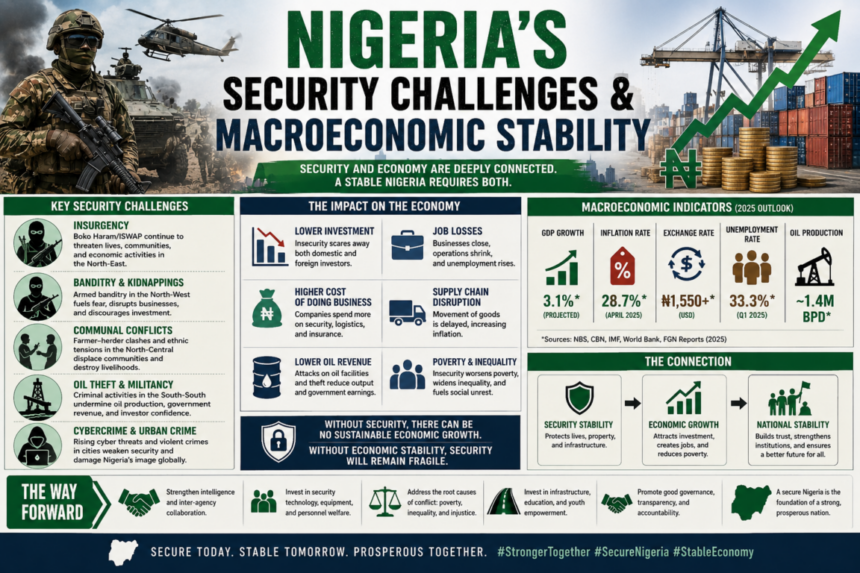
Over the last decade, Nigeria’s security challenges have expanded across multiple regions and dimensions. The country continues to battle insurgency in the North-East, banditry and mass abductions in the North-West, farmer-herder conflicts in the Middle Belt, separatist tensions in the South-East, and crude oil theft and maritime crime in the Niger Delta.
These challenges are producing serious economic consequences.
Agriculture, which supports millions of livelihoods and remains critical to food supply, has been severely disrupted in conflict-affected areas. Farmers in several northern states have abandoned farmlands due to attacks and kidnappings, while transportation of agricultural goods has become increasingly risky in some regions.
This disruption has weakened food production systems, reduced rural economic activity, and contributed significantly to rising food inflation across the country.
The oil and gas sector has also remained under pressure. Pipeline vandalism, illegal oil bunkering, and production disruptions continue to affect government revenue and foreign exchange earnings. Since crude oil exports remain a major source of public income and external reserves, instability in the sector directly impacts fiscal performance and exchange-rate stability.
Beyond direct losses, insecurity is also weakening investor confidence. Businesses now spend more on private security, logistics, and risk management, while some foreign investors increasingly view Nigeria as a high-risk environment.
Analysts warn that prolonged insecurity raises operating costs, discourages investment inflows, weakens productivity, and reduces economic competitiveness.
Nigeria’s Macroeconomic Environment Remains Fragile
Nigeria’s macroeconomic conditions have become increasingly difficult in recent years. Inflationary pressure, exchange-rate volatility, elevated debt levels, and pressure on foreign exchange reserves continue to challenge policymakers and economic institutions.
The Central Bank of Nigeria faces the difficult task of balancing inflation control with economic growth and financial-sector stability. However, many of the drivers of inflation are structural and therefore less responsive to traditional monetary policy tools.
Food supply disruptions caused by insecurity, energy price increases, foreign exchange shortages, transportation costs, and global commodity shocks continue to fuel inflationary trends.
This creates a complicated policy environment where efforts to tighten monetary conditions in order to control inflation may also slow private-sector growth, reduce credit expansion, and weaken investment activity.
Exchange-rate pressure also remains a major concern. Reduced oil production, weaker foreign exchange inflows, and global investor uncertainty have placed persistent pressure on the naira. Currency depreciation increases import costs, raises debt servicing obligations, and contributes to further inflation within the economy.
Global Geopolitical Tensions Are Also Affecting Nigeria
Nigeria’s economic vulnerabilities are being intensified by developments beyond its borders.
Global geopolitical tensions, supply-chain disruptions, rising interest rates in advanced economies, and shifts in international trade patterns continue to affect developing countries across the world.
The Russia-Ukraine conflict significantly disrupted global energy and food markets, contributing to higher prices internationally. Nigeria has also been affected by tightening monetary policy in advanced economies, which has encouraged capital outflows from emerging and frontier markets.
These developments have made external financing more expensive and increased pressure on countries already struggling with inflation and debt challenges.
At the same time, uncertainty in global trade relations continues to affect export competitiveness and long-term economic planning for many African economies, including Nigeria.
The research emphasizes that Nigeria’s economic future is now influenced not only by domestic policy decisions but also by changing geopolitical and financial conditions across the global economy.
Why Governance and Institutional Reform Matter
According to the research, addressing Nigeria’s current challenges requires more than temporary or reactive policy responses. Sustainable progress will depend on stronger institutions, improved governance, and better policy coordination.
Security operations alone cannot resolve the crisis without addressing deeper structural issues such as poverty, unemployment, weak institutions, inequality, and social exclusion.
Long-term investments in education, infrastructure, youth employment, and economic inclusion are essential for reducing vulnerability and supporting social stability.
Fiscal reforms are also necessary to improve revenue generation, strengthen public financial management, and reduce dependence on crude oil revenues. Analysts argue that subsidy reforms, tax administration improvements, and expenditure efficiency will be important for restoring fiscal sustainability.
At the same time, monetary and financial-sector reforms should focus on improving policy credibility, promoting exchange-rate transparency, strengthening financial inclusion, and expanding domestic capital markets.
Economic Diversification Remains Critical
One of the strongest messages emerging from the research is the urgent need for economic diversification.
Nigeria’s heavy dependence on crude oil exports continues to expose the economy to external shocks and commodity price volatility. Long-term resilience will require stronger growth in sectors such as agriculture, manufacturing, technology, solid minerals, renewable energy, and regional trade.
The African Continental Free Trade Area also presents important opportunities for industrial expansion, export growth, and regional economic integration if Nigeria improves infrastructure and competitiveness.
Human capital development remains equally important. Investments in healthcare, education, digital skills, vocational training, and youth empowerment are essential for increasing productivity and supporting long-term economic transformation.
Despite current difficulties, Nigeria still possesses major long-term advantages including a large youthful population, expanding digital innovation, entrepreneurial capacity, and strategic geographic positioning within Africa.
Security and Economic Stability Must Work Together
The broader lesson from the research is that security and economic stability cannot be separated.
A country struggling with persistent insecurity will find it difficult to achieve sustainable economic growth. At the same time, economic hardship, unemployment, and inequality can worsen instability and social tension.
Nigeria’s future development therefore depends on managing both challenges together through coordinated reforms, stronger institutions, credible leadership, and long-term strategic planning.
The country’s current problems are serious, but they are not beyond resolution. With sustained reforms, improved governance, stronger macroeconomic management, and investments in human capital and productive sectors, Nigeria can strengthen resilience and reposition itself for long-term stability and growth.
As the country navigates an increasingly uncertain domestic and global environment, the importance of institutional credibility, policy consistency, and strategic leadership has become more critical than ever.