In Nigeria’s biggest cities, “luxury” has become one of the most profitable words in real estate.
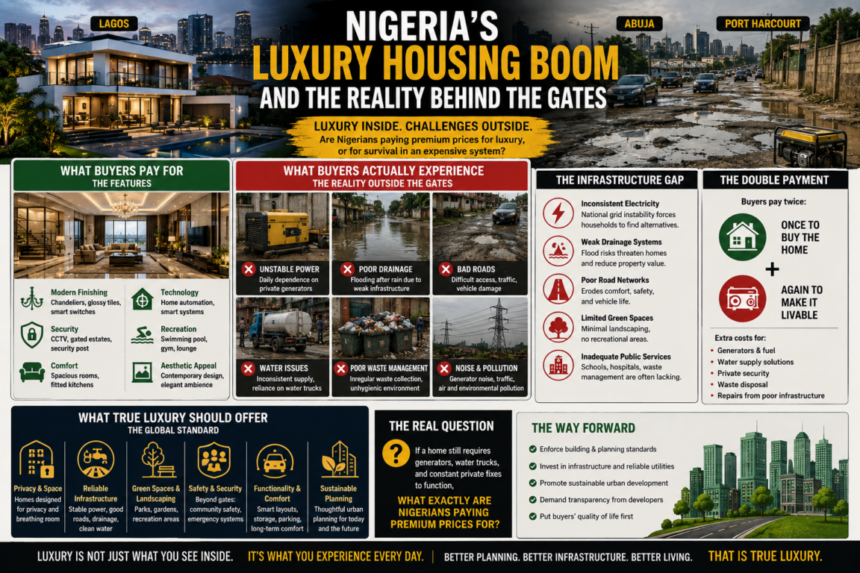
In Lagos, Abuja, and Port Harcourt, homes marketed as “premium” often sell for eye-watering sums, yet buyers still navigate bad roads, flooding risks from weak drainage, inconsistent public power, and a daily soundtrack of private generators.
That contradiction is the story.
Because what many Nigerians are paying for is not always a luxury environment, it is luxury inside a survival system.
Luxury, or expensive finishing?
Walk through a typical Nigerian luxury listing and you’ll see the features: chandeliers, glossy tiles, floor-to-ceiling glass, smart switches, CCTV, and a security post at the gate.
But global luxury is not defined by interior shine alone.
True luxury is a full living experience:
privacy, quiet, reliable infrastructure, thoughtful urban planning, green spaces, safety, functionality, and long-term comfort.
In Nigeria, many “luxury” homes are still built around private alternatives like power, water, security, private waste disposal. And that is where the value question becomes unavoidable.
The space problem nobody advertises
In many high-end estates, homes sit so close that privacy becomes a joke. Terraces face terraces. Windows stare into other windows. “Luxury” starts to look like expensive congestion.
And while some properties offer swimming pools, they’re often compact, more symbolic than functional. Garages may struggle with more than two or three cars. Green areas can be minimal, neglected, or treated as optional.
In other global markets, premium homes typically prioritise space, landscaping, recreation areas, storage, and design that protects privacy, because privacy is not a bonus; it’s the product.
Infrastructure: the missing half of the transaction
The biggest complaint from buyers is not just about housing, it’s about the neighbourhood.
Luxury pricing often exists alongside public infrastructure that cannot carry luxury living: unstable electricity, weak drainage, inadequate waste management, and poor road access.
And Nigeria’s broader power instability is not a matter of opinion. Repeated nationwide outages and grid disruptions have continued to expose a system under strain, forcing households and businesses to rely on private generation and backup solutions.
So the buyer pays twice, once to buy the home, and again to make the home livable.
But developers aren’t the only factor
Developers argue, fairly, that construction is now more expensive due to inflation, FX volatility, imported materials, and rising logistics costs. Those pressures are real in Nigeria’s current economy, and they feed into housing prices.
Still, economic hardship does not erase one essential question:
When a home is priced as luxury, does the buyer receive a luxury standard, inside and outside the gate?
Nigeria does not lack wealthy buyers. It lacks consistent urban planning, reliable public utilities, and enforced building standards that protect buyers from paying “global prices” for “local uncertainty.
Until luxury real estate delivers the full ecosystem, privacy, infrastructure, planning, and quality of life, the term “luxury” will keep sounding like branding, not value.
And the real test is this: If a home still requires generators, water trucks, and constant private fixes to function, what exactly are Nigerians paying premium prices for?