Voting remains one of the most important civic rights in Nigeria, during every election cycle, millions of Nigerians participate in choosing leaders at the federal, state, and local government levels.
However, not everyone qualifies legally to vote, as Nigeria’s Constitution and electoral laws clearly define who can participate in elections and the conditions citizens must meet before casting their votes.
Constitutional Backing for Voting in Nigeria
The right to vote in Nigeria is protected under the Constitution of the Federal Republic of Nigeria and the Electoral Act.
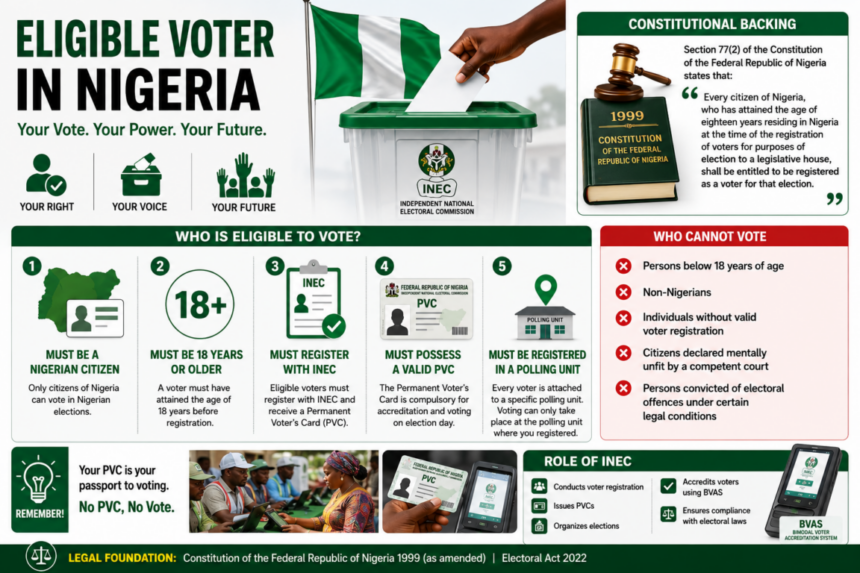
Section 77(2) of the Constitution states:
“Every citizen of Nigeria, who has attained the age of eighteen years residing in Nigeria at the time of the registration of voters for purposes of election to a legislative house, shall be entitled to be registered as a voter for that election”
This provision forms the legal foundation for voter eligibility in Nigeria.
Who Is Eligible to Vote in Nigeria?
To vote legally in Nigeria, an individual must meet specific requirements established by law.
1. Must Be a Nigerian Citizen
First, only Nigerian citizens can vote in Nigerian elections. Foreign nationals are not allowed to participate in the country’s electoral process.
A person may become a Nigerian citizen through:
- Birth
- Registration
- Naturalisation
These categories are recognised under the Constitution.
2. Must Be 18 Years or Older
Secondly, a voter must be at least 18 years old before registering with the Independent National Electoral Commission (INEC).
Anyone below the age of 18 is considered underage and cannot legally register or vote during elections.
Nigeria’s minimum voting age is 18 years.
INEC officials regularly warn against underage voting because it violates electoral laws and weakens election credibility.
3. Must Register With INEC
In addition, every eligible voter must register with INEC before participating in elections.
During registration, INEC collects personal information and biometric data. After successful registration, the commission issues a Permanent Voter’s Card, commonly known as a PVC.
Without registration, a citizen cannot vote.
4. Must Possess a Valid PVC
Furthermore, voters must present a valid Permanent Voter’s Card during elections.
The PVC serves as official proof that a person completed voter registration successfully.
INEC uses the card alongside the Bimodal Voter Accreditation System (BVAS) to verify voters before voting begins.
Consequently, anyone without a valid PVC cannot cast a ballot, even if previously registered.
5. Must Vote at the Assigned Polling Unit
Every registered voter is attached to a specific polling unit.
Therefore, voters can only cast their ballots at the exact polling unit where they registered.
A person cannot vote in another polling unit outside the registered location.
Who Cannot Vote in Nigeria?
Nigerian law also disqualifies certain categories of people from voting.
They include:
- Persons below 18 years
- Non-Nigerians
- Individuals without voter registration
- Citizens without valid PVCs
- Persons declared mentally unfit by a competent court
- Individuals convicted of certain electoral offences under the law
These restrictions aim to protect the integrity of elections.
Role of INEC in Nigeria’s Elections
The Independent National Electoral Commission plays a major role in managing Nigeria’s electoral process.
INEC is responsible for:
- Conducting voter registration
- Issuing Permanent Voter’s Cards
- Organising elections
- Accrediting voters
- Monitoring electoral compliance
- Deploying BVAS technology during elections
Over the years, the commission has also introduced digital systems to reduce electoral fraud and improve transparency.
Why Voter Eligibility Matters
Election experts say voter eligibility rules help strengthen democracy and protect election credibility.
These rules help prevent:
- Underage voting
- Multiple voting
- Identity fraud
- Electoral manipulation
- Illegal participation in elections
In addition, proper voter verification improves public confidence in election outcomes.
Challenges Affecting Voter Participation
Although millions of Nigerians register to vote, several challenges still affect voter participation across the country.
Some of these problems include:
- Delays in PVC collection
- Insecurity during elections
- Voter apathy
- Electoral violence
- Logistics challenges in remote areas
Analysts say stronger voter education and improved election management could help increase participation in future elections.
In Nigeria, the right to vote is protected by the Constitution and electoral laws. However, citizens must meet specific legal conditions before participating in elections.
To vote legally, a person must be a Nigerian citizen, be at least 18 years old, register with INEC, possess a valid PVC, vote at the assigned polling unit
As Nigeria continues to strengthen its democracy, voter education, lawful participation, and credible elections remain essential for national development