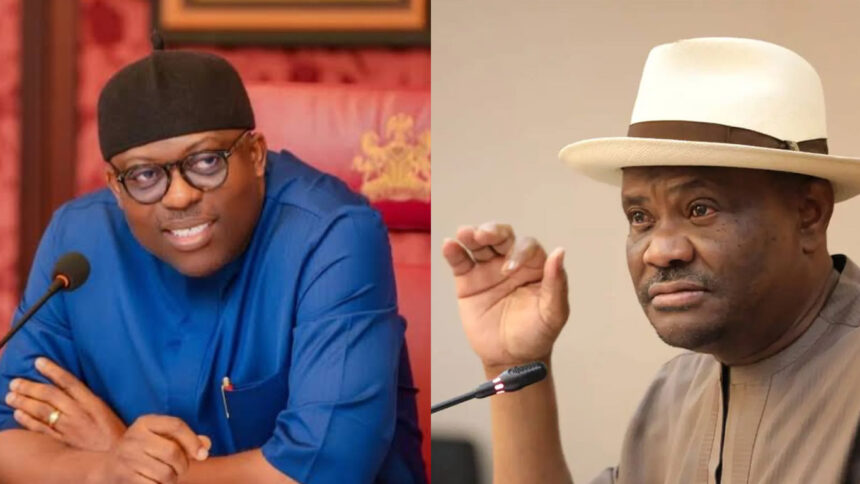
The lingering political crisis in Rivers State is, at its core, a story of succession gone wrong. The fallout between Nyesom Wike and Siminalayi Fubara has evolved beyond personal disagreement into a structural conflict that continues to test democratic stability in one of Nigeria’s most strategic states.
What was once a carefully managed political transition has become a prolonged struggle over authority, relevance, and control.
From Alliance to Alienation
Fubara emerged as governor largely through Wike’s political machinery after Wike’s eight-year tenure as Rivers governor. At the outset, the relationship followed a familiar Nigerian pattern: the outgoing powerbroker installs a trusted successor, expecting continuity in influence and loyalty.
That expectation collapsed almost immediately after Fubara assumed office. As governor, Fubara began asserting independence, reshaping administrative priorities and distancing himself from entrenched political interests loyal to his predecessor. What might have been a quiet power adjustment instead escalated into open confrontation.
The Battlefield: Institutions, Not Just Individuals
Unlike many political feuds driven purely by rhetoric, the Rivers crisis has played out through state institutions. The House of Assembly became the primary pressure point, with lawmakers aligned to Wike repeatedly clashing with the executive arm loyal to Fubara. Budget approvals, confirmations, and legislative authority turned into weapons of political control.
The result was near-paralysis of governance. Rather than focusing on policy delivery, the state became consumed by power plays, court battles, and political brinkmanship.
Federal Intervention and Its Consequences
At its peak, the crisis triggered federal intervention through the declaration of a state of emergency and the temporary suspension of democratic structures. While framed as a stabilising move, the intervention exposed deeper flaws in Nigeria’s political culture—particularly the unresolved tension between godfatherism and elected authority.
Although emergency rule was eventually lifted and Fubara reinstated, the underlying conflict was never resolved. The return to civilian governance did not bring closure; it merely paused the confrontation.
Why the Crisis Refuses to End
The durability of the Wike–Fubara conflict lies in what each man represents. For Wike, Rivers State remains the foundation of his national political relevance. Maintaining influence there is not optional—it is strategic. For Fubara, survival depends on breaking free from the shadow of his predecessor and proving he governs by mandate, not permission.
Neither objective allows for easy compromise.
Peace agreements have faltered because they addressed symptoms rather than structure. Without redefining political boundaries and influence, truces remain fragile and temporary.
The Bigger Nigerian Pattern
The Rivers crisis is not unique. It reflects a recurring national dilemma: how power is transferred without being surrendered. Across Nigeria, successors are often expected to govern while remaining subordinate to those who installed them. When they resist, institutions become battlegrounds and governance suffers.
In Rivers, the consequences are magnified by the state’s economic importance, political weight, and symbolic role in the Niger Delta.
The conflict between Nyesom Wike and Siminalayi Fubara is no longer just a personal feud—it is a referendum on political succession, loyalty, and democratic authority in Nigeria. Until the culture of enforced political obedience gives way to genuine institutional independence, Rivers State may remain trapped in cycles of crisis.
For now, the struggle continues—not because peace is impossible, but because power, once contested, is rarely surrendered quietly.