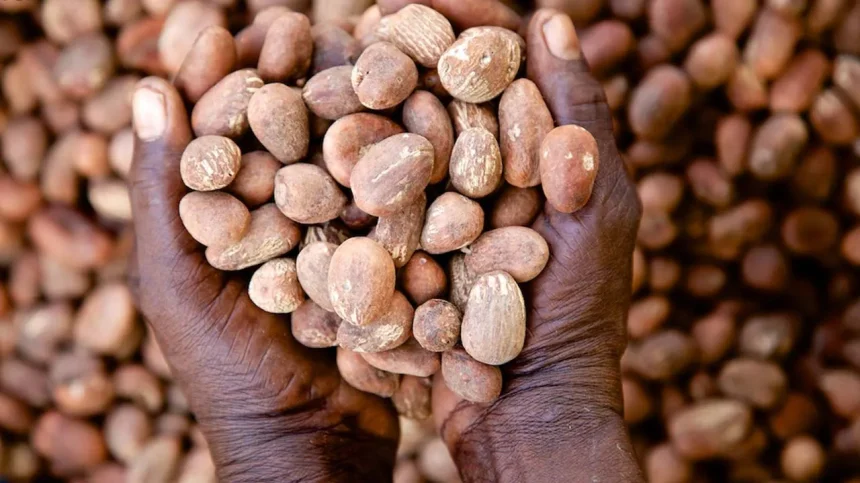
In August 2025, President Bola Ahmed Tinubu approved a six-month temporary ban on the export of raw shea nuts from Nigeria. The federal government described the move as a strategic step to discourage informal trade, encourage domestic processing, and reposition Nigeria as a leading supplier of high-value shea derivatives on the global market.
The policy is part of the administration’s broader effort to drive value addition, reduce dependence on crude oil, and support rural industries that can empower women and generate jobs. Vice President Kashim Shettima emphasized that the goal was not to restrict trade but to protect local processors and scale up industrial capacity.
Though Nigeria produces around 40% of the world’s shea nuts, the country contributes less than 1% to the estimated $6.5 billion global shea butter industry. The Tinubu administration aims to change that by shifting the country from being a raw material exporter to a hub of refined shea products. According to projections, the ban could generate as much as $300 million annually in the short term and significantly more by 2027, once full-scale refining and exports take off.
The Women Behind the Shea Industry
While the economic logic behind the ban is sound, the human cost has quickly become apparent. Across Nigeria’s rural North and Middle Belt regions, where shea trees grow wild, over 95% of the nut collectors are women. These women, often the sole breadwinners in their households, rely on the income from selling raw shea nuts to support their families.
Since the ban took effect, many of them have faced a sharp drop in income. The domestic market lacks enough processors to buy up the raw nuts, leading to a price crash of more than 30% in some areas. Without access to buyers or storage, thousands of women are now left with stockpiles of unsold produce, unable to earn a living or feed their children.
Some women interviewed by local media expressed concerns that the situation could push their children into hawking or worse. For them, the ban has disrupted not only their livelihood but their entire way of life.
Limited Capacity and Industry Challenges
Despite the good intentions of the federal government, Nigeria’s current shea processing capacity is inadequate to handle the national harvest of over 350,000 metric tonnes per year. While new processing plants like the Salid Agriculture refinery in Niger State show promise with a daily capacity of 30 metric tonnes such facilities are few and far between.
Many existing processors are underfunded, run outdated equipment, and operate far below capacity due to power outages and poor logistics. There’s also a lack of widespread cooperatives or financing structures to help small-scale women processors expand their operations.
Agricultural expert Grace Ajayi has warned that without coordinated investment in infrastructure and financing, the ban could hurt the very communities it’s meant to uplift. Similarly, Muda Yusuf, CEO of the Centre for the Promotion of Private Enterprise, cautioned that exporters now face loan defaults and broken contracts, as they had no time to adjust to the new policy.
Mixed Reactions and Policy Criticism
While some industry stakeholders have praised the ban as a necessary shift toward national development, others say it was rushed and poorly implemented. Mohammed Ahmed Kontagora, president of the National Association of Shea Products of Nigeria (NASPAN), supported the goals of the policy but called for a grace period of at least 90 days to allow exporters and aggregators to honor existing contracts and transition smoothly.
Several economic analysts have raised concerns about regulatory unpredictability. Sudden bans without robust stakeholder consultation or phased implementation can undermine investor confidence and destabilize industries built over years.
In the case of shea, much of the value chain remains informal and vulnerable. Without immediate support measures such as subsidized processing equipment, transport incentives, and guaranteed purchase schemes the gains from the ban may remain on paper, while rural producers continue to suffer.
Between Ambition and Reality
President Tinubu’s export ban is a reflection of Nigeria’s broader ambition to industrialize and control more of its export value chain. Economically, it is a step in the right direction. But in reality, policies that affect millions of poor and rural women must be implemented with care, support systems, and flexibility.
Transforming Nigeria into a hub of high-value shea products is a worthy goal, but ambition must be matched by preparation. Until the local economy can absorb the raw materials that exporters once moved abroad, the risk remains that this policy could harm the very communities it seeks to empower.
If the government wants the ban to succeed beyond press statements and projections, it must scale up investments in local processing, provide credit to women-led cooperatives, ensure reliable electricity for processors, and introduce immediate relief packages for those whose livelihoods have been disrupted.
The success of the shea export ban will depend not just on economic outcomes, but on the government’s willingness to listen, adapt, and ensure that no Nigerian especially the rural women at the heart of this industry is left behind.