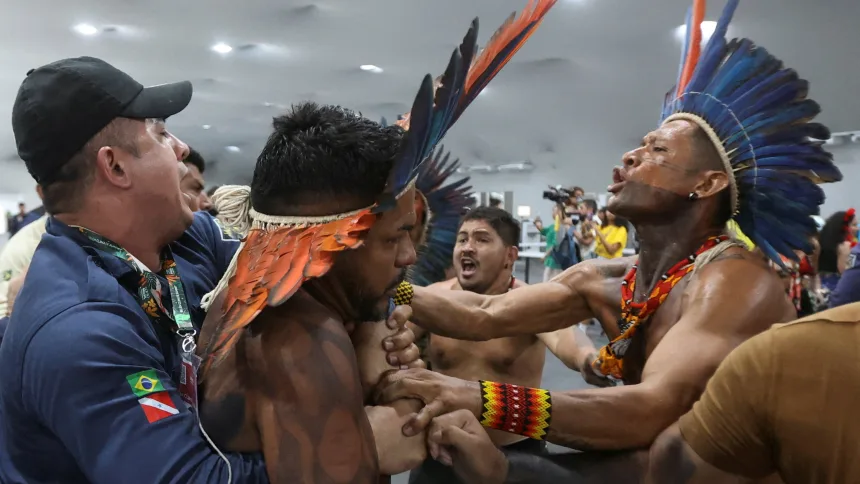
Tense scenes unfolded on the evening of November 11, 2025, at the United Nations Climate Change Conference (COP30) in Belém, Brazil, when Indigenous activists and their allies broke through security barriers at the main entrance of the summit venue. Witnesses described the confrontation as one of the most intense disruptions in the history of global climate negotiations.
Protesters, many of them Indigenous leaders from Amazonian communities, carried banners and chanted “Our land is not for sale” and “We can’t eat money.” As they surged toward the restricted “blue zone,” which hosts government officials and negotiators, they clashed with UN and Brazilian security personnel. According to reports, guards used tables and barriers to block the entrance, while protesters pushed past checkpoints before being contained. Two security staff sustained minor injuries, and parts of the entrance were damaged.
A UN spokesperson confirmed that “Brazilian and UN security personnel took protective actions to secure the venue, following established security protocols.” Negotiations inside the conference resumed shortly afterward, but the scene outside shows growing tensions between Indigenous peoples and the global climate establishment.
The protesters were demanding stronger protection for Indigenous lands, genuine participation in decision-making, and an end to fossil-fuel exploration and agribusiness expansion in Amazon territories. A man identifying himself as Gilmar, from the Tupinambá community near the Tapajós River, says: “We can’t eat money. We want our lands free from agribusiness, oil, and illegal miners.”
For many of those who gathered in Belém, the protest was about visibility as much as policy. Although COP30 is being held at the edge of the Amazon rainforest, a symbolic nod to the region’s ecological importance Indigenous representatives say they remain excluded from the talks that directly affect their futures. A scholar from the Federal University of Pará noted that while the summit celebrates the Amazon as the “lungs of the planet,” the people who live there were not allowed into the main negotiation zone.
The government of President Luiz Inácio Lula da Silva has publicly positioned Indigenous communities as central to Brazil’s climate agenda, yet tensions persist over ongoing oil and mining projects within protected lands. Critics argue that symbolic inclusion has not translated into concrete guarantees for Indigenous rights or enforcement against illegal deforestation.
After the altercation, additional security measures were introduced at the venue, though UN officials said the summit’s schedule continued without major disruption. The episode nevertheless cast a shadow over the event, showing a widening gap between high-level climate diplomacy and the demands of those living on the frontlines of environmental destruction.
The clashes in Belém serve as a stark reminder of the unresolved struggle over who gets to shape the world’s climate future and whose voices are still being left outside the doors where decisions are made.