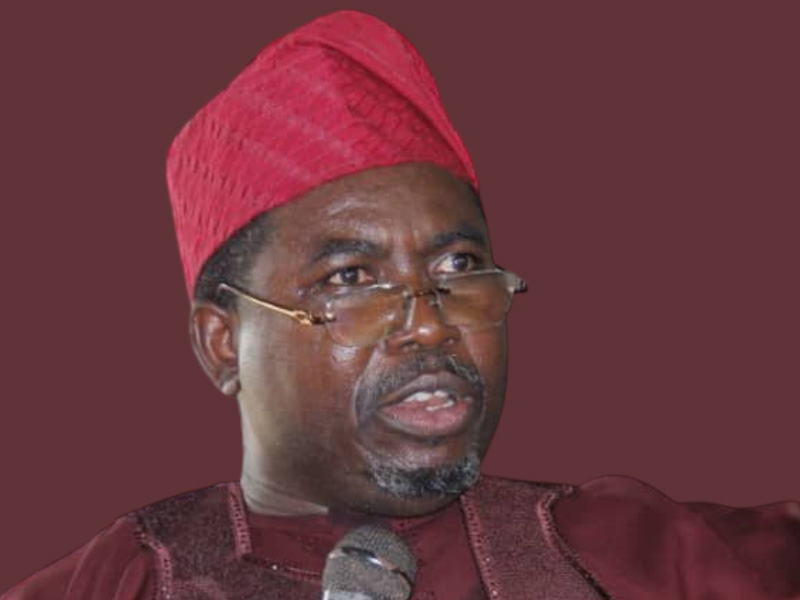
As Nigeria continues its democratic journey, the credibility of its electoral processes remains a defining issue. Amid growing public distrust in institutions, the need for leadership rooted in scholarship, integrity, and a deep understanding of governance cannot be overstated.
It is against this backdrop that the emergence of Professor Joash Ojo Amupitan (SAN) as a potential frontrunner for the position of Chairman of the Independent National Electoral Commission (INEC) deserves careful attention, and cautious optimism.
Professor Amupitan’s journey reflects the hallmark of consistency, intellect, and principled service. A product of the University of Jos, where he obtained his LL.B, LL.M, and Ph.D in Law, his academic roots are deeply tied to an institution that values critical inquiry and social justice. His steady rise from Assistant Lecturer in 1989 to Professor of Law in 2008 underscores not just dedication but mastery of his craft, an admirable blend of scholarship and leadership.
His specialization in Corporate Governance, Law of Evidence, and Privatization Law speaks volumes about his grasp of systems that underpin accountability and transparency. In a country where governance often teeters between public interest and political interference, his expertise could serve as a compass for institutional reform.
As Dean of Law, Head of the Department of Public Law, and later Deputy Vice-Chancellor (Administration) at the University of Jos, Amupitan has demonstrated a leadership style that balances academic rigor with administrative competence.
It is also telling that he was appointed Pro-Chancellor and Chairman of the Governing Council of Joseph Ayo Babalola University (JABU) in December 2023—an acknowledgment of his steady reputation as a man of integrity and structure. Leadership of that nature is not accidental; it is cultivated through years of tested service and earned respect.
If President Bola Tinubu indeed appoints him as the next INEC Chairman, Nigeria could be witnessing a paradigm shift in the leadership of one of its most critical democratic institutions. The electoral umpire does not only need someone who understands the law; it needs someone who embodies its spirit, fairness, justice, and the courage to stand firm against political pressure.
What sets Amupitan apart is not just his title as a Senior Advocate of Nigeria (SAN), an elite rank that crowns legal excellence, but his life as a teacher of law, shaping generations of Nigerian lawyers and public officers.
He represents the intellectual tradition that believes law must not only be studied but lived. His advocacy for reforms in corporate and electoral governance aligns with the urgent national need to rebuild faith in Nigeria’s public institutions.
Yet, as promising as this potential appointment may seem, the real challenge lies ahead. Academic brilliance, while essential, must now translate into practical, people-centered leadership. Nigeria’s electoral process requires not just procedural improvements but a moral reawakening, one that ensures elections are not contests of manipulation but reflections of citizens’ true will.
If Professor Amupitan assumes the role, he must be ready to navigate a politically charged environment while upholding constitutional fidelity.
The hope is that his tenure, if realized, would be marked by independence, reform, and the restoration of credibility. For a man who has spent decades nurturing minds in the classroom, perhaps it is time to nurture trust in one of Nigeria’s most fragile institutions.
Professor Joash Ojo Amupitan (SAN) stands at a crossroads between academia and national service. His appointment symbolizes not only a vote of confidence in scholarship but a rare opportunity for Nigeria to prove that competence and character still matter in public leadership. The question, however, remains, will the system allow integrity to thrive?