By Kabiru Abdulrauf
When Justice James Omotosho of the Federal High Court, Abuja, confirmed that witness summons had been issued for some of Nigeria’s most powerful figures to testify in Nnamdi Kanu’s terrorism trial, the announcement rippled through the country’s political and legal circles.
The list reads like a roll call of influence and authority: Nyesom Wike, Minister of the Federal Capital Territory; Hope Uzodinma, Governor of Imo State; Babajide Sanwo-Olu, Governor of Lagos; and two former Chiefs of Army Staff (Generals T.Y. Danjuma and Tukur Buratai).
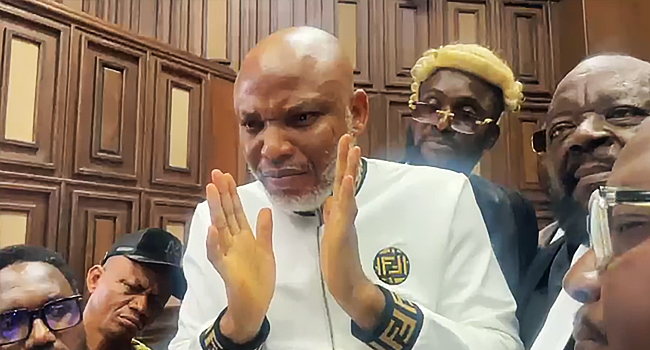
Each has now been called to appear in a courtroom where the leader of the Indigenous People of Biafra (IPOB) is determined to defend himself alone.
But as the summons make their way to these high offices, one question dominates public discourse: Will their testimony truly shape the case, or simply dramatize it?
For a man who just sacked a team of six Senior Advocates of Nigeria and declared his intent to represent himself, Kanu’s decision to summon top political and military elites feels both audacious and strategic. His defence now rests not only on legal technicalities, such as the alleged contempt of the Court of Appeal judgment and claims of forged medical reports but also on drawing into the open those he considers key witnesses in the chain of events that brought him to this point.
Yet, analysts are asking: will this summons yield any tangible result? In a political environment where lines between the judiciary and the executive often blur, compelling sitting governors, ministers, and retired generals to testify in a terrorism trial is no small feat. Compliance, sincerity, and impartiality will test the strength or fragility of Nigeria’s justice system.
For the summoned figures, the challenge may not just be about appearing in court, but about the tone and direction of their testimony. Can Wike, Uzodinma, or Sanwo-Olu, all serving under the Renewed Hope Government testify in a manner detached from the government’s position? Will the retired generals speak freely, given their past ties to national security operations against IPOB and other secessionist movements?
The fear among observers is that their testimony, even if given under oath, might carry the shadows of political allegiance, not the light of objective truth. As one senior lawyer put it: “In politically charged trials like this, truth often struggles to breathe between loyalty and fear.”
There’s also the question of political consequence. For a sitting governor or minister to take the stand in a case tied to separatism and state security, every word will be weighed not just by the court, but by the court of public opinion. Could their participation be seen as a sign of respect for judicial independence or as political miscalculation that exposes them to scrutiny from both supporters and opponents?
If they choose to cooperate fully, they risk angering political allies, If they hesitate or appear evasive, they risk accusations of shielding the truth. For some, particularly those with presidential or national ambitions, the optics could linger long after the case is closed.
Justice Omotosho’s decision to sign and approve the summons marks a significant moment, a signal that the court is, at least in principle, willing to hear all sides. But even that gesture raises deeper questions: will these witnesses actually appear in person? If they do, will their testimonies bring clarity or deepen controversy? And can the Nigerian judiciary enforce accountability at such a high level without political interference?
For Kanu, this phase could either vindicate his long claim of persecution or reinforce the government’s portrayal of him as a security threat, For the summoned elites, it may become a test of courage, credibility, and constitutional duty.
Ultimately, this trial has evolved beyond the fate of Nnamdi Kanu. It now probes the integrity of Nigeria’s institutions, the limits of political power, and the balance between justice and politics. Whether these high-profile witnesses speak in court or stay away, their names on that summons list have already altered the public narrative.
And when the court reconvenes on October 24, the world will not just be watching one man’s defence, but Nigeria’s capacity to let truth stand above power.